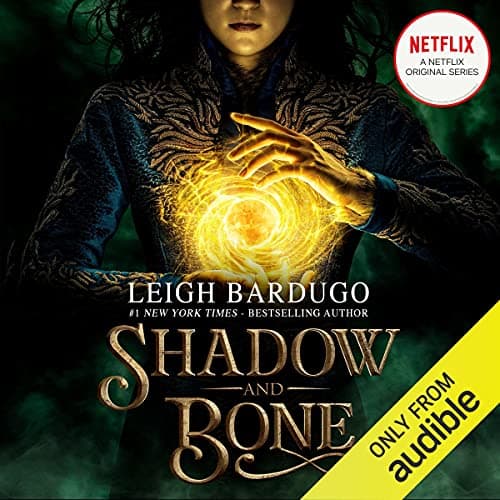

So it's 11:30 PM, I just got paged for what turned out to be a false alarm on a canary deployment, and I'm too wired to sleep. Kevin's already out cold. I pull up Shadow and Bone because I've been meaning to knock out the first Grishaverse book since the Netflix show dropped and everyone in my team's Slack started posting Darkling memes. Nine hours later - okay, spread across about four days of commutes and one insomniac night - I have thoughts.
Bottom Line: Worth your commute. Solid YA fantasy with a Russian-inspired magic system that's more structured than most, a villain who actually has a thesis statement, and narration that mostly holds up at 6AM. Not life-changing, but a clean, satisfying listen.
The Fold Is Basically a Load Balancer From Hell
The premise hooked me immediately: Ravka is split in two by the Shadow Fold, a swath of literal darkness full of monsters called volcra. Think of it as a network partition, except the packets are people and the dropped connections are fatal. Alina Starkov discovers she's a Sun Summoner - basically the only person who can patch this thing - and gets pulled into the Grisha, a caste of magic users who manipulate matter at the molecular level. The magic system here is what sold me. Bardugo calls it the "Small Science" and grounds it in manipulating existing elements rather than conjuring from nothing. Heartrenders slow your heart. Squallers control air pressure. It's categorized, it follows rules, and my engineer brain appreciated that it doesn't just hand-wave everything.
The Darkling is where the book gets interesting. He's not twirling a mustache - he's been alive for centuries, he built the Grisha military order, and his argument for why Alina should join him actually makes strategic sense. The moment where Alina realizes the Darkling created the Fold himself, that the guy she's been drawn to is literally the architect of her country's greatest disaster? That hit different at 1AM staring at my ceiling. There's a specific scene at the winter fete where he kisses Alina and you can feel the manipulation layered under genuine attraction. Fortgang plays it with this breathless uncertainty that lands the ambiguity perfectly.
Lauren Fortgang: Solid 7/10, Not Ray Porter (But Who Is)
Let me be real - Fortgang does a good job, not a great one. Her Alina is strong: self-deprecating, uncertain, increasingly angry as she figures out she's being used. The voice work differentiates characters clearly enough that I never lost track of who was speaking on the train, which is my baseline requirement. Her Darkling has this low, controlled quality that walks a fine line - one reviewer called it "just this side of creepy" and honestly? That tracks for the character.
But here's where I have to flag something: there were stretches in the middle third - basically the training montage sections at the Little Palace - where my attention drifted. And I don't think it was just me being tired. The pacing sags when Alina is learning to use her power, attending lessons, navigating Grisha social hierarchies. The narration doesn't quite inject enough energy to carry those slower passages. I caught myself rewinding twice during one commute, which almost never happens. The book picks back up hard once Alina escapes and the third act kicks in, but that middle section is the weak link in audio format specifically.
Pronunciation is a highlight though - Fortgang handles the Russian-inspired names (Ravka, Grisha, Materialki, volcra) without stumbling, which matters more than you'd think when you're half-conscious on the 6:47 Caltrain.
The "Could've Been a Blog Post" Question
At 9 hours 21 minutes, this is tight for a fantasy novel. No bloat, no unnecessary subplots about trade negotiations. Bardugo sets up the world, the magic system, the central conflict, and the love triangle (yeah, there's a love triangle - Mal vs. the Darkling, and look, the Darkling is more interesting, fight me) without padding. I listened at 1.5x and it felt right. Wouldn't go to 1.75x because you'll miss the Russian terminology on first exposure.
Is this the most original YA fantasy I've ever consumed? No. Alina is basically a chosen-one story with a dash of imposter syndrome, and the "ordinary girl discovers she's special" arc is well-trodden. Caraval runs the same chosen-girl-in-an-extraordinary-world playbook and I had nearly identical feelings about it - the bones are familiar but the specific details keep you listening. The execution is clean, the world-building is specific enough to feel real, and the Darkling elevates the whole thing from "generic fantasy" to "I'm starting the sequel tonight."
Who Gets the Commute Slot (And Who Doesn't)
Pick this up if you want a complete, self-contained fantasy that won't require a wiki to follow. Skip it if you need your fantasy dense and adult - this is YA and it reads like YA, which isn't a criticism but is a calibration. The romance is slow-burn and the stakes are more personal than epic (at least in book one). If you bounced off the Netflix show, the books are better - tighter, more interiority, and Alina actually has a personality here.
Perfect for: train, gym. Skip for: deep work.
The ROI on this audiobook is solid - 9 hours for a complete story with a satisfying-enough ending that doesn't cliff-hang you into rage-buying the sequel at midnight. (I still bought the sequel at midnight. But I wasn't rage-buying.)
Deploying to Production
I finished this in 4 commutes and one sleepless night, and I don't regret a minute of it. It's not cracking my top 10 of the year, but it's a reliable, well-built listen that does exactly what it promises. Think Mistborn for the YA crowd - structured magic, oppressive regime, unassuming protagonist discovers world-shaking power. If you've got a Grishaverse-shaped hole in your listening queue, this is a solid entry point. Now if you'll excuse me, I have Siege and Storm queued up and a 6AM alarm that won't snooze itself.