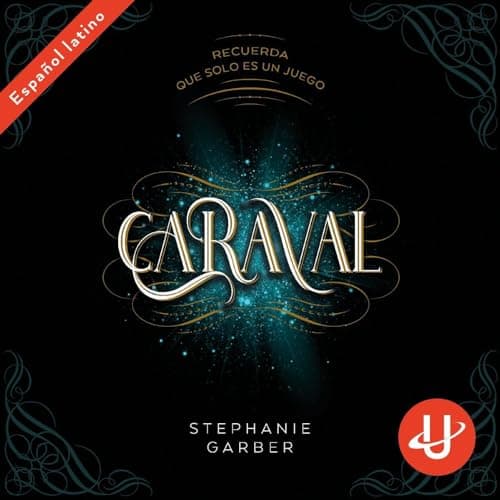

Look, I need to rant about something: why does every YA fantasy insist on the "nothing is what it seems" tagline like it's some revolutionary concept? Caraval literally has it in the subtitle — "recuerda que solo es un juego" — and then proceeds to spend 11 hours making sure you never forget that, yes, nothing is what it seems. I get it. I GOT it by hour two. And yet.
Here's the thing though. I picked this up at 11PM after a particularly brutal on-call week where I'd been staring at Datadog dashboards until my eyes crossed, and I needed something that was basically cotton candy for my brain. Kevin saw the cover art on my phone and said "that's not your usual thing" with the exact tone he uses when I order dessert wine. He was right. This is not my usual thing. But sometimes you need to let your brain run a garbage collection cycle, and Caraval turned out to be surprisingly decent at that.
The Island Girl Goes to Magic Carnival Pipeline
Scarlett's setup is efficient — abusive father, sheltered island life, fierce devotion to her sister Tella. You clock the emotional stakes fast. The moment they arrive at Caraval and Tella vanishes, the book becomes this scavenger hunt through a world where every shop, every person, every drink might be part of the game or might be genuinely dangerous. It's basically an escape room but scaled to a whole island with higher emotional stakes. The immersive, slightly-dangerous atmosphere reminded me of how White Witch, Black Curse builds dread through environment — though that one earns its tension through actual internal logic rather than vibes.
What Garber does well is the sensory world-building. She ties emotions to colors — Scarlett literally perceives feelings as colors, so fear is something she sees in shades of gray, desire in crimson. It's a neat trick that works better in audio than I expected because Gabriela Sánchez Mendoza leans into those descriptions with this dreamy, slightly breathless quality. When Scarlett tastes a cider that makes her relive her happiest memory, or when she puts on a dress that changes based on her desires, the narration slows down just enough to let you soak in the magic.
But — and this is where my engineer brain kept throwing exceptions — the rules of Caraval are frustratingly vague. The game supposedly has rules but they shift whenever the plot needs them to. It's like debugging a system where someone keeps changing the API contract mid-sprint. You can't solve the mystery alongside Scarlett because the information asymmetry is baked in. Every reveal feels less like a puzzle clicking together and more like the author pulling a new card from a deck you didn't know existed.
Gabriela Sánchez Mendoza vs. The Translation Gap
This is the Spanish edition, which I grabbed because I've been trying to keep my Spanish sharp (four years of classes shouldn't go completely to waste). Sánchez Mendoza is solid — her Scarlett has this earnest urgency that carries the first-person perspective well, and she gives Julian this lower, teasing register that makes the romantic tension land. But I don't have a great baseline for her against other Spanish-language narrators, so take my rating with a grain of salt.
What I will say: the translation reads naturally. Some Spanish audiobook translations feel like they're wearing a borrowed suit, all stiff phrasing and awkward idioms. This one flows. The dialogue between Scarlett and Julian during the carousel scene — where he's basically daring her to stop being so controlled — sounds like actual flirting rather than translated flirting, which is a low bar but one that plenty of translations trip over.
The pacing at 1.5x was comfortable. At my usual speed for business books (1.75x) the descriptive passages blurred together, so I backed off. This is a book that wants you to marinate in its atmosphere.
Who This Is Actually For (And Who Should Bail)
If you're coming from hard sci-fi or systems-heavy fantasy, Caraval will frustrate you. The magic has no consistent logic. The romance follows beats you can predict from chapter three. The twist at the end is... fine? It recontextualizes some things but doesn't fundamentally change the emotional math.
But if you want a book that feels like walking through a really gorgeous, slightly sinister theme park — where the point isn't solving the puzzle but experiencing the atmosphere — then the ROI on this audiobook is actually pretty decent for 11 hours. I burned through it in about four commutes plus that one late-night session, and it did exactly what I needed: gave my brain something sparkly to chew on that wasn't a Kubernetes error log.
Worth the Caltrain Real Estate?
Bottom Line: Worth your commute if you're in the mood for atmospheric YA fantasy that prioritizes vibes over logic. Not my forever genre, but I get why millions of people ate this up. It's a carnival. You go for the spectacle, not the structural engineering. I finished this in 4 commutes and I'm not mad about it — though I'm probably not rushing to book two either.