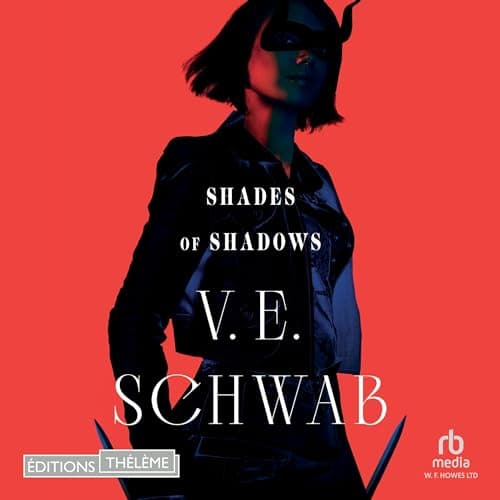

What happens when you take a magic system built on parallel Londons — each one a different shade of magical saturation — and then throw a tournament arc into the mix? You get the kind of book that made me close my thesis proposal document at 2 AM and just... keep listening.
I was debugging a procedural dungeon generator (or at least pretending to) when I fired up Shades of Shadows, the French edition of Schwab's A Gathering of Shadows. And look, I need to address the elephant in the room: yes, this is a French audiobook, and yes, I listened to the whole thing. My French is mediocre at best — leftovers from high school and a semester abroad that consisted mostly of ordering croissants — but I wanted to experience Schwab's multi-London world through a different lens. And the dual narration by Jérôme Keen and Sandrine L'ara was honestly a fascinating way to do it.
The Jeux des Éléments Hit Different in French
The Elemental Games — les Jeux des Éléments — are the centerpiece of this book, and Schwab structures everything around the build-up to this cross-kingdom magical tournament. It's essentially a fantasy Olympics for elemental magic users, and if that doesn't scream "my D&D group would love this," I don't know what does. The progression is satisfying. You get competitors from three rival kingdoms, political tensions simmering beneath the spectacle, and Kell sulking on the sidelines because royalty apparently means you can't compete. Meanwhile Lila — because she's Lila — has been off doing pirate things and shows up with a stolen identity to enter the tournament herself.
The magic system is chef's kiss. Schwab's conceit that magic exists in different concentrations across parallel worlds — Grey London (our boring mundane reality), Red London (magic everywhere, breathable like air), White London (magic-starved, people killing each other for scraps of power), and Black London (consumed entirely, sealed off) — creates this incredible tension where balance isn't just thematic, it's structural. For one London to thrive, another declines. That's not just worldbuilding, that's the engine of the entire plot.
Keen and L'ara: One Voice Soars, One Occasionally Grates
The dual narrator setup splits the POVs nicely — Keen handles Kell's perspective and L'ara takes Lila. Keen is solid throughout. His delivery is measured, warm when it needs to be, and he carries the political scenes between Kell and Rhy with real weight. But here's the thing: L'ara's Lila voice... it rubbed me the wrong way sometimes. Lila is supposed to be sharp and abrasive — she's a thief with a chip on her shoulder the size of Red London — but there were stretches where the vocal performance pushed past "scrappy" into "genuinely grating." I can see some listeners bouncing off it hard. Others might find it perfectly fitting for the character. Your mileage will vary.
The French adds something unexpected to the atmosphere, though. The incantations, the place names, the way "Londres" rolls off the tongue versus the hard stop of "London" — it gave the whole thing a slightly more romantic, slightly more dangerous quality. Like the difference between a rapier and a broadsword.
The 400-Page Wall Is Real
I need to be honest: this book drags before the tournament kicks in. There's a lot of setup — Kell brooding about Lila's departure, political maneuvering, introducing competitors from the other kingdoms. It's worldbuilding-heavy, and if you don't like info-dumps, this isn't for you (but you're wrong). I hit a similar wall mid-listen with Summer Days, which also front-loads its setup before everything clicks into place. The pacing genuinely picks up around the equivalent of the 400-page mark, and from there it's a sprint. But that first half? I read — er, listened to — this instead of writing my thesis, and even I felt the slow burn. At 17 hours, this is a commitment. Yes, it's worth it, but maybe bump to 1.25x through the early stretches.
The slow build does pay off. The Black London thread — the idea that a sealed-off dead world is waking back up — is genuinely unsettling, and Schwab threads it in gradually enough that when it hits, it hits. Holland's arc from the first book gets complicated in ways I didn't expect, and the threat feels earned rather than manufactured.
This Is Sanderson-Level World-Building (Fight Me)
I'll say it: Schwab's parallel London conceit is one of the best structural magic systems in modern fantasy. It's not as mathematically precise as Sanderson's allomancy, but it's more atmospheric — the rules are felt rather than calculated. And the tournament arc scratches the same itch as a good LitRPG progression system. You've got defined magical disciplines, ranked competitors, escalating stakes. My D&D group would love this.
Roll for Initiative or Walk Away
If you loved the first book's premise but wanted more scope and spectacle, this delivers. If you bounced off book one's pacing, this one won't convert you — the slow sections are slower, but the peaks are higher. And if you're considering the French edition specifically: it's a fun experience if you have even conversational French, but know that Lila's narrator may test your patience in spots. Skip this one entirely if tournament arcs bore you or if your French tops out at "bonjour" — the 17-hour runtime in a second language is no joke.







![Shades of Magic, tome 1 [A Darker Shade of Magic (Shades of Magic, Book 1)] audiobook cover](/_next/image?url=https%3A%2F%2Fm.media-amazon.com%2Fimages%2FI%2F41K6iEqKFJL._SL1200_.jpg&w=1920&q=75)