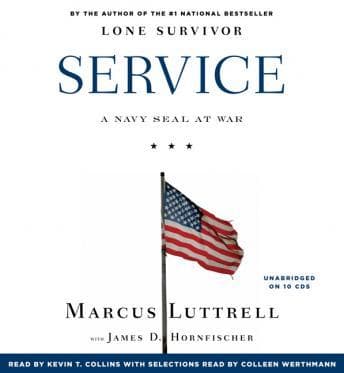

I'll be honest with you. I went into this expecting a straightforward military memoir - the kind of book that tells you what happened, when, and who was there. What I got instead was something that made me rethink how I teach narrative voice to my juniors.
Marcus Luttrell's Service isn't just a war story. It's a meditation on why people choose to serve, wrapped in the visceral reality of combat in Ramadi. And that combination - the philosophical alongside the brutal - is what kept me walking an extra mile along the lakefront every morning for two weeks.
The Dual Narration Gamble
Here's where things get interesting. Kevin T. Collins handles the main narrative, and the man has an Audie Award for a reason. He doesn't just read Luttrell's words - he interprets them. There's a difference. When Luttrell describes losing brothers in combat, Collins finds this register that's controlled but cracking at the edges. Not melodramatic. Just... human.
Then you have Colleen Werthmann reading the letters home. She brings this slight Southern accent that feels authentic to the military families she's voicing. The letters are the gut-punch moments. I was grading papers at 11 PM - don't ask about the stack of junior essays on The Great Gatsby - and I had to stop. Just stop.
Now, some listeners apparently find the narration "corny" or overly dramatic. I get it. If you're coming at this cynically, the patriotism might feel heavy-handed. But here's what I think those critics are missing: this is how these men actually talk about service. The earnestness isn't performance. It's culture.
Two Wars, One Haunting
The book operates on two tracks. First, you get the return to combat - Luttrell going back to Iraq with SEAL Team 5, taking on Ramadi during some of the most intense urban fighting of the war. This is where the pacing really shines. Six months of high-intensity operations, and Collins keeps you locked in without ever feeling rushed.
But then Luttrell keeps circling back to Afghanistan. To Operation Redwing. To the men who died saving him. And this is where Service becomes something more than a war memoir. It becomes Luttrell's attempt to answer a question that clearly haunts him: why do we do this? Why do men sacrifice everything for each other?
(My students would probably roll their eyes at this. "Mr. Williams, not everything is about the human condition." Yes it is. Everything is about the human condition. That's literally what literature is.)
The new details about his rescue are worth the listen alone. If you read Lone Survivor, you know the broad strokes. But hearing these moments through Collins' narration adds a layer of emotional weight that the printed page couldn't quite capture.
Nobody Goes It Alone
Luttrell keeps returning to this idea that nobody goes it alone. That no one gets left behind. It's not just a military slogan in this book - it's the organizing principle of his entire worldview.
And look, I teach Hemingway. I teach the lost generation and their disillusionment with war. So I came to this with a certain literary skepticism about war narratives. That same skepticism served me well when I listened to Great Influenza, which examines how institutions respond when everything falls apart. But Luttrell isn't trying to glorify combat. He's trying to explain a bond that civilians - myself included - will probably never fully understand.
The production is clean. Professional. No audio issues, no weird volume jumps. At 12 hours, it's a commitment, but the pacing earns that runtime.
Your Syllabus Check
If you loved Lone Survivor, this is essential. If you're interested in the Iraq War, in what Ramadi actually looked like from the ground level, this delivers. If you want to understand the psychology of service - not the politics, the psychology - Luttrell gives you something honest.
Skip it if you're sensitive to combat violence. This doesn't sanitize war. Skip it if earnest patriotism makes you uncomfortable. And maybe skip it if you need fast-paced, because Luttrell takes his time with reflection.
I listened at 1.0x because the pauses matter. The silences between thoughts are part of the text. Speed this up and you lose something.
Class Dismissed
Worth pausing the faculty meeting for? Absolutely. (Sorry, Principal Martinez. Still not sorry about the budget presentation.)








![Steve Jobs [unabridged audiobook] audiobook cover](/_next/image?url=https%3A%2F%2Fcovers.audiobooks.com%2Fimages%2Fcovers%2Ffull%2F9788499923406.jpg&w=1920&q=75)