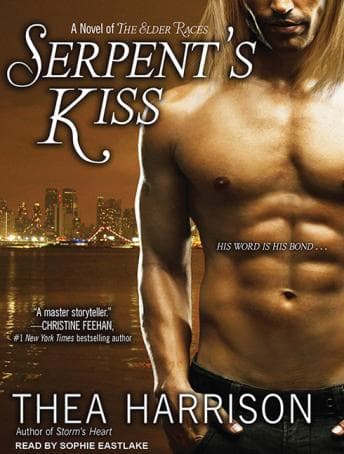

Look, I'll be honest with you. I picked this up because Denise was visiting her sister for the weekend and I had the apartment to myself - no grading, no lesson plans, just me and the lakefront and thirteen hours of a paranormal romance about a Vampyre Queen. My students would lose their minds if they knew. I teach Beloved and Their Eyes Were Watching God. I am not supposed to be this invested in whether a shape-shifting gryphon and an ancient vampire find a cure for a supernatural disease while also falling for each other.
But here we are.
When Immortality Gets Boring, That's When It Gets Interesting
What surprised me about Serpent's Kiss - and this is the third book in Thea Harrison's Elder Races series, so I should've expected it by now - is that Harrison actually cares about what centuries of existence would do to a person's psychology. Carling isn't just "old and powerful." She's a woman who has watched entire civilizations rise and crumble, who was once a slave in ancient Egypt, and who now faces something she's never had to reckon with: an ending. The vampyric disease eating away at her power pulls her into episodes where she literally relives moments from her past, and these aren't just convenient flashbacks for exposition. They're disorienting, dangerous, and they change the fabric of reality around her.
This reminds me of what Hemingway said about writing - that the dignity of movement of an iceberg is due to only one-eighth of it being above water. Harrison's world-building works that way. You sense the weight of Carling's millennia without getting a dry history lecture. I got a similar sense of layered revelation in Last Time I Lied: A Novel, where the past keeps reshaping what you think you know about the present. (My students could learn something from this. So could some of my grad school professors, frankly.)
Rune, the Wyr sentinel, is the counterbalance - younger by comparison, which still means ancient by human standards, but with this almost reckless optimism that grinds against Carling's pragmatic fatalism. Their dynamic isn't just attraction. It's two fundamentally different philosophies of existence arguing with each other while also wanting to tear each other's clothes off.
Sophie Eastlake Understands That Pause Is Punctuation
I've listened to enough audiobooks now to know the difference between a narrator who reads competently and one who interprets. Eastlake interprets. Her Carling carries this controlled, almost regal exhaustion - you can hear the weight of those centuries in the way she delivers certain lines, with just enough restraint that when Carling's composure cracks, it actually lands. And her Rune is distinct without being cartoonish. There's a warmth there, an easy confidence that shifts into something more vulnerable when he's alone with Carling.
What really impressed me is how she handles the historical episodes - when Carling gets pulled back into ancient Egypt or other moments from her past. The vocal register changes subtly. It's not a different character, exactly, but a different version of the same woman, and Eastlake navigates those transitions without ever losing you. At 1.0x speed - yes, I listened at normal speed, as God intended - the pacing felt right. The prose deserves to be savored, especially during Carling's memories.
One listener called Eastlake "a fantastic craftsman when developing different voices," and I'd agree, though I'd push it further: she doesn't just differentiate characters, she gives them emotional arcs you can track purely through vocal performance.
The Part Where I Admit This Isn't Middlemarch
Let's talk about what this book is really saying - and what it isn't. This is paranormal romance. There's a political subplot involving the Vampyre council that sometimes feels like it's clearing its throat while the real story waits. The romance escalates quickly, and if you're not on board with the intensity of the supernatural bonding element, you'll find yourself checking the chapter count. The sexual content is explicit. (Principal Martinez, this is definitely not what I was listening to during that last faculty meeting. Definitely not.)
But here's what Harrison does well that a lot of genre fiction doesn't bother with: consequence. The cure they're chasing has actual stakes - not just "will they or won't they" but "what does it cost to reshape the fundamental rules of magic?" And the power dynamics between Carling and Rune feel genuinely negotiated rather than defaulting to one of them being dominant by authorial fiat. That kind of genuine negotiation between leads is rarer than you'd think - I kept waiting for it in Naked Heat, which plays with similar tension but never quite lets both characters operate on equal footing.
If you loved Anne Rice's early Vampire Chronicles but wished Lestat had better romantic leads opposite him, this is its spiritual successor - with tighter plotting and less philosophical meandering. (I say that with love for Rice. Mostly.)
Who Should and Shouldn't Spend the Thirteen Hours
This works for paranormal romance fans who want their world-building to have actual structural integrity and their love interests to feel like complete people with histories that matter. If you've been following the Elder Races series, this is the payoff book - Carling's been a background presence, and finally getting inside her head is worth the wait.
Skip it if you need your romance without the speculative fiction framework, or if explicit content isn't your thing. And probably don't start here - the world mechanics assume you've done some homework with the earlier books.
The Annotation in the Margin
I finished this at two in the morning, sitting on the couch with cold coffee, and I immediately texted Denise to tell her I'd found her next listen. She texted back "Go to sleep." Fair. But I stand by it. This is smart genre fiction performed by a narrator who treats the material with the seriousness it earns. My students would hate that I'm saying this about a vampire romance. I love it.