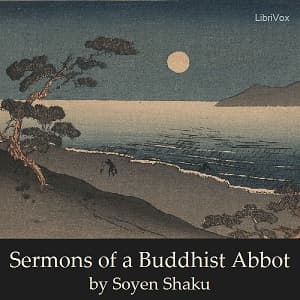

I have a complaint. A real one. Soyen Shaku opens this collection by essentially telling you that the thing you're about to listen to - the explanations, the logic, the careful Western-friendly arguments - can never actually convey the thing it's trying to convey. The second patriarch told Bodhi Dharma that Zen which can be explained isn't really Zen. And then Shaku spends five hours explaining it anyway. This is like me telling my students "you can't understand Hamlet by reading a summary" and then handing them a summary. The audacity. The beautiful, necessary audacity.
I was up past midnight last Tuesday, supposedly grading junior essays on The Great Gatsby (Denise had already gone to bed, the apartment was that particular brand of quiet where you can hear the radiator thinking), and I put this on because I figured Buddhist sermons would be calming background while I bled red ink over misused semicolons. I did not grade a single paper. Not one.
A Zen Master Walks Into 1905 America
Here's what you need to understand about this book: it's not a monastery recording. It's not incense and gongs. These are lectures delivered to American audiences in 1905 and 1906, translated by Daisetz Suzuki - who would go on to become probably the single most important figure in bringing Zen to the West. So what you're hearing is a Japanese abbot trying to bridge an enormous cultural and philosophical gap for people whose frame of reference was Christianity, rationalism, and Teddy Roosevelt. And he does it with this remarkable patience that comes through even in translation, even across a century.
Shaku doesn't condescend. He draws parallels to Christianity when useful, drops them when they'd be misleading. There's a section where he discusses the concept of God in Buddhism that I had to pause and sit with for a while - not because it was confusing, but because it reframed something I thought I understood. That is prose as architecture - nothing in it is there for show. Shaku builds structures. He doesn't decorate.
The Tolstoy connection is real, by the way. Leo Tolstoy referenced some of these essays in his later philosophical work. When a mind like Tolstoy's finds value in your writing, that's not a blurb - that's a credential.
The LibriVox Question (Let's Be Honest)
Okay. LibriVox. I need to talk about this because it matters for the listening experience. Multiple volunteers narrate different sections, which means you lose consistency. One reader might have a measured, contemplative delivery that suits the material perfectly, and then the next chapter switches to someone with a completely different rhythm and energy. It's jarring in the way that having a substitute teacher is jarring - the content is the same but the room feels different.
This isn't a knock on the volunteers. LibriVox is a genuine gift to literature - free audiobooks, public domain, read by people who care enough to donate their time and voice. But for a book like this, where the pauses between ideas function almost like the silence between notes in music, the inconsistency pulls you out of the meditative quality the text naturally creates. I'd have loved a single narrator with some understanding of Buddhist terminology and the patience to let Shaku's arguments breathe.
At five hours and thirteen minutes, it's a modest commitment. Short enough that you can relisten sections - and you will want to, because some of these ideas need a second pass. Not because they're poorly expressed but because your Western-trained brain (mine included, twenty years of teaching the Western canon) keeps trying to fit them into familiar boxes and they keep slipping out.
The Case for Sitting with Uncertainty
Most of my juniors would bounce off this by minute ten. I loved it anyway. They'd call it slow, abstract, disconnected from their lives. And I'd want to tell them that this is exactly the kind of text that rewards the patience they've never been asked to develop - that Shaku is doing something radical here, asking an audience raised on certainty to sit with uncertainty, asking people who want answers to consider that the question might be the whole point.
There's a lecture on the practice of dhyana - meditation - that strips away every mystical association and presents it as something almost practical. Almost scientific. Remember, this is 1905. Shaku is standing in front of Americans and essentially saying: your mind is a tool, and you've never learned to use it properly. Over a century later, we're spending billions on meditation apps to hear the same message delivered by someone with better production values.
The translation by Suzuki deserves credit too. It reads like English that remembers it was once Japanese - there's a formality to the sentence structure that feels intentional rather than awkward, a precision in word choice that suggests Suzuki understood he wasn't just translating language but transplanting an entire way of thinking.
Calibrate Your Expectations, Then Press Play
This is a free LibriVox recording of a 119-year-old lecture series, so let me calibrate expectations properly. You're not getting polished Audible production. You're getting the intellectual equivalent of finding a first edition at a used bookstore - scuffed, imperfect, but the words inside are the real thing. If you loved Marcus Aurelius's Meditations as an audiobook, this is its spiritual successor from a completely different philosophical tradition arriving at some surprisingly similar conclusions about how to live.
Who should listen: anyone curious about Buddhism who wants the real thing instead of the Instagram version. Teachers, philosophers, insomniacs with good taste. If you want that broader map of where Buddhism sits among the world's traditions before diving into Shaku's deep end, World Religion 101 gave me enough context that I stopped embarrassing myself in conversations with people who actually know things. People who listen at 1.0x because the author chose those words.
Who should skip: anyone who needs consistent narration quality to stay engaged, or anyone looking for a practical how-to-meditate guide. This is philosophy, not instruction manual.
I went back and graded those Gatsby essays the next night. But I kept thinking about Shaku's line about how we see the world not as it is but as we are. My students would say that's obvious. It took a Buddhist abbot from 1905 to make me actually hear it.