
What happens to children who are never allowed to grieve?
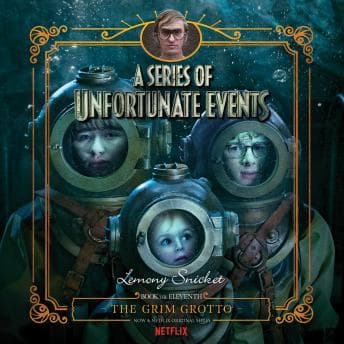
I was stirring a pot of dal at 10 PM — the kind of elaborate, unnecessary cooking my mother would approve of but never witness — when Tim Curry's voice slithered through my kitchen describing the Baudelaire orphans descending into a submarine. And I stopped stirring. Because eleven books into this series, Lemony Snicket is doing something genuinely interesting with these kids, and I'm not sure enough people are paying attention.
The Baudelaires as a Longitudinal Study in Chronic Trauma
Here's what got me: by The Grim Grotto, the Baudelaire orphans aren't just sad children anymore. They're exhibiting classic patterns of hypervigilance and parentification — Violet making decisions no fourteen-year-old should make, Klaus intellectualizing danger as a coping mechanism, and Sunny, who is literally an infant, developing competencies that read like a case study in accelerated development under duress. The research actually shows that children in unstable environments often develop precocious practical skills while their emotional processing lags behind. Snicket — or rather, Daniel Handler — understands this intuitively.
What makes this volume particularly fascinating from a character psychology standpoint is Captain Widdershins. He's this submarine captain who cannot stop saying "aye" and repeating "He who hesitates is lost" like it's scripture. And at first? Annoying. I'll be honest. By his fifteenth "aye" I was reaching for my phone to check if anyone else found this grating (they did). But then I found myself asking: why does Widdershins really cling to this phrase? Because it's the same thing traumatized people do — they build rigid behavioral scripts to manage anxiety. His compulsive catchphrases aren't just quirky writing. They're a man who's terrified of inaction because inaction once cost him something.
Or maybe I'm reading too much into a children's book at nearly midnight while overcooking lentils. My therapist would have thoughts about that too.
Tim Curry Understands That Evil Sounds Polite
Let's talk about the performance. Tim Curry brings this unctuous, almost slimy quality to his narration that is — and I mean this as the highest compliment — deeply unsettling in exactly the right way. His Count Olaf doesn't sound like a cartoon villain. He sounds like the kind of person who'd charm your parents at a dinner party and then steal the silverware. That same particular brand of charming-predator energy is something I spent a lot of time dissecting in my review of Neon Gods — a very different book, yes, but the psychology of a villain who operates through social manipulation rather than brute menace is its own fascinating study. There's a social intelligence to how Curry voices him that psychologically tracks for someone with antisocial personality features.
But the real surprise? His Captain Widdershins. Curry gives him this delightful, unselfconscious brogue — Irish-adjacent, warm, a little bombastic — that immediately separates Widdershins from the rest of the cast. You hear the accent and your brain instantly categorizes: this person is different from the VFD world of measured, secretive adults. He's louder. Less careful. And that vocal choice tells you something about the character before the text even gets there.
The sympathetic tone he uses for the orphans is restrained in a way I appreciate. He doesn't oversell their sadness. He lets you sit with it. That's harder than it sounds.
Now — the repetitiveness. At six hours, The Grim Grotto is a quick listen, but certain catchphrases do start to wear. I can see adult listeners checking out during the third identical "He who hesitates is lost" exchange. This is a book designed for children who find repetition comforting rather than tedious, and it shows. Not a dealbreaker, but worth knowing.
The VFD Mystery and Why It Actually Works as Narrative Psychology
The deeper VFD conspiracy is doing something I find genuinely clever: it's teaching children that adult institutions are fallible. That the organizations meant to protect you might be fractured, corrupt, or simply absent. The Baudelaires keep searching for a reliable authority figure and keep finding people who are either dead, missing, or morally compromised. This is a fascinating case study in how children construct — and reconstruct — their understanding of trust.
The sugar bowl subplot, which gets its first real traction here, is essentially a MacGuffin. But it functions psychologically as an externalization of the children's grief — this object that everyone wants and no one can explain, standing in for the answers about their parents' death that nobody will give them straight.
Snicket's narrator voice — unreliable, digressive, warning you constantly to stop reading — is itself a psychological defense mechanism. Humor as deflection. Intellectualization as armor. My therapist would have thoughts about Lemony Snicket.
Who Gets the Most Out of This
If you're a series completist, this is essential — the mythology payoffs from books 9 and 10 continue building here. If you're coming in cold, absolutely not. You'll be lost within twenty minutes. And if you're an adult listener with low tolerance for repetitive character tics, maybe bump the speed to 1.25x during Widdershins-heavy scenes. Tim Curry's performance is strong enough to hold at faster speeds without losing the characterization.
Kids will love the submarine setting, the danger, the dark humor. Adults will either appreciate the layered psychology or get bored. There's not much middle ground.
My Case Notes
Eleven books in, the Baudelaire orphans are carrying trauma that most adult literary characters couldn't handle. The fact that this series takes children's suffering seriously — wraps it in dark comedy, yes, but never dismisses it — is why it endures. Tim Curry's narration is the right vehicle for this particular volume: slimy where it needs to be, tender where it counts, and committed enough to make a submarine captain's brogue feel like a real person rather than a bit.
Not the strongest entry in the series. But psychologically? One of the most interesting.