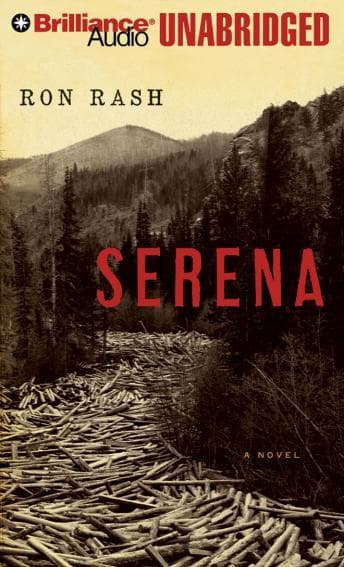

People kept telling me Serena was "Lady Macbeth in the Smoky Mountains." I nodded, smiled, and figured that was one of those lazy comparisons reviewers reach for when they don't want to do the actual work of describing a book. Then I listened to it. And honestly? The comparison undersells what Ron Rash is doing here. Lady Macbeth unravels. Serena Pemberton calcifies.
I started this one during a Saturday morning walk along the lakefront with Denise. By the time we got back to the apartment, she had to physically take my arm because I'd stopped walking twice - just standing there on the path like a weirdo, staring at the lake while Phil Gigante described Serena handling a timber crew with the quiet authority of someone who has never once questioned whether she belongs anywhere. Denise asked if I was okay. I said I was listening to a woman plot the murder of a child. She put her headphones in.
The Prose Deserves to Be Savored - Even When It's Ugly
Rash writes like the mountains he's describing: spare, ancient, and indifferent to whether you're comfortable. This is Appalachia in 1929, and the timber camps feel lived-in because Rash doesn't romanticize them. The workers speak in a clipped, almost biblical cadence - there's a Greek chorus of camp laborers whose dialogue runs together without attribution, and it took me a few chapters to realize that was intentional. They're not individuals. They're the forest watching itself get destroyed. That same chilling erasure of individual identity in service of a larger, indifferent force is something Golding pulls off with brutal economy in Lord of the Flies - though where Golding strips boys down to instinct, Rash strips laborers down to landscape. This reminds me of what Hemingway said about writing - the dignity of an iceberg is that only one-eighth of it shows above water. Rash leaves so much below the surface that you feel the weight of what's unsaid pressing against every scene.
The opening at the train station sets the whole thing up with surgical efficiency. George Pemberton arrives with his new wife, and within minutes someone is dead. Not in a thriller-ish way - in a quiet, inevitable way that tells you exactly what kind of story you're in. Rash doesn't waste a single sentence. Eleven hours and twenty-four minutes, and I can't think of a paragraph that didn't earn its place.
But here's the thing my students would push back on, and they'd have a point: the secondary characters come and go like extras in a stage play. You learn just enough about them to watch them get crushed by the Pembertons' ambition, and then they're gone. It creates this deliberate emotional distance that serves the novel's themes - these people are expendable to Serena, so Rash makes them feel expendable to us. Smart choice. Also a cold one.
Gigante's Upper-Crust Serena vs. Everything Else
Phil Gigante gives George Pemberton this deep, commanding baritone that works perfectly - you believe this man could walk into a logging camp and take charge. And his Serena is pitched with an upper-crust precision that communicates everything about how she sees herself in relation to these mountain people. The class divide isn't just in the dialogue; it's in the vocal register.
Now. The female voices. I have to be honest. When Gigante voices Rachel - the young mother fleeing with George's illegitimate child - there's a thinness to it that doesn't quite land. Rachel's sections are some of the most emotionally devastating in the book. She's ill, she's carrying her baby through the mountains, and you need to feel her desperation in your bones. Gigante gets about seventy percent of the way there. The prose does the remaining heavy lifting. It's not bad narration - it's narration that reminds you a single male voice has limits when channeling a dying mother's terror.
The pacing is slow. I mean genuinely, deliberately slow. Some listeners will hate this. I listened at 1.0x because the author chose those words and Rash's sentences have a rhythm that accelerating would destroy. But I'll admit - around hour seven, when the plot becomes more predictable, that slowness starts to feel less like patience and more like inevitability you've already accepted. The ending isn't shocking so much as it's the only ending this story could have had. Which is either brilliant or disappointing depending on what you wanted.
Who Gets the Assignment (And Who Should Skip Class)
If you loved Cormac McCarthy's spare brutality or Daniel Woodrell's Ozark noir, this is their spiritual successor filtered through a PEN/Faulkner sensibility. It's literary fiction wearing historical fiction's work clothes. You want this for focused listening - no multitasking, no half-attention during faculty meetings. (Principal Martinez, I did try. The budget numbers just couldn't compete with Serena training an eagle to hunt timber rattlesnakes. Context matters.)
Skip this if slow-burn pacing makes you reach for the 2x button, or if you need to love - or even fully understand - the characters you're spending time with. Serena is magnificent and monstrous and Rash never once asks you to sympathize with her. That's brave writing. It's also exhausting.
The Red Pen Says
Ron Rash wrote a novel that trusts its readers enough to be uncomfortable for eleven straight hours. Phil Gigante mostly rises to meet it. The prose deserves to be savored, the story deserves your full attention, and the movie adaptation deserves to be forgotten entirely. Worth pausing the faculty meeting for - but bring your patience and maybe a strong coffee. My students would hate this. I love it. Mostly.