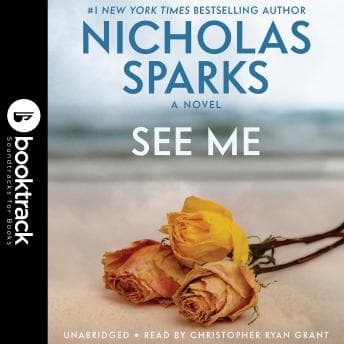

Let me be upfront about something: I host a horror podcast. I have read every Shirley Jackson novel at least twice. My idea of a romantic evening is listening to something that makes me check the locks twice. So when I tell you I spent a Saturday afternoon reorganizing the library's new acquisitions cart with See Me playing through my earbuds - and I didn't turn it off - that actually means something.
I went in skeptical. I came out... complicated.
The Music Situation (We Need to Talk About This First)
The Booktrack edition adds a musical score throughout, and I have feelings. Mixed, contradictory, slightly exhausted feelings.
Here's the thing - the music during the actual story? Fine. Genuinely fine. The tempo shifts when tension ramps up, and it earns its keep during the suspense sequences where Maria's past starts bleeding into the present. It's not subtle, but Sparks isn't writing subtle, so okay.
But whoever decided to bookend the whole experience with what I can only describe as a dramatic orchestral statement at the very beginning and again at the very end... that person and I need to have a conversation. I nearly pulled my earbuds out in the first three minutes. And listeners who make it through 14+ hours of emotional investment only to have the ending interrupted by a musical swell that feels like a network TV drama's season finale credits? I felt that complaint in my bones. It's the audio equivalent of someone talking through the final scene of a film. The structure of the Booktrack format itself is the problem - not the music quality, but the placement.
What Grant Actually Does With This Material
Christopher Ryan Grant's voice is doing real work here, and I want to be specific about where it lands and where it wobbles.
Colin - the reformed fighter with a violence-streaked past trying to build something clean - Grant nails. There's a controlled tension in how he voices Colin's internal restraint, this sense of a man who has learned to hold himself very still. When Colin is trying to be measured and the narrative is testing that, Grant's pacing earns it. That's not easy. A lot of narrators flatten reformed-bad-guy characters into either brooding or wholesome. Grant finds the in-between.
The female voices are where it gets genuinely awkward. Not catastrophically - he's not doing anything embarrassing - but Maria in particular loses something. Her scenes carry the heavier emotional weight of the thriller elements, and when a male narrator has to voice a woman processing real fear and trauma, there's a distance that opens up. You feel it most in the quieter, more vulnerable exchanges. Some listeners won't care. I noticed it.
The Southern accent that shows up for a secondary character got flagged by multiple listeners as slightly off, and they're not wrong. It's not offensive, just... approximate. Like someone describing an accent rather than inhabiting one.
Sparks Doing the Thing He Does (For Better and Occasionally Worse)
Here's my honest read on the book itself: Sparks knows exactly what he's doing, and he's doing it with more structural ambition than his reputation sometimes gets credit for. The suspense thread - the stalker elements that start surfacing in Maria's life - is genuinely effective in audio form. The dread builds slowly, and Grant's emotional delivery complements the suspense in a way that kept me engaged through what is, let's be honest, some very detailed romantic description. The kind of slow-building dread that actually lands - where you feel it accumulating before you can name it - is also what makes Innocent Victims so hard to shake, though that one goes somewhere much darker and doesn't offer the romance as a counterweight.
The dialogue gets heavy in places. There are conversations between Colin and Maria that run long, and the detailed descriptions of their emotional states occasionally feel like Sparks explaining the subtext instead of trusting it. In audio, that's more noticeable than on the page - you can't skim.
But the core tension works. Two people with damaged histories trying to build something careful and real, while something threatening circles closer. That's a functional thriller structure dressed in romance clothes, and at its best, this audiobook delivers on both. That slow-burn dread circling a domestic life is something Apples Never Fall does with a different kind of menace - family as the threat rather than a stranger, but the same creeping sense that something underneath the surface has been wrong for a very long time.
Who's Going to Get the Most Out of This
If you already love Sparks, this is considered one of his stronger audiobooks - the suspense elements give it more texture than his purely romantic work, and Grant's performance during the thriller sequences is where he's most confident.
If you're a thriller reader who's Sparks-curious, this is actually a reasonable entry point because the mystery-adjacent plot gives you something to track beyond the romance.
If you're me - a horror librarian who listens to things like this between episodes of something genuinely terrifying - you'll find it more engaging than you expected and then feel vaguely surprised by that fact. Shirley (my cat) wandered away during the romantic sequences. She stayed for the suspense. I'm choosing to read into this.
Just go in knowing the opening music is A Lot, and budget for it.