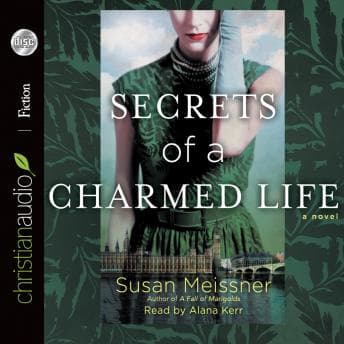

Look, I need to get something off my chest: I am so tired of historical fiction that uses the present-day framing device as a crutch. You know the setup - modern-day character discovers old letter/diary/mysterious grandmother, and we toggle back and forth until the Big Reveal connects past and present. It's become the genre's security blanket, and nine times out of ten, the contemporary storyline is the weaker half. So when Susan Meissner opens Secrets of a Charmed Life with Kendra Van Zant, an American scholar in Oxford interviewing the elderly Isabel McFarland, I'll admit I groaned a little. I was walking the lakefront with Denise on a Sunday morning that was too cold for late October, and I almost switched to something else.
I'm glad I didn't. Because Meissner does something interesting with that framing device - she makes it matter.
The Choice Emmy Couldn't See
This is a novel about blindness. Not literal blindness, but the way fifteen-year-old Emmy Downtree can only see one future for herself - apprenticing with a London fashion designer - even as the Luftwaffe is literally reducing the city to rubble around her. Meissner nails that particular brand of adolescent tunnel vision, the kind I watch play out in my classroom every single day. The kid who's so focused on getting into one specific college that they can't see three other good options sitting right in front of them. Emmy's obsession with getting back to London during the Blitz isn't written as stupidity - it's written as the fierce, narrow wanting of a young person who hasn't yet learned that the world doesn't care about your plans.
And that's what makes the separation from her younger sister Julia so devastating. It's not a random act of war. It's the direct consequence of Emmy's choice - a choice she made because she literally could not see past her own desire. This reminds me of what Hemingway said about how people go bankrupt: gradually, then suddenly. Emmy's mistake doesn't feel sudden. You watch it build, chapter by chapter, this slow accumulation of small selfishnesses until the one irreversible moment arrives.
My students would hate this. They'd want Emmy to be either a hero or a villain, and she's neither. She's a teenager. I love it.
Alana Kerr and the Weight of Quiet Moments
Here's where I have to be honest about some gaps in what I can tell you. Alana Kerr Collins has an Earphones Award on her shelf, and her voice is genuinely lovely - warm, clear, the kind of voice that makes twelve hours feel manageable. She handles the emotional weight of the wartime sections with real care. There were moments during the evacuation scenes where I had to stop grading papers and just sit with what I was hearing.
But - and this is a real but - I wanted more distinction between the characters. Emmy and Julia needed to feel more physically different in my ears, and the present-day Kendra sections sometimes blended tonally with the 1940s material in ways that flattened the dual timeline rather than sharpening it. The narrator understands that pause is punctuation, and Kerr uses silence well in the heavier scenes, but I found myself occasionally losing track of which era I was in when my attention drifted. For an audiobook that depends on the contrast between then and now, that's a problem.
Some listeners absolutely loved her performance - and I get it, she has genuine emotional range. A few others couldn't connect with her at all. I land somewhere in the careful middle: good narration that serves the story without quite elevating it.
What Meissner Is Really Saying
Let's talk about what the author is really saying, because it's sneaky. On the surface, this is a WWII novel about sisters separated by the Blitz. But the real subject is the stories we tell ourselves to survive our own worst decisions. Isabel McFarland has kept her secrets for decades not because they're shameful in the conventional sense, but because the truth requires her to admit that she was once a selfish teenager who made an irreversible choice. The prose deserves to be savored in those late-chapter revelations, when the weight of seventy years of silence finally breaks.
The Cotswold cottage sections are lovely - almost too lovely, which I think is intentional. Meissner wants you to feel the safety Emmy is throwing away. The countryside is practically an Austen novel while London burns twenty miles away.
If you loved The Nightingale by Kristin Hannah, this is its spiritual successor - quieter, more domestic in scale, but asking similar questions about what ordinary people sacrifice and surrender during extraordinary times.
Who Gets the Most From This
This is built for focused listening. Don't put this on while you're at the gym or pretending to pay attention in a faculty meeting. (Worth pausing the faculty meeting for, though.) The dual timeline requires you to track two storylines, and the emotional payoff only works if you've been paying attention to the small details Meissner plants early on.
Historical fiction readers who care more about character than battlefield strategy will find a lot to love here. If you need action-driven pacing, you'll get restless - this is a slow burn that earns its ending through accumulation, not momentum.
The Assignment I'd Give This Book
Solid historical fiction with a genuinely painful moral center. Not flawless - the present-day framing is still the weaker half despite Meissner's efforts, and the narration needed sharper character separation. But that core question - what do you do when you can't undo the worst choice you ever made? - stayed with me past the final chapter. Denise asked me why I was so quiet on our walk home. I told her I was thinking about sisters. She gave me a look. I deserved it.
This is why we still read the classics - and the books that aspire to sit beside them. I gave A.D. 30 a four-star rating partly for that same reason - it reaches for something genuinely serious about what ordinary people carry through extraordinary circumstances, even if it doesn't always stick the landing.