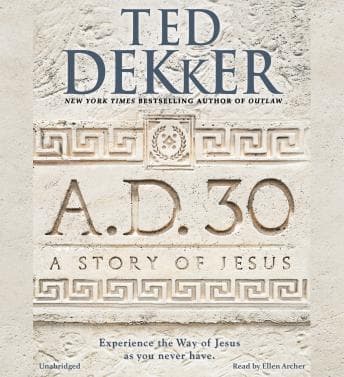

I was grading essays on The Great Gatsby at 11:30 PM - you know, the ones where students insist Gatsby is "just a rich guy who throws parties" - when I realized I needed something to restore my faith in storytelling. Thirteen hours later, I'm still thinking about a Bedouin outcast named Maviah and the way Ted Dekker made me see the Gospels through entirely foreign eyes.
This is why we still read the classics. Or in this case, listen to them being reimagined.
The Desert as Character
What struck me first wasn't the biblical setting - it was Arabia. The vast, unforgiving Nafud desert that Dekker builds around Maviah feels less like backdrop and more like antagonist. There's a sequence early on where Maviah and her protectors Saba and Judah are crossing sand that's described with such tactile brutality that I actually paused my grading (sorry, third period) to just... listen.
Dekker does something clever here. He takes a woman who would be invisible in most historical fiction - illegitimate daughter, cast out, female in a warrior culture - and makes her the lens through which we encounter Yeshua. Not as Christians know him. Not even as Jews of the period knew him. But as an outsider, a political refugee seeking alliance with Herod, would experience this strange teacher whose words upended everything she understood about power.
My students would hate this. I love it.
Ellen Archer Understands the Assignment
Archer knows that pause is punctuation. Her performance is steady without being monotonous - she kept me engaged through nearly thirteen hours, which is no small feat when you're juggling Bedouin warriors, Jewish politics, and the philosophical weight of the Beatitudes.
Here's what works: she doesn't try to do too much. The male voices aren't cartoonish attempts at deep registers. Instead, she modulates tone and pacing to distinguish characters. Saba, the warrior who speaks more with his sword than his voice, comes through in clipped, economical delivery. Judah, the Jewish guide who reads stars, gets a more contemplative rhythm. And Maviah herself carries this quality of wounded determination that Archer maintains across the entire runtime.
I listen at 1.0x because the author chose those words. With Dekker's prose - which swings between spare desert poetry and theological meditation - that pace felt exactly right.
The Yeshua Problem (And How Dekker Solves It)
Let's talk about what the author is really doing. Writing Jesus into fiction is a minefield. Go too reverent and you've got a Sunday school pageant. Go too human and you'll alienate your core audience. Dekker threads this needle by keeping Yeshua somewhat peripheral - present but not protagonist. We experience his teachings through Maviah's confusion, her gradual understanding, her resistance.
This reminds me of what Hemingway said about the iceberg theory - the dignity of movement comes from what's beneath the surface. Dekker isn't trying to novelize the Gospels. He's asking: what would these radical ideas about power and weakness, about loving your enemies, sound like to someone whose entire world runs on blood feuds and tribal honor?
The answer, it turns out, is both alien and strangely contemporary.
Where It Stumbles
I won't pretend this is flawless. There are stretches in the middle act - the political maneuvering with Herod, the court intrigue - where the pacing drags. Dekker is clearly more comfortable in the desert than in palace halls. And some of the violence, while not gratuitous, is intense enough that I'd hesitate before recommending this to, say, my more sensitive book club members.
Also - and this is minor - the book is clearly first in a series, which means certain threads feel deliberately unresolved. Not a cliffhanger exactly, but you can feel the architecture of a larger story being laid.
Who This Is For (And Who Should Skip It)
If you loved historical biblical fiction like Anita Diamant's The Red Tent, this is its spiritual successor - though darker, more action-driven, more explicitly theological. That same blend of historical weight and character intimacy shows up in Lincoln Highway, though Towles trades ancient Arabia for 1950s America. If you're coming from Dekker's thrillers expecting pure adrenaline, recalibrate. This is a slow burn across ancient sand, punctuated by violence and interrupted by philosophy. Skip it if you need fast pacing or prefer your faith kept separate from your fiction.
Class Dismissed
Denise and I walked the lakefront three times this week just so I could keep listening. She asked what I was so absorbed in. "A Bedouin woman meeting Jesus," I said. She raised an eyebrow. "It's better than it sounds," I promised.
It was. The prose deserves to be savored.