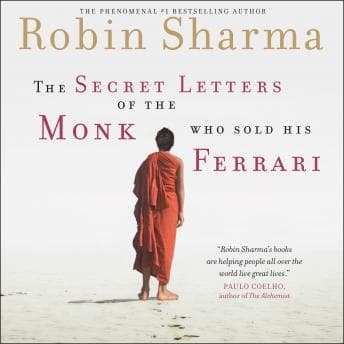

I was making aloo gobi at 10 PM on a Tuesday—the kind of elaborate cooking I do when my brain won't stop spinning on a research problem—when Julian Mantle showed up in my earbuds with his mystical Himalayan wisdom. I'll be honest: I approached this one with my skeptic's hat firmly on. Self-help wrapped in a globe-trotting adventure? My academic brain was ready to pick apart every motivational platitude.
But here's the thing. Robin Sharma did something clever. He built a narrative framework that actually works as a delivery system for psychological insights. Jonathan Landry chasing his mysteriously enlightened cousin across Buenos Aires, Paris, Shanghai, Sedona—it's basically a treasure hunt structure, and our brains are wired to respond to quests. The research on narrative transportation is clear: we absorb lessons better when they're embedded in story. Sharma seems to understand this intuitively.
The Psychology Behind the Cheese
Okay, yes. Some moments are cheesy. I won't pretend otherwise. There's a certain earnestness to the life lessons that made me roll my eyes once or twice while chopping onions. But—and this is important—the cheesiness doesn't undermine the validity of the core concepts. Sharma's talking about reclaiming personal power, authenticity, fear-based living. These aren't woo-woo ideas. They're backed by decades of research in positive psychology, self-determination theory, behavioral science.
What makes Jonathan compelling is that he isn't presented as broken. He's presented as... stuck. Which is psychologically more realistic than the typical self-help setup where someone hits rock bottom before transformation. Character Building explores this same territory—people who aren't broken, just stalled in patterns they've outgrown. Most of us aren't at rock bottom. We're just vaguely dissatisfied, sensing there's something more. Jonathan exhibits classic patterns of someone living according to external expectations rather than intrinsic values. I found myself asking: why does he really need these letters? The answer is more interesting than "to find wisdom." He needs permission. Permission to want something different.
Adam Verner Made Me Visit Sedona in My Kitchen
I couldn't find much about Adam Verner's background online, but based on this performance? The man knows how to build atmosphere. The tango halls of Buenos Aires, the catacombs of Paris—listeners aren't wrong when they say you travel with the protagonist. Verner's pacing shifts subtly depending on location. The Buenos Aires sections felt warmer, more languid. Paris had this haunting quality. It's not flashy voice acting with distinct character voices for everyone, but it's something better for this genre: immersive environmental narration.
His emotional delivery lands without being overwrought. When the wisdom moments arrive—and they arrive frequently—he doesn't hammer them. There's restraint. My therapist would have thoughts about why I find restraint in emotional expression so appealing, but that's a different conversation.
The pacing worked for my kitchen adventures and morning jogs through Cambridge. At just under seven hours, it's digestible. I never felt like Sharma was padding content to hit a page count, which happens way too often in the self-help space.
Who Should Listen (And Who Should Run)
Here's my honest assessment. If you're someone who dismisses anything with spiritual undertones, you'll struggle. There's definitely a philosophical, almost mystical layer here. But if you can separate the delivery mechanism from the underlying insights, there's genuine utility.
This is a fascinating case study in how to make personal development content accessible. Sharma's not writing academic papers (thank god—nobody reads those anyway, trust me). He's writing stories that happen to contain applicable life principles. It's the opposite approach from something like Wealth of Nations—dense theory that assumes you'll do the work of extracting meaning yourself. Sharma understands human nature well enough to know we need narrative hooks.
Best for: commuters who want something that feels like escapism but leaves them thinking. People in transition periods. Anyone who's read the original Monk Who Sold His Ferrari and wants more. Skip if: you need action-driven plots, you're allergic to any hint of self-improvement messaging, or you expect rigorous citations. (I'm usually that person. I made an exception.)
The Researcher's Reluctant Endorsement
Probably wouldn't listen again cover to cover. But I bookmarked a few sections—the Sedona chapters particularly—for future re-listening when I need a reset. The production is clean, Verner's voice is genuinely pleasant company, and despite my initial skepticism, some of Sharma's insights stuck with me past the end credits.
Is it life-changing? Psychologically, that depends entirely on where you are when you encounter it. But it's a well-constructed, warmly narrated reminder that the stories we tell ourselves about our lives matter. And as someone who's built a career studying exactly that—I can't argue with the core premise.