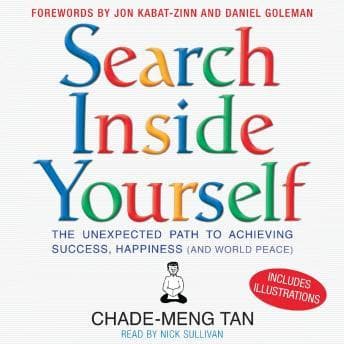

Look, I need to rant for a second. Why does every Google engineer who discovers meditation feel compelled to write a book about it? The same "I have discovered something and must tell everyone" energy saturates Open Book, though at least that one earns it. And why does every one of those books have a subtitle that promises "world peace" in parentheses like it's a cute afterthought? Chade-Meng Tan's Search Inside Yourself commits both sins, and honestly, for the first hour I was ready to mentally file this under "could've been a blog post" and move on.
But then - annoyingly - some of it started to land.
The Mindfulness-as-API Framework Actually Works
Here's what Meng does differently from your standard "breathe and be present" book: he treats emotional intelligence like a trainable skill with specific exercises, not some woo-woo personality trait you either have or don't. Think of it as unit tests for your brain. He breaks mindfulness into components - attention training, self-knowledge, building mental habits - and structures them like a curriculum, which makes sense given this started as an actual course at Google called "Search Inside Yourself" (yes, that's really the internal course name, and yes, it's as Silicon Valley as it sounds).
The stuff on emotional regulation during high-stress situations hit different for me. There's a section where he talks about experiencing anger as a physical sensation - observing the heat in your chest, the tension in your jaw - rather than the story your brain is spinning. I was listening to this at like 11:30 PM, couldn't sleep after a particularly cursed deploy, and I caught myself actually trying it in real time. Monitoring my own frustration like checking system metrics. It felt ridiculous and also... kind of useful?
The book leans heavily on Daniel Goleman's emotional intelligence framework and Jon Kabat-Zinn's mindfulness work, which gives it more scientific grounding than your average self-help title. The studies Meng cites on neuroplasticity and meditation actually hold up - I've seen the same research referenced in other places. But he also peppers in Google anecdotes and his own engineer-brain humor that's very "I'm the fun one at the all-hands meeting." Your mileage will vary on whether that's charming or grating.
At 7 hours 43 minutes, it's mercifully compact for a self-help book. I got through it in about 4 commutes at 1.75x. Could've been trimmed further - there's repetition in the guided exercise sections that feels like padding - but it respects your time more than most books in this genre.
Nick Sullivan and the Humor Problem
Okay, here's where things get complicated. Meng's writing has this specific dry, self-deprecating engineer humor. He literally held the job title "Jolly Good Fellow" at Google. The book is supposed to be funny in places. Nick Sullivan's narration is... not funny. It's clear, it's professional, it's competent. But it's also stiff in a way that flattens every joke. Imagine someone reading your funniest Slack messages in a corporate training voice. That's the vibe.
Sullivan isn't bad - his pacing for the instructional content is actually solid, and when Meng gets into the more serious neuroscience sections, the straightforward delivery works fine. But every time there's a punchline or a playful aside, you can feel the disconnect between what's on the page and what's coming through your earbuds. Some of the self-aware humor that probably makes the print version feel light and accessible just... dies on arrival.
I wouldn't call it a dealbreaker, but it does make a 7-hour listen feel longer than it should.
Who Gets ROI Here (And Who Doesn't)
Perfect for: Engineers and tech workers who are meditation-curious but allergic to anything that sounds too spiritual. Meng frames everything in terms of performance optimization and emotional debugging, which - yes, I know, very Silicon Valley - but it works if that's how your brain is wired. Also solid for anyone dealing with workplace stress who wants practical exercises, not just theory.
Skip for: Anyone who already has a regular meditation practice or has read more than two books on mindfulness. This is Mindfulness 101 with a Google lanyard. If you've done MBSR or read Wherever You Go, There You Are, you're going to be bored. Also skip if author humor is important to you in audio format, because Sullivan's narration strips most of it out.
Perfect for: train, gym. Skip for: deep work (ironic, given the subject).
The Commit Message
The ROI on this audiobook is moderate. It's a decent primer on applied mindfulness, packaged for people who think in systems and processes. Meng's engineer-to-engineer approach to emotional intelligence is genuinely useful, even if the "I work at Google" energy gets thick sometimes. The narration holds it back from being a strong recommend - this is a book that really needed to be author-narrated, or at least read by someone who could sell the humor. At full credit price, I'd say wait. At a discount or through your library app? Worth the 4 commutes.