
Three hours. This book is three hours long. I almost wept with gratitude.
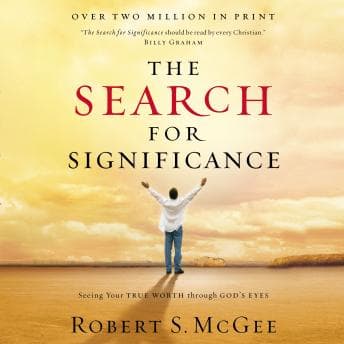
I was up late Sunday night, Jenny asleep, scrolling through my Audible library looking for something short enough to finish before Monday's 7 AM client call. Search for Significance had been sitting in my queue for months - a recommendation from a pastor friend who knows I'm skeptical of anything that mixes faith and self-help. At three hours, the commitment risk was low. So I hit play, poured some tea, and sat at the kitchen table in the dark like some kind of contemplative monk. Which, honestly, might have been the right posture for this one.
The Performance Treadmill Has a Korean Name
Here's what got me. McGee identifies four false beliefs that drive most of our self-worth issues: the performance trap, the approval addict, the blame game, and the shame spiral. He doesn't call them that exactly, but that's the gist. And the performance trap - the idea that your value equals your output - hit me like a truck at 11:47 PM on a Sunday.
Because that's the water I grew up swimming in. My parents' dry cleaning shop in Koreatown wasn't just a business. It was proof of worth. You work harder, you earn more, you matter more. Nobody sat me down and taught me that formula. Nobody had to. I absorbed it watching my mom press shirts at 9 PM on a Tuesday. McGee would call that a false belief. My parents would call it survival. The truth is probably somewhere in between, and this book at least has the honesty to sit in that tension rather than offering some breezy "just let go and let God" platitude.
The four false beliefs framework is genuinely useful. It's not revolutionary psychology - any decent therapist will tell you that tying self-worth to performance or approval is destructive. But McGee does something most self-help authors skip: he gives you the replacement belief alongside the diagnosis. Not just "stop doing this" but "here's what to think instead, and here's the theological grounding for why it's true." That's practical. That's something I can actually use with the startup founders I coach who are one bad quarter away from an identity crisis.
Mike Flynn Reads Like Your Favorite Pastor
Flynn's narration is warm, clear, and appropriately pastoral without being saccharine. He's got the tone of a guy who's delivered a lot of sermons and knows when to let a sentence breathe. No dramatic vocal pyrotechnics, no attempt to turn a counseling book into a theatrical experience. He reads it straight, which is exactly what this material needs. The pacing is measured - almost meditative - which at 2.0x speed translates to a comfortable, focused listen. At 1.0x, I suspect it might feel a touch slow for the impatient among us. (That's me. I'm the impatient among us.)
One thing I noticed: Flynn handles the Scripture quotations with genuine reverence without shifting into that "reading the Bible aloud in church" voice that some narrators default to. It feels integrated, not performative. Small thing, but it matters for a book that's asking you to internalize these passages as identity truths.
Where It Falls Short (Because Nothing's Perfect)
Look, this book was first published in 1990 and it shows in places. Some of the psychological framing feels dated - the kind of pop-psych language that was cutting edge thirty years ago but reads as surface-level now if you've spent any time with more recent work on attachment theory or cognitive behavioral therapy. McGee was ahead of his time in integrating faith and counseling, but the field has moved. That gap between the theological foundation and the contemporary scholarship is something How to Read the Bible for All Its Worth handles more deftly — it's genuinely rigorous without feeling like it's stuck in the decade it was written. This "re-launch" adds some updated material, but the bones are still very much 1990.
Also - and Jenny would say I'm being harsh, Jenny is right - the workbook elements don't translate well to audio. There are moments where McGee references exercises and reflection questions that clearly belong on paper. In an audiobook, you're just... listening to instructions you can't follow while driving. That's a format problem, not a content problem, but it's worth knowing.
Who Gets the Most Out of This
If you're a Christian who intellectually knows God loves you but emotionally still operates like your worth is a quarterly earnings report - this is your book. If you're a counselor or mentor in a church context, the four false beliefs framework is a genuinely handy diagnostic tool. If you're a founder or Type-A professional who grew up in a high-performance immigrant household (hello, it me), the performance trap chapter alone justifies the listen.
Skip it if faith-based content isn't your thing. McGee's framework is built on a Christian foundation, and there's no secular version hiding underneath. That's not a criticism - it's just clarity about what you're getting.
The Bottom Line on Your Three-Hour Investment
Bottom line: at three hours, this is one of the most efficient faith-based self-help listens I've encountered. The core framework is solid, the narration is clean, and it respects your time - something I wish more business and self-help authors understood. It's not going to replace therapy, and it won't fix your childhood in an afternoon. But as a starting point for understanding why you tie your identity to your output? Finally, a book that respects your time. My parents did what McGee describes instinctively - tied worth to work. Now it has a framework. And a three-hour audiobook. That's an ROI I can respect.