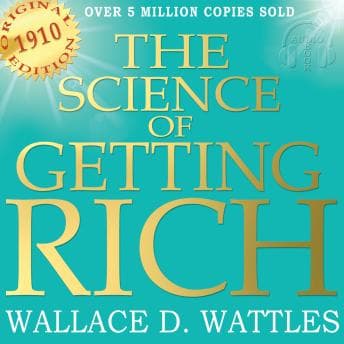

Look, I need to rant about something. It's 2024 and we're still publishing audiobooks of a 1910 self-help text with zero added context, no introduction, no historical framing - just the raw text read aloud like it's a firmware update changelog. Wallace Wattles wrote The Science of Getting Rich over a century ago, died the year after, and somehow this book keeps getting resurrected in new audio editions like it's the literary equivalent of a zombie process nobody will kill.
I listened to this on a particularly brutal Monday morning commute - 6:12 AM, standing room only, wedged between a guy eating an egg sandwich and someone FaceTiming their mom on speaker. Perfect conditions to test whether a 2-hour-24-minute prosperity manifesto could hold my attention against competing sensory horrors.
The 1910 Blog Post That Keeps Getting Repackaged
Here's the thing about Wattles: the core idea is actually interesting. Give more in use value than you take in cash value. Think in a "Certain Way" (his caps, not mine). There's a proto-Law of Attraction framework here that predates The Secret by nearly a hundred years, and unlike Rhonda Byrne's version, Wattles at least tries to ground it in action rather than pure vibes. He explicitly says you can't just visualize wealth - you have to do the work in your current situation and give real value.
But here's where my Could've Been A Blog Post alarm goes off at full volume: this is 17 short chapters that essentially repeat the same three ideas with slightly different phrasing. Wattles hammers "thinking in a Certain Way" so many times that by chapter 10 I started counting. The repetition might have worked as a pamphlet you re-read weekly in 1910, but as a linear audio experience in 2024, it feels like a for-loop with no exit condition.
The most genuinely useful section is his breakdown of why competitive thinking fails and creative thinking wins - basically arguing that wealth isn't zero-sum, which was a pretty radical take for the early 1900s. That chapter alone is worth the price of admission. The rest is scaffolding. The accountability-through-action angle reminded me of QBQ! The Question Behind the Question, which covers similar ground about personal responsibility but at least has the decency to feel like a book written in the same century I'm living in.
Christa Lewis and the Robotic Narrator Problem
Okay, so the reviews on this one are polarized about Christa Lewis's narration, and I land somewhere in the conflicted middle. She reads with clarity - I could follow every word even through the egg sandwich haze - and she doesn't inject weird dramatic pauses or breathy emphasis where it doesn't belong. For a dry instructional text, that's honestly fine.
But the complaints about robotic delivery aren't wrong either. There's a flatness to the pacing that makes the already-repetitive content feel even more monotonous. No variation in energy between chapters. No shift when Wattles gets genuinely passionate (and he does - his section on gratitude has real fire in the original text). Lewis reads the philosophical arguments and the practical instructions with the exact same cadence, like she's narrating a terms-of-service agreement. At 1.5x speed it's tolerable. At 1x I think I would've zoned out completely.
Compare this to, say, how Ray Porter would handle the same material - he'd find the humor in Wattles's Victorian confidence, he'd punch up the declarative statements, he'd make you feel the conviction behind "There is a thinking stuff from which all things are made." Lewis just... reads it. Competently. Without soul.
Who This Is Actually For (Be Honest With Yourself)
If you've never encountered Wattles and you're curious about the OG prosperity literature that spawned an entire industry - sure, spend the 2.5 hours. It's short enough that the ROI on your time isn't terrible, and there are genuinely interesting ideas buried in the repetition. Listen at 1.75x, treat it like a long podcast episode.
If you've already read Think and Grow Rich, The Secret, or basically any modern manifestation book - skip this version. You already have the ideas, repackaged with better production value. And if you DO want to experience Wattles specifically, there are other audio editions with narrators who bring more energy.
If you're a history-of-ideas nerd (guilty) who wants to trace the genealogy of American self-help culture, this is a fascinating primary source. Just know that the audio format doesn't add much beyond convenience.
The Commit Message
TL;DR: The source material is a historically interesting 114-year-old prosperity pamphlet with 2-3 genuinely good ideas buried in heavy repetition. This particular audio edition is functional but flat - Christa Lewis delivers clarity without charisma. At 2 hours 24 minutes, it's low-commitment enough to not feel like a waste, but you're basically paying for someone to read a public domain text aloud without adding anything. I finished it in one commute each way and immediately started something else. The ideas are worth knowing. This specific audiobook is just... an okay delivery mechanism for them.