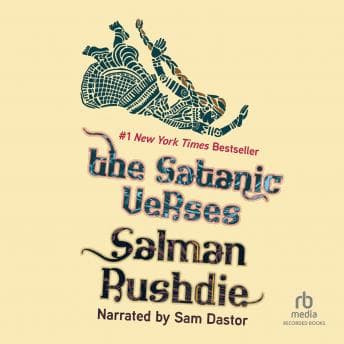

I'm going to start with a complaint. Twenty-one hours. Twenty-one hours of Salman Rushdie's dense, swirling, metaphor-heavy prose, and Sam Dastor pronounces "Bombay" like he's never met an Indian person in his life. I teach Rushdie to my AP Lit students. I've read passages from this book aloud in class. I know how these names should sound. And every time Dastor stumbled over a place name or character, I winced like someone had scraped chalk across a blackboard.
But here's the thing—and this is why I kept listening through all twenty-one hours while grading junior essays on The Great Gatsby—the man can perform. When he's not tripping over Hindi, Dastor has this theatrical energy that matches Rushdie's maximalist prose perfectly. This is a book that demands drama. It's operatic in scope, juggling Gibreel Farishta's Bollywood star madness and Saladin Chamcha's identity crisis across continents and centuries. A flat reading would've killed it.
The Narrator Problem (And Why I Kept Listening Anyway)
I couldn't find much about Sam Dastor's background online, but based on this performance, he's clearly trained in classical British theatre. You can hear it in how he handles Rushdie's sentences—those long, comma-laden constructions that wind through three ideas before landing on a fourth. Dastor rides them like waves. He knows where the humor lives, when to pause for the absurdist punch.
But the accent work. Ugh. Some listeners have called it "comical" and honestly? They're being kind. When Dastor voices Indian characters, there's a caricature quality that made me uncomfortable. I kept thinking about how my students—several of whom are South Asian—would react to hearing this in class. It's the kind of thing that was probably acceptable when this audiobook was recorded, but lands differently now.
And yet. The man handles the theological complexity with such clarity. The Satanic Verses is not an easy book. Rushdie layers dreams within dreams, religious visions within Bollywood fantasies, immigrant experience within mythological framework. Dastor never loses the thread. He knows which voice belongs to which reality, even when Rushdie is deliberately blurring them.
Why We Still Read Rushdie (Even When It Hurts)
I finished this during faculty meetings, lakefront walks with Denise, and one memorable three-hour grading session where I was supposed to be reading student essays on symbolism in Lord of the Flies. (Principal Martinez, I was definitely paying attention to the curriculum review. I wasn't listening to a controversial novel about religious doubt and immigrant identity. Definitely not.)
Here's what Rushdie does that nobody else does quite the same way: he makes you laugh at things you shouldn't find funny, then gut-punches you with genuine tragedy. Gibreel and Saladin falling from an exploding plane, transforming mid-air—it's absurd, it's magical realist, it's also somehow about every immigrant who's ever felt themselves becoming unrecognizable.
The prose deserves to be savored. I listened at 1.0x because Rushdie chose those words, chose that rhythm, and speeding through would've been like fast-forwarding through a symphony. I had a completely opposite experience with Where'd You Go, Bernadette—that one I actually did speed up because the pacing was so brisk.
My students would hate this book. The sentences are too long. The references are too dense. The structure is too fragmented. I love it. This is why we still read the classics—because someone took language and pushed it past what it was supposed to do.
Who Should Queue This Up (And Who Should Skip)
If you're a Rushdie fan who wants to experience the full linguistic fireworks of his most controversial work, Dastor delivers the drama. But if mispronunciations are going to pull you out of the story—and they might, especially if you have any connection to South Asian culture—sample first. My students? They'd bail after chapter two. Readers who want their prose clean and their plots linear should look elsewhere.
Final Grades, Over Cold Coffee at 11 PM
The book itself remains extraordinary. Rushdie's comic sensibilities, his cultural observations, his absolute command of English prose—it's all here. The fatwa that followed this novel's publication has overshadowed its literary achievement for decades, but listening to it now, you remember why it mattered so much in the first place. This is a writer grappling with faith, identity, and belonging in ways that still feel urgent.
Dastor is the man of a thousand voices, some of them better than others. But he understood the assignment: make this dense, difficult, brilliant novel accessible to the ear. He mostly succeeds. Just maybe keep your finger near the rewind button for the names.