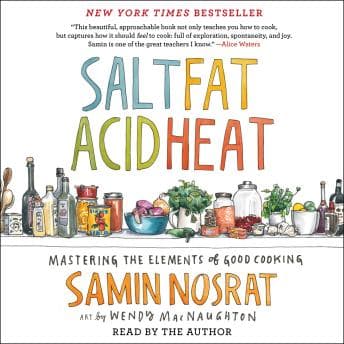

Look, I'm an English teacher. I analyze Hemingway's prose and debate whether Fitzgerald was a genius or just lucky. I do not, as a general rule, listen to cookbooks.
And yet here I am, having finished Samin Nosrat's Salt, Fat, Acid, Heat while grading sophomore essays on The Great Gatsby, and I'm genuinely annoyed that a book about braising techniques made me feel things.
When a Cookbook Becomes a Memoir
Here's what caught me off guard. Nosrat doesn't just explain how salt works—she tells you about the first time she truly understood it, working in Alice Waters' kitchen, feeling like an impostor among real chefs. There's a vulnerability there that reminds me of the best literary memoirs. She's not performing expertise. She's sharing a journey. That kind of honest vulnerability—admitting you don't have all the answers—is what makes I Need Your Love - Is That True? work so well too.
The framework itself is elegant in a way my literature-obsessed brain appreciates. Four elements. That's it. Salt enhances, fat delivers, acid balances, heat transforms. It's the kind of thesis statement I wish my students would write—clear, arguable, and actually defended throughout the work. Nosrat builds her case like a good essayist, layering examples and returning to her central argument with the confidence of someone who knows she's right.
Denise (my wife, who actually cooks) kept pausing the audiobook to say "That's why!" about things she'd been doing instinctively for years. Which, honestly, is exactly what good teaching looks like. You take intuition and give it structure. You name the thing people already half-know.
The Voice That Makes It Work
Nosrat narrating her own book is the right call. Her voice has this warmth—Iranian-American inflection, genuine enthusiasm that never tips into that Food Network performative excitement. She sounds like she's explaining something to a friend at her kitchen counter, not lecturing from a stage.
I listened at my usual 1.0x (yes, I know, I'm ancient) and the pacing felt natural. She lingers where lingering matters—the science of why salt needs time to penetrate meat, the way acid brightness can rescue a flat dish—and moves briskly through the more mechanical stuff. There's a rhythm to it. Prose rhythm, if I'm being pretentious about it. Which I am.
The production is clean. No weird audio artifacts, no jarring transitions. Just Nosrat's voice and the occasional chapter break.
The Limitation Nobody Wants to Admit
Okay, here's where I have to be honest. This is a cookbook without the cookbook. The physical book has gorgeous illustrations, detailed recipes, visual guides. The audiobook has... words about those things.
I found myself wishing I could see what she was describing. When she explains the proper consistency of a vinaigrette or the color of properly caramelized onions, I was filling in mental images that may or may not be accurate. If you're a complete beginner who's never watched cooking videos or stood next to someone who knows what they're doing, you might feel a bit lost.
And look—experienced cooks might find some of this basic. One reviewer I came across called it a "beginner's guide," and that's not entirely wrong. If you already understand why you're deglazing a pan, you're not going to have revelations here. You might just feel validated.
But for the rest of us? For the people who cook from recipes without understanding why those recipes work? This is the book that finally explains the grammar of cooking. (Yes, I just made a grammar metaphor about food. I teach English. It's what I do.)
The Netflix Connection
The book spawned a Netflix series, which I haven't watched but probably should. Apparently Nosrat travels to different countries exploring each element—salt in Japan, fat in Italy, that sort of thing. If the show captures even half of her audiobook warmth, it's probably worth your time.
Who Should Listen (And Who Should Skip)
Skip this if you're an experienced cook who already understands the "why" behind your techniques—you'll just nod along. But if you're like me, someone who follows recipes without grasping the underlying logic, or if you want the philosophy of cooking rather than step-by-step instructions, this is your book. Fair warning: get the physical copy if you need actual recipes to follow.
Final Grade
I listened while grading papers at 11 PM, and instead of feeling drained, I felt like I'd learned something. That's rare. My students would probably find this boring. But my students think The Sound and the Fury is boring, so their judgment is suspect.
Denise wants me to actually try cooking something now. Using the principles. Salt early, fat generously, acid at the end, heat appropriately.
I'll let you know how that goes. (Don't hold your breath.)