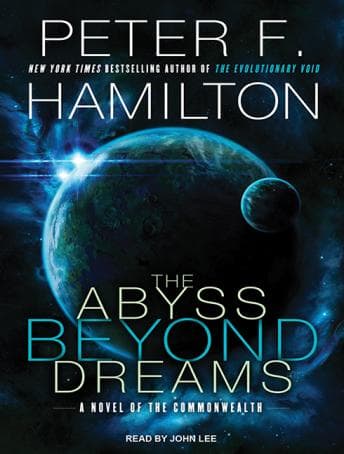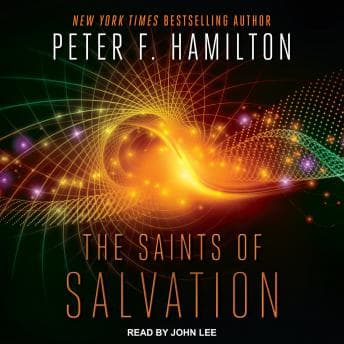

Look, I know what the internet says about John Lee. Half the reviews call him one of the best narrators working in sci-fi today. The other half say his inflection is "weird." I've been listening to this man narrate Hamilton's books for years now, and here's where I land: he's like that one friend who tells stories in a slightly odd cadence but you stop noticing after twenty minutes because the story is that good. By hour three of Saints of Salvation, I wasn't thinking about Lee at all. I was thinking about millennia-spanning battle plans and alien zealots and whether humanity had any business surviving this one.
I finished this at 2 AM on a Tuesday, sitting on my apartment floor surrounded by board game boxes I was supposedly reorganizing. (Narrator: he was not reorganizing.) Dr. Patel's going to love hearing about my "progress" this week.
Hamilton Plays the Longest Long Game in Sci-Fi
So the Salvation Sequence has been building to this. The Olyix — religious alien invaders who've been scooping up billions of cocooned humans to drag to their God at the End of Time — are the kind of antagonists that make you go "okay but what's the actual play here?" And Hamilton, being Hamilton, has been setting up dominos across three books and literal millennia of in-universe time. This is where they fall.
The scope is genuinely absurd. You've got ultra-secret spy missions running in parallel with what the book calls one of the grandest battles ever seen, and it earns that. Hamilton's doing his thing where he juggles like six different timelines and character groups, each operating on a different scale of the plan. Some of these threads are intimate — a handful of people making desperate choices. Others are galaxy-brain strategic moves that've been cooking since Book One.
This is Sanderson-level world-building, but with a hard sci-fi backbone. Where Sanderson gives you elegant magic systems, Hamilton gives you FTL mechanics and alien biology and post-human civilization design that all feel like they could work. That same slow-burn payoff from a sprawling multi-book plan is something I chased when I reviewed The Great Hunt — Jordan is doing something structurally similar with the Wheel of Time, just with swords instead of FTL drives. The progression is satisfying in the way that a 200-piece Rube Goldberg machine is satisfying — you see pieces click into place that were set up 40 hours ago across three books. If you don't like info-dumps, this isn't for you (but you're wrong).
The "You Need to Actually Pay Attention" Problem
Here's the thing nobody warns you about: this is NOT a background listen. I cannot stress this enough. Hamilton has this habit — and it's especially pronounced in Saints — where crucial events happen with very little hand-holding. Things just... occur. And if you zoned out for ninety seconds because you were trying to figure out if your thesis bibliography formatting was APA or Chicago, you will come back to a completely different strategic situation with zero explanation of how you got there.
I rewound more times than I want to admit. Not because the writing is unclear — it's not — but because Hamilton trusts his readers to keep up, and at 17 and a half hours with this much going on, that's a big ask in audio format. The pacing whips between slow strategic exposition and sudden action sequences that feel like they should have had more buildup. It works on the page, probably. In your earbuds while you're doing anything else? You're gonna miss stuff.
John Lee handles the complexity about as well as any single narrator could. He's got surprising range with character differentiation — different accents, tonal shifts, little moments of dry humor that land perfectly. But yeah, sometimes his inflection choices are... choices. There's this thing he does where emphasis falls on unexpected words in a sentence, and it pulled me out of the story maybe three or four times across the whole listen. Minor stuff. The man is shouldering a genuinely massive cast and a plot that would make most narrators cry, and he does it with confidence.
Who's Rolling Initiative and Who Should Sit This One Out
If you haven't read the first two books — Salvation and Salvation Lost — do not start here. You will understand literally nothing. This is a payoff book, not an entry point.
If you've been with the trilogy from the start? Yeah, this is worth it. The ending hits the themes Hamilton's been building — freedom of choice, humanity's stubbornness, the audacity of fighting a war across thousands of years. My D&D group would love this. It's basically what happens when your campaign goes from level 1 to level 20 and the DM actually planned the whole thing from session zero.
But if you want tight, efficient storytelling? If you want every scene to earn its minutes? Hamilton has always been a maximalist, and this book is no exception. There are stretches that feel indulgent. The sprawl is the feature AND the bug.
Yes, it's 17 hours. Yes, it's worth it. But clear your schedule and put your phone down. This one demands your full attention or it will punish you for it.
The Thesis Can Wait Another Day
Hamilton stuck the landing on a trilogy that could've easily collapsed under its own ambition. It's not his absolute best work — I'd still point people to the Commonwealth Saga first — but as a conclusion to the Salvation Sequence, it delivers. The scale is staggering, the payoff is real, and John Lee gets you through it with enough skill that you forgive the occasional odd vocal choice. I read this instead of writing my thesis. Worth it.