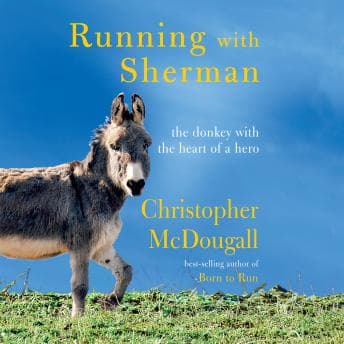

I was halfway through a Sunday morning dal makhani—the kind that requires constant stirring and absolutely no distractions—when Sherman arrived in my ears. Matted fur, hooves so overgrown he could barely stand, rescued from an animal hoarder's nightmare. And I'm standing there with my wooden spoon suspended mid-stir, completely forgetting about the cream I was supposed to add, because Christopher McDougall just described this broken creature with the same clinical precision I use for case studies.
A fascinating case study in rehabilitation psychology, actually. Not just for Sherman, but for everyone who touches his story.
The Psychology of Purpose (And Why Donkeys Need Jobs)
What makes this book compelling is McDougall's accidental stumble into something therapists have known for decades: purpose heals. The research shows that having meaningful work—a reason to get up, a goal to chase—is one of the most powerful interventions for trauma recovery. Metahuman explores similar territory about unlocking potential, though Chopra's approach is decidedly more mystical than McDougall's hooves-on-the-ground pragmatism. And here's McDougall, applying it to a donkey.
Sherman doesn't just need his hooves trimmed and his coat brushed. He needs something to do. So McDougall decides they'll train for the Pack Burro Racing World Championship in Leadville, Colorado. Yes, that's a real thing. Humans running alongside donkeys at altitude, a callback to mining days when burros hauled supplies up impossible mountain trails.
The protagonist exhibits classic helper syndrome—McDougall can't just rescue an animal, he has to give it a whole narrative arc. But honestly? It works. Watching Sherman transform from a creature who couldn't walk to one preparing to race is genuinely affecting. My therapist would have thoughts about why I found a donkey's recovery arc more emotionally satisfying than most human ones I've encountered in my research.
McDougall Reading McDougall
Here's where author-narrated audiobooks get interesting. McDougall isn't a professional voice actor, and you can tell. But that's actually the point. When he talks about Sherman's first hesitant steps, or the way the donkey's ears perked up when he finally understood what they were training for, there's an emotional authenticity that a hired narrator couldn't replicate. He wrote these words. He lived them. You hear it.
Compared to Born to Run, his breakout about ultramarathoners and the Tarahumara people, this is a smaller story. More intimate. Born to Run had that propulsive, almost journalistic energy—McDougall chasing a mystery across Mexican canyons. Running with Sherman is quieter. It's about his backyard in Pennsylvania Amish country, his neighbors, his community rallying around one stubborn donkey.
Some listeners complained about tangents. Fair enough. McDougall does wander—into the history of burro racing, into the lives of female long-haul truckers who become unlikely training partners, into the philosophy of Amish running clubs (which, yes, exist). I found myself asking: why does he really keep digressing? And I think it's because the book isn't actually about Sherman. It's about how healing happens in community. The tangents are the point.
Who Should Queue This Up (And Who Should Skip)
If you want a tight, focused narrative with no detours, this will frustrate you. The pacing meanders like a donkey who's spotted interesting grass. But if you're in a season where you need something gentle and hopeful—something that reminds you that broken things can be made whole, that community still exists, that purpose matters—this is your book. Skip it if animal stories leave you cold or if you need plot momentum to stay engaged.
I listened during cooking, during my morning jogs through Cambridge, during one particularly anxious Sunday when the news was too much and I needed something that wasn't about humans being terrible to each other. Sherman delivered. (The donkey, not some metaphor. Though also the metaphor.)
The 12-hour runtime is substantial. At 1.25x speed, it became a comfortable companion for about a week of commutes and kitchen time. McDougall's narration handles the acceleration well—he's conversational enough that speeding up doesn't make him sound robotic.
Clinical Notes on a Donkey
Psychologically, this tracks. Every element—the community involvement, the gradual physical rehabilitation, the building of trust between human and animal—aligns with what we know about trauma recovery. McDougall probably didn't set out to write a case study in applied psychology, but he did anyway.
Is it perfect? No. The tangents can feel long-winded, and if you're not invested in the human-animal bond, you'll wonder what all the fuss is about. But for those of us who understand that sometimes the best therapy comes with four legs and extremely loud opinions about carrots, this is a delight. I had a similar realization listening to What a Time to be Alone—that healing doesn't always look like what we expect it to, whether it's a donkey or radical self-acceptance.
Sherman made it to Leadville, by the way. I won't spoil how the race goes. But I will say I cried into my dal makhani. The cream never got added. Worth it.