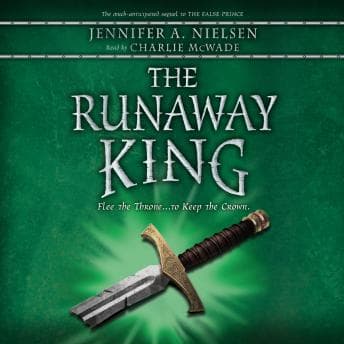

I picked up The Runaway King because I needed something to listen to while pretending to work on my thesis, and middle grade fantasy is basically comfort food for my brain. Sometimes you don't want a 40-hour Sanderson epic with seventeen magic systems. Sometimes you just want a clever kid outsmarting adults for eight hours. Though honestly, Grimm's Fairy Tales scratches that same itch when I need something even lighter—just fairy tale logic and kids being clever. Sue me.
And Jaron? This kid is basically what would happen if a rogue and a bard had a baby and that baby was also a king. The first book set up this whole "orphan pretending to be a prince who's actually the prince" thing, and book two just runs with it. Hard.
When Your Protagonist Rolls Natural 20s on Deception
Here's the thing about Jaron—he's infuriating in the best way. The kid has a plan. Always. But he never tells anyone what it is, including the reader, which means you spend half the book going "what are you DOING" and the other half going "oh. OH. That's actually brilliant."
Nielsen does this thing where she makes you genuinely worried Jaron has finally gotten in over his head. The assassination attempt at the beginning? The whole "I have to abandon my kingdom to save it" plot? It sounds like standard YA fare, but the execution is tighter than you'd expect. The political maneuvering isn't Sanderson-level world-building (nothing is), but for a middle grade book, there's actual stakes here. Kingdoms falling. Pirate kings. Betrayal that actually stings.
My D&D group would absolutely love this kid. He's the player who says "I have a plan" and then does something so unhinged the DM has to take a five minute break. Chaotic good energy through and through.
Charlie McWade Nails the Cocky Disaster King
I couldn't find a ton about Charlie McWade online—he's not exactly Steven Pacey levels of narrator fame—but based on this performance? The guy's solid. Really solid.
He nails Jaron's voice. That's the big thing. Jaron is cocky and wounded and clever and kind of a disaster, and McWade captures all of it. The sarcasm lands. The vulnerable moments hit different. When Jaron's being a little snot to his advisors, you can hear the smirk. When he's genuinely scared? You feel it.
I've seen some people online say his accent takes getting used to, and... yeah, maybe? I didn't notice it much after the first chapter, but I also listen to a lot of British fantasy narration, so my baseline is probably skewed. I had a similar adjustment period with Camp of the Dog, where the narrator's style felt odd at first but ended up working perfectly for the atmosphere. If you're picky about accents, maybe sample first. But honestly, the character work is strong enough that I stopped thinking about technique and just got absorbed in the story. That's the goal, right?
Pacing-wise, the eight and a half hours flew by. I listened during a coding session that was supposed to be thesis work (it was not thesis work) and suddenly it was 2 AM and I was invested in whether this fourteen-year-old could outmaneuver a pirate king. No regrets.
A Middle Book That Actually Levels Up
This is a solid middle book in a series. And I say that as someone who's read a LOT of middle books that just... exist. You know the type—nothing really happens, it's just setup for book three, everyone's treading water.
The Runaway King isn't that. Jaron actually grows here. The stakes escalate. The relationships shift in ways that matter. There's a specific betrayal moment—I won't spoil it—that genuinely got me. Like, I said "oh no" out loud. In my apartment. Alone. At 2 AM. (My neighbors probably think I'm unhinged. They're not wrong.)
Is it predictable in places? Sure. It's middle grade. You know Jaron's gonna figure something out. But Nielsen is smart enough to make the HOW interesting, even when the WHAT is obvious. The magic system is basically "Jaron is really good at lying and also sword fighting," which isn't going to satisfy anyone looking for hard magic rules, but it works for what this is.
Roll for Initiative (Or Don't)
If you liked The False Prince, this is a worthy sequel. If you're an adult looking for something lighter between your Brandon Sanderson doorstoppers, this scratches that itch. If you have kids who are into fantasy, this is a great gateway drug before you hand them Mistborn. Skip it if you need complex magic systems or can't handle a protagonist who's smarter than everyone around him—Jaron's cockiness is a feature, not a bug, but it's not for everyone.
The audiobook format works well here. McWade keeps the energy up, the chapters are good commute-length, and there's enough action that you won't zone out during the slower political bits.
I'm definitely grabbing book three. After I make some progress on my thesis. (I will not make progress on my thesis.)