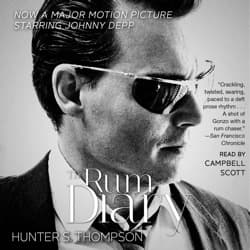

Look, I've got a bone to pick with Hunter S. Thompson. The man wrote this thing at twenty-two years old, and here I am at sixty-three still trying to figure out how to write a decent after-action report. That's not fair. That's just not fair.
I finished this one on a late-night drive back from Houston—client meeting ran long, Linda was already asleep when I pulled into the driveway, and Ranger gave me that look dogs give you when you've been gone too long. Six hours of Texas highway, six hours of Paul Kemp drinking himself stupid in 1950s Puerto Rico. Fitting, somehow.
Before the Madness Took Hold
This isn't Fear and Loathing. Let me cut to the chase on that right now. If you're expecting bat country and ether binges, recalibrate your expectations. This is Thompson before he became THOMPSON—capital letters, sunglasses indoors, the whole circus. What you get instead is a young journalist watching himself become cynical in real-time. That hit closer to home than I expected.
Kemp's working for a dying newspaper in San Juan, surrounded by drunks and schemers and get-rich-quick Americans trying to carve up the Caribbean like a Thanksgiving turkey. The corruption is casual, almost boring in how normalized it is. I've seen this scenario play out in real life—different location, same human greed. Thompson understood that at twenty-two, which is either impressive or deeply sad. Maybe both.
The love story—if you can call it that—involves a woman named Chenault who belongs to someone else. Thompson doesn't romanticize it. Kemp wants her because she's beautiful and unavailable and represents something he can't have. That's it. That's the whole thing. No redemption arc, no grand gesture. Just a man making bad decisions because the rum is cheap and the nights are long.
Christopher Lane's Petulant Genius
Here's where I might surprise you. Christopher Lane's narration is—and I don't say this lightly—exactly right for this material. His voice has this scratchy, youthful quality with an undertone of petulance that fits Kemp perfectly. The man's already jaded in his early thirties, and Lane captures that particular flavor of self-loathing that comes from knowing you're wasting your potential and doing it anyway.
Lane stays true to the novel's essential seriousness. This isn't a comedy, despite what the marketing might suggest. There are funny moments, sure—Thompson could always land a joke—but the core is something darker. Lane gets that. He keeps the aimlessness and self-indulgence right to the end, which is no small feat when your protagonist spends most of his time drunk and making questionable choices.
Could Lane have injected more of the gonzo energy Thompson would later become famous for? Maybe. There are moments where Kemp's periodic nastiness gets a bit grim, and a lighter touch might've helped. But I'm not sure that would've been true to the text. This is pre-gonzo Thompson. The madness was still brewing. Big Little Lies runs about the same length, and I appreciated both for knowing when to end the mission.
Worth Your Time? Here's the Debrief
At six hours, this is a quick deployment. The pacing matches the languor of Caribbean heat and too much alcohol—things happen, but slowly, like watching someone drown in molasses. If you need constant action, look elsewhere. But if you want to understand how one of America's strangest literary voices started out, this is essential intel.
Thompson clearly did his homework on Puerto Rico's boom years. The corruption, the American developers swooping in, the locals caught between old ways and new money—it feels authentic in a way that matters. He wasn't just writing about drinking (though there's plenty of that). He was documenting a particular kind of American ugliness abroad.
Who should listen? Anyone who appreciates Thompson's later work and wants to see the foundation. Anyone who's ever worked somewhere they knew was dying and stayed anyway. Anyone who's made bad decisions in tropical climates. (No judgment. We've all been there.)
Who should skip? If you need plot momentum, this isn't it. If you want the full gonzo experience, start with Fear and Loathing. And if you're in recovery, fair warning—this book treats alcohol like oxygen.
End of Patrol
Ranger slept through most of this one, which I take as neither endorsement nor criticism. The German Shepherd has standards, but he also has a very comfortable bed in my office.
The Rum Diary isn't Thompson's best work, but it might be his most honest. Before the persona, before the myth, there was just a young man with a typewriter and a drinking problem, trying to figure out what kind of writer he wanted to be. Lane's narration serves that story well—no fireworks, just steady, committed work.
Mission accomplished, with caveats. This is a character study disguised as a thriller, a coming-of-age story for someone who never quite came of age. Worth your time if you know what you're getting into.