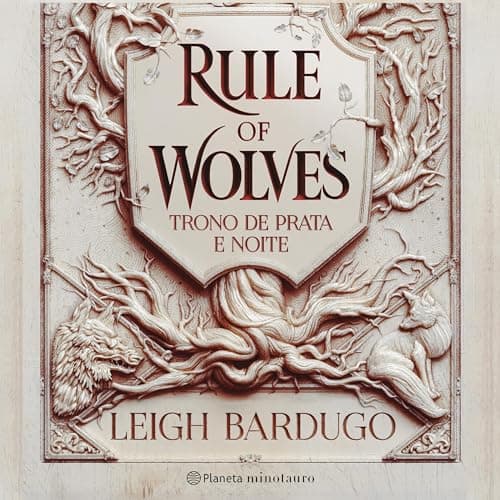

What happens when a fantasy author who built her reputation on morally gray thieves and shadow summoners tries to write a war epic? Sometimes you get something that feels like it's reaching for a scope the story can't quite hold — and sometimes you get Rule of Wolves.
I finished this one at the reference desk during a dead Sunday shift, earbuds in, pretending to catalog returns while Carla Dias narrated Nikolai Lantsov's last desperate play for Ravka's survival. My coworker asked if I was okay because apparently I'd been making faces at my screen for twenty minutes. Fair.
Three POVs Walk Into a War
Here's the thing about Bardugo's Grishaverse — she's always been better at intimate stakes than epic ones. The Six of Crows duology worked because the world was filtered through a tight crew with personal grudges and survival instincts. Rule of Wolves tries to do something different: it's a geopolitical thriller wearing fantasy armor, splitting time between Nikolai's political maneuvering, Zoya's transformation into something genuinely terrifying, and Nina's espionage arc behind enemy lines in Fjerda.
Zoya's arc is the strongest thread here, and it's not close. The closest thing I've read lately to that specific flavor of cozy-versus-terrifying tension is The House in the Cerulean Sea, which takes the opposite approach — characters choosing warmth over power — and somehow lands just as hard. Watching her wrestle with grief and power — the way Bardugo frames her choice to become a weapon rather than a general — that's the kind of character work that actually earns the word "devastating." There's a moment where Zoya confronts what she has to sacrifice to access her full power, and it lands because Bardugo spent two books building toward it. Nikolai, by contrast, sometimes feels like he's coasting on charm that worked better in smaller doses. His wit was electric in the original trilogy. Here, with a kingdom collapsing around him, the quips occasionally feel like a defense mechanism the narrative never fully interrogates.
Nina's chapters are the wildcard. Her grief-fueled revenge tour through Fjerda gives the book its darkest edges, but the pacing sags when her storyline has to sync up with the other two. You can feel the gears of the plot machine grinding when all three threads need to converge.
Carla Dias and the 21-Hour Commitment
I'll be honest — I went into a Portuguese-language audiobook with limited expectations and limited research to draw from. Specific details about Dias's performance are scarce, which means I can't speak to accent differentiation or vocal character work with the precision I'd like. What I can say is this: 21 hours and 24 minutes is a significant commitment for a single narrator, and the fact that this edition exists at all — a full Portuguese production of a Grishaverse conclusion — says something about the reach of Bardugo's world.
For Portuguese-speaking listeners who've been following the Grishaverse, the question isn't really whether to listen. It's whether you want to experience it in your language or stick with the English narration. I can't do a direct comparison, but I will say that fantasy narration in translation is its own beast — invented terminology, place names, Grisha power classifications — and getting all of that to flow naturally across 21 hours is no small feat.
Where This Stands in the Grishaverse Ranking
Look, I came to Bardugo through Six of Crows, like a lot of people. And Rule of Wolves is not Six of Crows. It doesn't have Kaz Brekker's razor-wire tension or Inej's quiet ferocity anchoring every scene. What it does have is ambition — Bardugo swinging for a conclusion that ties together threads from multiple series, juggling politics and magic systems and a romance that actually develops instead of just happening.
Does it stick the landing? Mostly. The final act delivers genuine consequences — characters make irreversible choices, alliances fracture and reform, and Bardugo resists the urge to give everyone a clean ending. But the middle third drags, particularly when Nikolai's political chess starts to feel like setup without payoff. I found myself checking the progress bar around hour 12, which is never a great sign.
The Zoya material, though. My podcast listeners are going to love this — there's a conversation to be had about how Bardugo writes women who choose power over comfort, and how that choice is never framed as uncomplicated. Shirley Jackson walked so this author could run, at least in the "women and the monstrous" department.
Who Should Listen (And Who Should Skip)
If you've read King of Scars and you're invested in how the Grishaverse wraps up, this is the payoff you've been waiting for — uneven in places, but emotionally real where it counts. Portuguese-speaking fans who want the full experience in their language have a solid option here. If you're new to Bardugo, start literally anywhere else. This book assumes you've done the homework, and it doesn't hold your hand.
Solid conclusion. Not her best work, but proof she can write endings that matter. Shirley (my cat) was unimpressed. I was satisfied. There's a difference between those things, but both are honest.