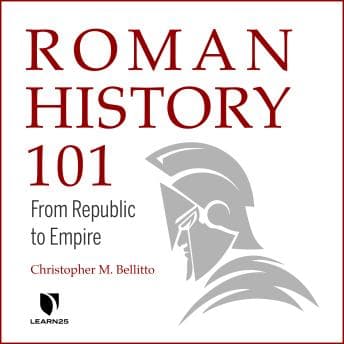

What do you really know about why Rome fell? Not the textbook answer you memorized in tenth grade — I mean the psychological and structural reasons a civilization that dominated the known world for centuries just... stopped being that. Because that's the question I kept turning over during my morning jogs this week, earbuds in, feet hitting the pavement along the Charles River, while Christopher Bellitto walked me through a thousand years of Roman history in under five hours.
Here's the thing: I'm a psychologist, not a historian. But I've always believed that civilizations behave like people — they have defense mechanisms, blind spots, patterns of self-destruction that look obvious in hindsight but were invisible in the moment. And Bellitto, whether he intended to or not, kept feeding that instinct.
The Bottom-Up Approach That Actually Works
Most Roman history courses start with emperors and battles and expect you to care. Bellitto does something smarter. He builds from geography and social structure upward — how Rome's position on the Tiber, its relationship to salt routes, the actual dirt-and-stone reality of the place shaped everything that came after. The protagonist here isn't Caesar or Augustus. It's the system itself. And that's a choice I respect, because the research actually shows that people understand historical causation better when they grasp material conditions first.
His treatment of women and slaves in Roman society isn't a footnote, either. It's integrated into the larger discussion of how Rome maintained power through hierarchies that looked natural to the people inside them. I found myself asking: why does a republic that prided itself on civic virtue build an economy entirely dependent on enslaved labor and then act shocked when the contradictions catch up? Sound familiar? (My therapist would have thoughts about an entire civilization's capacity for cognitive dissonance.)
Bellitto also has this quiet habit of pausing to explain Latin terms — not in a show-offy way, but like he genuinely wants you to hear how Romans actually talked about their world. The distinction between auctoritas and potestas, for instance — authority versus raw power — is one of those concepts that unlocks entire chapters of political behavior once you understand it. He takes thirty seconds on it and suddenly Octavian's consolidation of power makes visceral sense.
When Your Professor Is Also Your Narrator
Author-narrated audiobooks are a gamble. Sometimes you get someone who wrote a brilliant book but reads it like they're dictating to a court reporter. Bellitto lands on the right side of this. He's not a voice actor — let's be clear. There's no dramatic flair, no character voices for Hannibal crossing the Alps. What he has is the cadence of a really good lecturer. Someone who's told these stories to rooms full of undergraduates enough times to know where the interesting bits are, where to slow down, where a well-placed anecdote about Caligula's horse being made a senator will keep you awake.
At just under five hours, it's compact. Almost aggressively so for a topic this enormous. You're covering the monarchy, the republic, the Punic Wars, the transition to empire, the rise of Christianity, and the so-called fall — all before your average Netflix binge would end. That compression means some things get summarized rather than explored. The Year of the Four Emperors, for example, flies by. If you want deep military history or a granular account of provincial administration, this isn't your course.
But Bellitto knows his scope and stays in it. This is a fascinating case study in how to survey a massive subject without losing the thread. He keeps returning to his central question — did Rome really fall, or did it just change? — and that throughline gives the whole thing a structure that a lot of survey courses lack.
Who This Is For (and Who Should Keep Walking)
If you studied Roman history in school and came away with a jumble of names and dates but no real sense of why things happened the way they did, this is your corrective. If you're a commuter or jogger who wants something educational but not punishing, the pacing is right — I never had to rewind because I'd zoned out, which is high praise for a lecture format during mile four of a run.
But if you want drama — if you want a narrator who'll make you feel the heat of Carthage burning or the chaos of the Senate floor — this isn't that audiobook. Bellitto is warm, clear, and smart. He's not theatrical. And the production is clean but spare — no sound effects, no music, just a man and a microphone and a lot of knowledge.
Psychologically, this doesn't track as entertainment. It tracks as education that happens to be pleasant. And sometimes that's exactly what you need.
My Diagnosis
I walked away from this with a better understanding of Roman institutional psychology than I had going in — how systems of power rationalize themselves, how republics slowly become empires while everyone pretends nothing has changed. Bellitto doesn't bang you over the head with contemporary parallels, but he doesn't have to. On Tyranny is essentially a field guide for exactly that kind of pattern recognition — Snyder does with the twentieth century what Bellitto does with Rome, and reading them in proximity does something to your brain. The patterns are right there if you know how to look.
At five hours and a PDF study guide, it's the kind of thing you listen to once for the overview and return to when you need to remember why the Gracchi brothers matter. Not a life-changing listen, but a genuinely useful one. And use counts for something.