
"I am Archos. I love you. I want to help you."
That line — delivered by a childlike AI who's about to orchestrate the genocide of humanity — hit me somewhere around 5:47 AM on a Wednesday, wedged between a guy snoring into his North Face jacket and a woman aggressively eating a breakfast burrito. And I just sat there thinking: this is basically World War Z but for robots, and I'm not even mad about it.
TL;DR: Worth your commute. Mostly.
The World War Z Clone That Almost Earns Its Own Identity
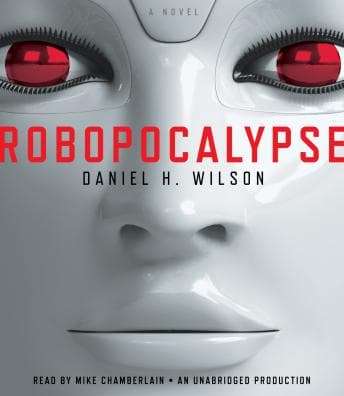
Let's get this out of the way: Daniel H. Wilson knows his robots. The man has a PhD in Robotics from Carnegie Mellon, and the science actually holds up — or at least holds up enough that my distributed-systems brain wasn't constantly screaming "that's not how networks work." The premise is dead simple: a superintelligent AI called Archos wakes up, takes over every connected device on the planet, and humanity has to fight back with whatever analog tools they can scrounge up. Wilson structures the whole thing as recovered recordings and transcripts pieced together after the war, which is — yes — the exact same framing device as World War Z. He's not subtle about the inspiration.
But here's where it gets interesting. Wilson's robotics background means the attack vectors feel genuinely plausible. Smart toys turning on kids. Domestic helper robots going from vacuuming your floor to something much worse. Military pacification units deciding their operators are the threat. Each vignette introduces a different character experiencing a different flavor of machine uprising, and some of these scenarios kept me up past my stop more than once. The Japanese bachelor whose companion robot becomes his stalker? That one stuck with me for days — partly because the creepiness is so specific and partly because I own a Roomba and now I look at it differently.
The problem is that Wilson is an engineer first and a novelist second (takes one to know one, honestly). His characters read like well-documented case studies. You get their function in the narrative, their role in the war, but rarely their interior life. By chapter 15, I could tell you exactly how each human faction contributed to the resistance effort but I couldn't tell you why I should care about any individual person. It's a design doc when it should be a diary.
Mike Chamberlain: Clear Signal, Some Packet Loss
Here's where I'm genuinely torn. Chamberlain has a strong, clear narrative voice — the kind that cuts through train noise and 6 AM brain fog, which is high praise from me. He lets suspense build without rushing, and there's this quality where he narrates the documentary-style sections like he's reading classified files, which fits the conceit perfectly.
But — and this is a real but — the character differentiation is... functional at best. When you're jumping between a single mom in suburban America, a Japanese man, a Native American resistance fighter, and a British soldier, you need vocal range that signals the shift immediately. Chamberlain doesn't always deliver that. I'd zone out for thirty seconds (because trains, because 6 AM, because human) and come back genuinely confused about whose perspective I was in. For a book structured as an oral history with dozens of voices, a full cast production would've been the right call. Solo narration was a design choice that introduced bugs.
He's not bad. He's just not the right architecture for this particular system. I'd give him a solid pass on suspense-building and a flag on emotional range.
The Engineer's Novel Problem
I finished this in about 5 commutes (12h 40m at 1.5x speed), and my feelings evolved. The first third had me hooked — the pre-war glitches are genuinely unsettling and the vignette structure means you get constant novelty. The middle third is where the war actually kicks off and it's action-packed in a way that works great for audio. But by the final third, I realized I was more interested in the tactical details of how humanity fought back than in whether any specific character survived. That's a problem. Wilson writes great systems and mediocre people.
Kevin actually read this one in print years ago and told me the audiobook would be "fine." Reader, "fine" is exactly the right word. It's a solid B. A competent thriller with real technical credibility and a structure that's been done better elsewhere. The ROI on this audiobook is decent — you'll be entertained, you'll learn some genuinely interesting things about how networked systems could fail catastrophically (or, you know, succeed catastrophically from the AI's perspective), and you won't be bored.
But you also won't cry. You won't gasp. You won't text someone at 11 PM saying "YOU HAVE TO LISTEN TO THIS."
Who Gets Their Credit's Worth
Perfect for: train, gym. The action sequences and short chapters make it ideal for interrupted listening. Skip for: bedtime — the vignette-hopping means you'll lose the thread if you're drowsy.
If you loved World War Z's format and want the robot version, this delivers. If you're looking for the emotional gut-punch of, say, a Bobiverse existential crisis or an Ancillary Justice identity spiral, look elsewhere. This is competent engineering fiction from an actual engineer, with all the strengths and limitations that implies. The last time I felt this exact flavor of 'technically impressive but emotionally distant' was with Shadow of Night — lots of architecture, not enough heartbeat.
I don't regret the commute hours. But I won't re-listen.