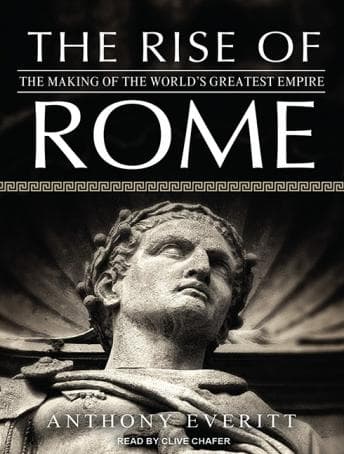

What happens when a civilization gets so good at conquering everyone else that it forgets how to govern itself?
That question kept rattling around my head somewhere on I-35 between Austin and San Antonio, fourteen hours deep into Anthony Everitt's Rise of Rome. I'd taken a client meeting in San Antonio - corporate security assessment for a logistics company - and the drive back gave me the last stretch of this one. Ranger was riding shotgun, ears perked like he was absorbing every word about the Punic Wars.
The Briefing Room Version of Eight Centuries
Let me cut to the chase: Everitt covers roughly 800 years of Roman history, from a muddy collection of hill villages to the death of the Republic, and he does it without turning it into a textbook. That's harder than it sounds. The guy wrote biographies of Cicero and Augustus, so he knows this material cold, and it shows. Where a lesser historian would've just rattled off dates and senate votes, Everitt builds the story around personalities - Cincinnatus walking away from absolute power to go back to his farm, Scipio Africanus outmaneuvering Hannibal not just on the battlefield but in the political arena afterward, Cato the Elder being the most stubborn man in the ancient world (and I've known some stubborn men).
The strategic analysis is where the author clearly did their homework. Rome's decision to offer citizenship to conquered peoples - that's not just ancient history, that's a counterinsurgency playbook. I've seen this scenario play out in real life, or at least the failed versions of it. When Everitt walks through how Rome absorbed the Italian allies, turned enemies into stakeholders, it reads like a case study you'd find at the War College. The parallels to modern nation-building aren't forced. They're just... there. Sitting on the page, waiting for you to notice.
Where the Trenches Get Muddy
Now, here's where honesty matters. Parts of this book are dry. Not Everitt's fault, really - Roman constitutional law and the specifics of patrician-plebeian political maneuvering are inherently dense material. There's a stretch in the middle where you're wading through the mechanics of tribunes and vetoes and land reform legislation, and even at 1.25x speed, my attention wandered. I caught myself thinking about my client's access control vulnerabilities instead of the Lex Hortensia. Not a great sign.
But then Everitt drops you into Hannibal crossing the Alps with elephants, or the absolute carnage at Cannae - where Rome lost somewhere around 50,000 men in a single afternoon - and you're locked back in. The pacing is uneven. Battles and political crises hit hard; the institutional scaffolding between them requires patience. If you're coming to this expecting a straight military history, you'll get frustrated. It's more like 60% political history, 40% warfare. The warfare is excellent. The politics is important but occasionally feels like sitting through a Pentagon budget briefing.
Clive Chafer Behind the Mic
Chafer's British accent is well-suited for this material - there's a natural authority to it that works for ancient history narration. Clean delivery, good pacing, professional throughout. He handles the Latin names and places without stumbling, which is more than I can say for some narrators I've suffered through. That said, it's a straightforward single-narrator read with no dramatic flair. He's not doing voices for Scipio and Hannibal - it's more like a very good lecturer than a performer. For this kind of history, that's probably the right call. You don't need theater. You need clarity. And Chafer delivers that.
Worth noting: at 14 hours and 20 minutes, this is a commitment. It's not a book you throw on during a quick grocery run. You need windshield time or dedicated listening sessions to get through it properly.
The Parallel That Kept Me Up
What stuck with me most - and this is the part I was still chewing on at 11 PM with a bourbon - is Everitt's argument about constitutional erosion. Rome didn't fall because barbarians showed up one day. The Republic died because its own success made its citizens impatient with the slow, messy business of compromise and governance. Political violence became normalized. Strongmen started looking attractive. Institutions that had held for centuries got treated as inconveniences.
I'm not going to draw the obvious modern parallels. You're adults. You can see them. That same sense of institutions failing the people they're supposed to serve hit me hard in Behind the Beautiful Forevers, though the setting couldn't be more different - modern Mumbai instead of ancient Rome, but the structural rot feels uncomfortably familiar.
Mission Debrief
Worth your time? Here's the debrief: if you want to understand how Rome became Rome - not the glamorous imperial version but the scrappy, strategic, sometimes brutal Republic that built the foundation - this delivers. It's not perfect. The dry patches are real. But the strategic insights and the character portraits of men like Scipio and Cato are genuinely valuable, and Chafer's narration is reliably solid throughout.
If you need explosions every chapter, look elsewhere. If you've got the patience for a slow build with serious payoff, and you care about why civilizations rise and fall - Ranger approved this one. So do I.







![Steve Jobs [unabridged audiobook] audiobook cover](/_next/image?url=https%3A%2F%2Fcovers.audiobooks.com%2Fimages%2Fcovers%2Ffull%2F9788499923406.jpg&w=1920&q=75)