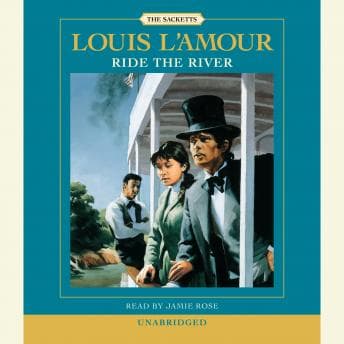

When's the last time you picked up a Western and the hero was a sixteen-year-old girl from the Tennessee mountains? Not a love interest. Not a damsel. The actual protagonist, carrying a rifle and an inheritance claim into a city that wants to eat her alive.
That's Echo Sackett, and she's the reason this slim little L'Amour novel—barely five hours—sticks in your head longer than it probably should.
A Girl With a Long Rifle and a Longer Memory
Louis L'Amour built the Sackett family saga across dozens of books, and most of them follow men who are tough, quiet, and handy with a gun. You know the type. Ride the River breaks that mold by handing the story to Echo, a mountain girl who treks to Philadelphia to claim family money and immediately runs into a crooked lawyer who assumes she's easy prey. She is not. L'Amour was never a prose stylist in the Faulkner sense—nobody's spending three pages on a single sentence here—but he had a gift for clean, direct storytelling, and Echo's voice carries real personality. She's resourceful without being a caricature, young without being naive, and genuinely dangerous in the backcountry while genuinely vulnerable in the city. One listener called her "nine kinds of awesome with extra kick-ass on top," and honestly? That's about right.
The plot is straightforward: girl gets money, bad men want money, girl must survive the ride home. L'Amour doesn't complicate things unnecessarily. At five hours, he doesn't have time to. And that's both the strength and the limitation. The pacing clips along nicely in the middle chapters when Echo's on the trail being pursued, but the setup in Philadelphia feels rushed, and the resolution comes fast enough that you almost miss it. This isn't L'Amour's deepest work. It reads more like a long campfire story than a novel—which, for a podcast guy who spends too much time analyzing symbolism in Middlemarch, was honestly kind of refreshing.
I was listening during a Sunday walk along the lakefront with Denise, and she actually pulled out an earbud and asked what I was smiling about. Something about Echo telling off a city man who underestimated her. L'Amour wrote this in 1983, and it feels like he was quietly arguing that the frontier made women just as hard as men—he just didn't make a big speech about it. He let Echo demonstrate.
Jamie Rose and the Narration Problem Nobody Can Agree On
Here's where things get complicated. Jamie Rose has a pleasant voice—warm, clear, the kind of voice that would read you a bedtime story and you'd feel safe. But "pleasant" and "engaging" aren't the same thing, and this is a book that needs grit. Echo Sackett grew up in the mountains. She's sharp, wary, a little wild. Rose's delivery is... steady. Maybe too steady. There are moments where the tension should tighten—Echo being followed through unfamiliar streets, a confrontation on the trail—and the narration stays at the same even keel.
The narrator understands that pause is punctuation, and Rose does use silence well in spots. But differentiation between characters? I couldn't detect much. The crooked lawyer and the mountain men and Echo herself all come through in roughly the same register. For a book that's essentially a chase story, I wanted more urgency in the dangerous moments and more softness in the quiet ones.
And then there's the audio quality issue. Multiple listeners have mentioned a faint distortion—a flutter or tape wobble—running through the recording. I noticed it too, mostly in the first hour, like listening through a window screen. It's not deal-breaking, but it's there, and for a production you're paying for, it shouldn't be.
Some folks loved Rose's narration. Some felt it actively hurt the experience. I land somewhere in the middle: competent, occasionally warm, but not the performance this particular character deserved. Echo Sackett needs a narrator who can shift from mountain dialect to city wariness to trail-hardened steel. Rose gives you one mode.
Who This Trail Is Meant For
If you're working through the Sackett series, this is a welcome change of pace—a different lens on the same family mythology. If you loved L'Amour's Hondo or The Daybreakers, this is its spiritual successor in terms of clean frontier storytelling, just with a female lead who earns every mile of her journey.
My students would hate this. Too short, too "old-fashioned," not enough moral complexity for their AP essays. But sometimes a story doesn't need to be complicated to be good. Sometimes it just needs a sixteen-year-old girl with a rifle who refuses to be cheated.
Skip this if you need deep character psychology or layered prose. Come to it if you want a quick, satisfying ride—emphasis on quick—and you're willing to forgive a narration that doesn't quite match the fire of its protagonist. I had a similar experience with Undomestic Goddess—another slim, breezy story where the protagonist's resourcefulness carries you through faster than you expect, and you close it feeling better than the word count probably warranted.
The Grade I'd Write in the Margin
A solid B-minus. The story earns its keep. Echo Sackett is genuinely memorable—one of L'Amour's best characters in one of his slighter books. The narration and audio quality knock it down a notch from what it could've been. At five hours, the commitment is low and the payoff is real, but I'd say catch this one on sale or through your library app rather than spend a full credit. The prose deserves to be savored, even if this particular recording doesn't always let you.