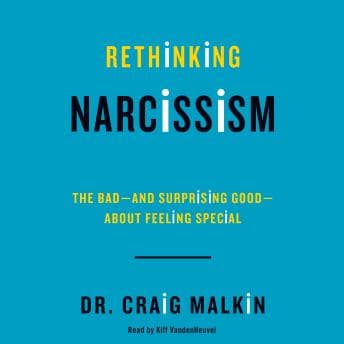

I was stress-cooking dal makhani at 10 PM—the kind of elaborate session where you're definitely avoiding grading student papers—when Malkin dropped a line that made me stop stirring. He was talking about "echoists," people so terrified of appearing narcissistic that they've essentially erased themselves. I stood there, wooden spoon suspended, thinking about three former therapy clients who suddenly made so much more sense. That same feeling of sudden clarity hit me reading Matilda—watching a child psychologically dissect the adults around her with terrifying accuracy.
This is a fascinating case study in how we've collectively butchered a clinical term. Malkin argues—convincingly—that we've turned "narcissist" into a meaningless insult while missing the actual psychology entirely. The research shows that some narcissism is healthy. Necessary, even. The protagonist of your own life should feel somewhat special, or you end up an echoist, apologizing for existing.
The Spectrum Nobody Talks About
What makes this book compelling is Malkin's narcissism spectrum model. Zero to ten. Echoists at the bottom, pathological narcissists at the top, and healthy self-regard somewhere in the middle. It's elegant. It's clinically useful. And it explains why your ex who posted too many selfies probably isn't the same category as your boss who genuinely cannot process that other humans have feelings.
My therapist would have thoughts about this framework—specifically, she'd probably appreciate that it gives people language for their experiences without the diagnostic creep that happens when everyone becomes an armchair psychiatrist. Malkin distinguishes between garden-variety self-absorption and the kind of narcissism that actually destroys relationships. The difference matters.
The SOS method he introduces (Spot the feeling, Own the feeling, Share the feeling) sounds deceptively simple. Psychologically, though, it tracks. It's essentially forcing narcissistic individuals into the vulnerability they've been avoiding. Whether they'll actually do it is another question entirely, but at least the framework is sound.
VandenHeuvel Does the Heavy Lifting
Why does psychology audiobook narration so often feel like being lectured by a disappointed professor? VandenHeuvel avoids this trap entirely. His delivery is warm without being condescending—he sounds like a clinician explaining something to a colleague, not a TED Talk speaker performing concern for an audience.
The pacing works for the content. At six hours, this isn't a commitment that requires rearranging your life. I finished it across three cooking sessions and one particularly long morning jog through Cambridge. The concepts are dense enough that you want focused listening, but VandenHeuvel's clarity means you won't need to rewind constantly.
Where Malkin Gets It Right (And Where He Hedges)
The section on raising healthy narcissism in children is genuinely useful. Not the vague "praise effort, not results" advice you've heard a thousand times, but specific interventions grounded in attachment research. Malkin understands how parents inadvertently create echoists by punishing any display of self-regard.
But here's my issue. Malkin occasionally softens his claims in ways that feel more diplomatic than scientific. He's careful not to pathologize anyone too definitively, which I understand from a clinical ethics standpoint. But sometimes you want the psychologist to just say: yes, that person is a problem, and here's exactly why. The research supports stronger conclusions than he sometimes draws.
The millennial bashing that opens the book also feels dated now. (Written in 2015, so fair enough.) The "most narcissistic generation" framing has been pretty thoroughly debunked, and Malkin himself seems skeptical of it, so I'm not sure why it's the hook.
Who This Is For (And Who'll Be Frustrated)
If you've been throwing around "narcissist" to describe everyone from your mother-in-law to your coworker who talks too much in meetings, this book will recalibrate your understanding. Mental health professionals will find the spectrum model clinically useful in ways that the DSM criteria aren't. But if you're looking for a takedown of narcissists or validation that your ex was definitely a terrible person, you'll be frustrated. Malkin is more interested in nuance than vindication. (My therapist would say that's healthy. She's probably right.) The audiobook format works well—VandenHeuvel keeps the clinical content accessible without dumbing it down—but if you want to reference the assessment tools Malkin includes, keep the print version handy.
A Framework Worth Simmering On
I went into this expecting another pop-psychology book capitalizing on our cultural obsession with labeling difficult people. What I got was a genuinely useful clinical framework that's changed how I think about self-regard—in my research, in my own life, in the characters I analyze.
The dal makhani, by the way, turned out perfectly. Sometimes you need something simmering in the background while your brain processes new information. This book was worth the focused attention.