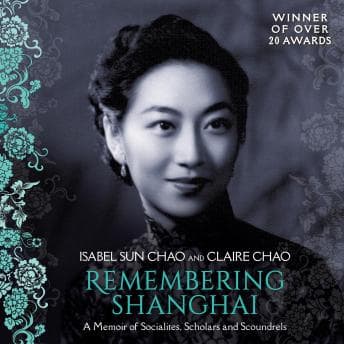

There's a moment early in this audiobook where Isabel describes the silk dresses her mother wore to Shanghai's grand parties, and I had to stop grading papers because I could see them. Not imagine them—see them. That's when I knew this wasn't going to be background listening.
Look, I've taught enough memoir excerpts to know when a family story transcends the personal and becomes something larger. Remembering Shanghai does that thing I'm always trying to explain to my students about how the best history isn't written by historians—it's lived by the people who survived it.
When Personal Memory Becomes History
The structure here is ambitious. Five generations of the Sun family, starting from a position granted by the Empress Dowager herself, winding through glamorous 1930s Shanghai, Japanese occupation, Mao's rise, the Cultural Revolution, and eventually to Hong Kong. That's a lot of ground. And honestly? There are moments where the narrative shifts from Isabel's vivid personal memories into broader historical context, and you can feel the gear change.
But here's the thing—I didn't mind it. (Don't tell my students I said this, but sometimes the digressions ARE the point.) The historical sections give weight to the personal ones. When Isabel leaves Shanghai at 18, not knowing she'll never see her father again, that moment hits harder because you understand what's coming for China. You understand what she's escaping and what she's losing.
The book earns its subtitle. Socialites? Check. Scholars? Absolutely. Scoundrels? Oh, there are concubines and kidnappers and underworld crime bosses woven through this family tree. It reads like a novel, except it's real, which makes it better.
Three Voices, One Living Room
Rachel Yong does the heavy lifting here, and she's remarkable. Over 60 distinct character voices across multiple generations. That's not just range—that's architecture. She builds each person from the ground up, and you can hear the difference between a 1930s Shanghai socialite and a Cultural Revolution survivor. The texture changes.
But what makes this audiobook special is that Isabel and Claire Chao—the actual authors, mother and daughter—also narrate portions. There's something about hearing Isabel tell her own story, in her own voice, that no professional narrator could replicate. It's intimate in a way that feels almost intrusive, like you're sitting in someone's living room while they show you old photographs.
The production is clean, professional. No weird audio jumps between narrators. The transitions feel natural, which is harder to pull off than it sounds.
The Slow Burn That Rewards Patience
I'll be honest—this isn't a page-turner in the thriller sense. It's eight hours of careful, layered storytelling. Some listeners might find the pacing uneven when the narrative moves from Isabel's personal experiences into ancestral history or broader Chinese political context. I get that. I had a similar experience with Titanic—the historical digressions slow things down, but they're what make the personal stories land.
I listen at 1.0x because the author chose those words, and Claire and Isabel Chao chose them carefully. The prose deserves to be savored. There's a reason this thing won 29 book awards, including the Rubery Award Book of the Year and the Writer's Digest Grand Prize. That's not marketing—that's recognition of craft.
The book's website suggests listening alongside the illustrated print version, which includes 160 historical images and family photographs. I didn't do that, but I understand the impulse. This is a story that wants to be seen as much as heard.
Who This Is (and Isn't) For
If you loved Wild Swans or The Joy Luck Club, this is their spiritual successor—a multigenerational Chinese family saga that doesn't flinch from the hard parts but also doesn't wallow in them. It's harrowing and heartwarming, sometimes in the same chapter. This is for commuters who want something substantial. For history lovers who prefer their history personal. For anyone who's ever wondered what their grandparents didn't tell them about where they came from.
Skip it if you need constant plot momentum. If historical context feels like an interruption rather than enrichment. If you're looking for something light.
What Gets Passed Down
I finished this walking the lakefront with Denise, and we ended up talking about her grandmother's stories from Korea, and what gets passed down and what gets lost. That's what good memoir does—it makes you think about your own history.
My students would probably say this is too slow. They'd be wrong. Some stories need time to breathe.