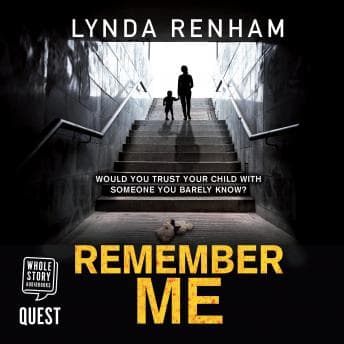

The neighbor-from-hell thriller is one of those subgenres that should work every single time. The setup is primal - someone invades your space, your routines, your family - and yet so many books fumble it by making the threat obvious from page one. Remember Me doesn't entirely escape that trap, but it does something interesting with the slow suffocation of Clare's credibility that kept me listening well past when I should've been asleep.
I was shelving returns at the library on a quiet Tuesday afternoon, earbuds in, when the first real shift happened - the moment Sharni stops being helpful and starts being present in a way that makes your skin crawl. Not because she does anything overtly wrong, but because the kindness becomes a cage. Rosie Akerman's narration nails that transition. She gives Sharni this warm, slightly too-eager quality in the early chapters that gradually curdles into something possessive. It's not a dramatic shift. It's incremental. And that's what makes it effective.
The Gaslighting is the Monster
Look, I grew up in a household where control wore the mask of concern. "We're doing this because we love you." So when Sharni starts positioning herself as indispensable - always there for Ben, always anticipating Clare's needs, always one step ahead - I felt that in my chest. This understands that horror isn't about gore - it's about dread. The dread of not being believed. The dread of watching someone dismantle your life while everyone around you thinks they're wonderful. Black and Endless Sky chases that same psychological suffocation, though it routes the dread through something more overtly supernatural - worth a listen if the slow unraveling here is what's working for you.
Renham builds the isolation methodically. Clare's husband Chris gets pulled into Sharni's orbit. The other neighbors think Sharni's a saint. And Clare - who we're listening to unravel in real time - starts questioning herself. There's a stretch around the midpoint where every interaction Clare has feels like she's speaking a different language than everyone else, and Akerman plays that confusion with a brittle edge that really landed. Clare's voice gets tighter, more clipped, while Sharni stays smooth and accommodating. The contrast does a lot of heavy lifting.
Where it stumbles: the red herrings. There are a lot of them. And some feel less like misdirection and more like the plot buying time. A couple of the twists you can see coming if you've consumed any amount of domestic suspense - I called one major reveal about four chapters early, and I wasn't even trying. But the final twist? Didn't see it. Genuinely didn't. And at 7 hours and 30 minutes, the pacing is tight enough that the weaker misdirections don't have time to really drag.
Akerman Commits - and That's Rare
Here's my issue with a lot of thriller narration: performers play the anxiety at a constant simmer from minute one, which means there's nowhere to go when things actually escalate. Akerman doesn't do that. She starts warm. Domestic. Almost cozy. The early chapters sound like a women's fiction audiobook, which is exactly the right call because it mirrors Clare's sense of security before everything cracks.
The narrator commits. That's rare. She doesn't oversell the creepy moments - she trusts the text to do its work and just... inhabits the growing unease. Her Sharni is particularly good. There's this quality to the voice - bright, helpful, just slightly too attentive - that reminded me of the best "friendly villain" performances. Not mustache-twirling. Just a person who's decided your life belongs to them.
I do wish Akerman differentiated the male characters a bit more. Chris and Tom blurred together vocally in a few dialogue-heavy scenes, and I had to rewind once to figure out who was speaking. Minor complaint for an otherwise solid performance, but worth noting.
Who Needs This (and Who Doesn't)
If you're deep into the domestic suspense genre - The Girl on the Train, Behind Closed Doors, that whole wave - this is comfort food. Good comfort food. Well-seasoned, satisfying, not trying to reinvent the recipe. If you scare easily, skip. If you don't, you need this - not because it's terrifying in a supernatural sense, but because the psychological ratcheting is genuinely uncomfortable.
If you need your thrillers to surprise you every thirty minutes, the middle section might test your patience. But stick with it. The ending earns its keep.
Skip if: you've hit domestic thriller fatigue and need something that breaks the formula wide open. This plays within the lines. It just plays well.
Lights Stay On for This One
I listened to the last two hours in bed with Shirley (my cat) pinning my arm down, and I'll say this: it's not the kind of horror that makes you check the locks. It's the kind that makes you side-eye your neighbor the next morning. Renham understands that the scariest thing isn't a stranger in your house - it's a friend who won't leave. My podcast listeners are going to love this, especially the ones who've been asking me to cover more psychological horror that doesn't rely on body counts. This is that. Quiet menace done right.