
"Social nourishment is as essential as actual nourishment."
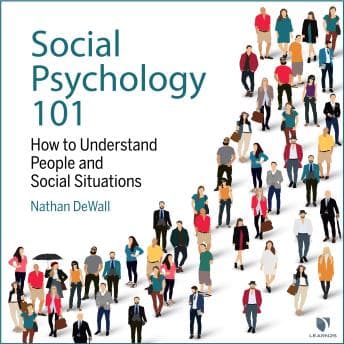
That line hit me somewhere around hour three, while I was sautéing onions for a chana masala I'd eat alone at my kitchen table. And look — I'm a person who genuinely enjoys eating alone. But DeWall's argument isn't about loneliness as a lifestyle failure. It's about what happens inside your body, at the hormonal and immunological level, when your social connections are starved. That reframing? That's the kind of thing that makes me stop stirring and just stand there in my kitchen, spatula in hand, recalibrating.
When Your Psych Textbook Author Becomes Your Narrator
So here's the thing about Nathan DeWall narrating his own material: it's a mixed bag, and I want to be honest about that. He's clear. He's knowledgeable — obviously, the man co-writes the world's best-selling psych textbooks with David Myers. His pacing is solid, and he uses pauses well, giving you a beat to absorb a finding before moving on. But when he gets into the weeds of data — effect sizes, longitudinal study parameters — his delivery flattens. It's not bad, exactly. It's just... professorial in the way that reminds you of that 2 PM lecture slot where the room was always a little too warm.
I've sat through hundreds of those lectures. I've given some of those lectures. So I'm sympathetic. But the audiobook format demands something slightly different than a lecture hall, and DeWall doesn't always make that adjustment. When he's walking through a case study — like the research on how relationships literally alter gene expression — he's genuinely engaging. When he's reading off methodology, my attention drifted to whether my onions were burning. (They weren't. Barely.)
The Science That Actually Made Me Rethink Things
What makes this course valuable — and it IS valuable — is that DeWall treats relationship science the way I wish more pop psychology would: as real science with real mechanisms. This isn't "love languages" dressed up in lab coats. He walks through evolutionary psychology's explanation for why we're wired for connection, then moves into the physiological evidence. Relationships affecting your immune system. Your hormones. Your brain functioning.
The research actually shows — and DeWall lays this out clearly — that the quality of your close relationships is a better predictor of health outcomes than smoking, exercise, or diet. That same hierarchy of what actually keeps us healthy — with the soft-sounding stuff outranking the measurable stuff — is something Gary Taubes circles from a completely different angle in Why We Get Fat: And What to Do About It, and I had the same reaction reading him: why did it take science this long to say the obvious out loud. I found myself asking: why does mainstream self-help still treat relationships as soft science when the data is this robust? DeWall makes that case compellingly.
I also appreciated the myth-busting sections. The "never argue" myth gets dismantled not with platitudes but with evidence about effective conflict strategies. This is a fascinating case study in how folk wisdom about relationships often contradicts what controlled studies reveal. My therapist would have thoughts about this — specifically, she'd probably say "I've been telling you this for two years, Priya."
The third section on online relationships and social networks feels thinner, though. It's clearly the most time-sensitive material — research on digital relationships ages fast — and at just over six hours total, there wasn't enough room to go deep. DeWall touches on how social networks shape health behaviors, which is genuinely interesting territory, but it felt like a survey when I wanted a deep dive.
Where the Psychology Doesn't Quite Track
Here's my professional gripe. The course is tagged under "Religion & Spirituality" as well as "Self-Help," which is... puzzling? There's nothing overtly religious here from what I could tell. It's empirical psychology. The categorization might set wrong expectations for listeners coming from either direction.
And while DeWall's case studies are engaging, I wanted more complexity in the character portraits. He references couples, individuals, research subjects — but they tend to serve as illustrations rather than fully drawn psychological profiles. As someone who analyzes fictional characters like case studies, I suppose I hold real-world case studies to the same standard. Give me the contradictions. Give me the person who knows the research and still self-sabotages. That's where the interesting psychology lives.
The 2.5 average rating I've seen floating around feels harsh but not inexplicable. This is a lecture course, not a narrative audiobook. If you come in expecting storytelling, you'll be disappointed. If you come in expecting a well-organized psych course with practical takeaways — which is what it is — you'll get your money's worth.
Who Gets the Most From This
If you're a psychology nerd who wants relationship science without the Instagram-therapy oversimplification, this works. If you're in a helping profession — therapy, counseling, social work — it's a decent refresher on the empirical foundations. Commuters, this is ideal for your drive; the lecture format maps well to highway miles.
Skip it if you need high-energy narration to stay engaged, or if data-heavy stretches make you zone out. And maybe don't start with this if you've never encountered relationship psychology before — it assumes a certain comfort with research terminology.
My Clinical Assessment
The protagonist here — DeWall himself, essentially performing as both lecturer and narrator — exhibits classic academic passion constrained by format. He clearly loves this material. The science is solid, the practical advice is grounded, and the argument that social connection is a biological necessity rather than an emotional luxury is one I wish more people heard. But the delivery needed about 15% more warmth and 15% less data recitation to really land as an audiobook experience rather than a recorded course.
I finished it. I learned things. I thought about my own relationships differently — specifically, about the ones I tell myself I don't need while my cortisol levels quietly disagree. That's worth something. Just maybe not a full credit. Find Your People: Building Deep Community in a Lonely World covers adjacent territory and leans harder into the practical application side — less mechanism, more blueprint, which depending on your personality might actually be the better starting point before you come back to DeWall's empirical foundation.