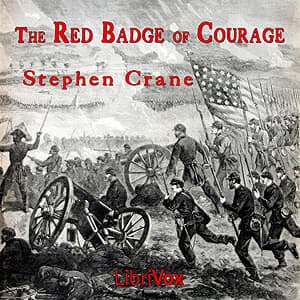

Most people think they know this book. They don't.
I say that because I've taught The Red Badge of Courage maybe fifteen times, and every September I watch a new batch of juniors reduce it to "boy goes to war, gets scared, gets brave." Which is like saying Moby-Dick is about fishing. And I'll be honest - after years of dissecting Henry Fleming's cowardice on worksheets and marking up passages with red pen, I'd started to reduce it myself. The book had become furniture in my brain. Familiar, functional, invisible.
Then I listened to Mike Vendetti read it while Denise and I walked the lakefront last Sunday, wind coming hard off the water, November-gray sky pressing down on everything, and something cracked open. I heard this book like I was eighteen again.
A Purple Heart Reading About Running Away
Here's what makes this particular production worth your attention, and it's the thing most reviews will bury as a footnote: Mike Vendetti is a Purple Heart recipient, Vietnam, November 1965. He's not an actor playing at war. He's a man who has been under fire reading about a boy who runs from it.
That changes everything. Not in flashy ways - Vendetti doesn't do theatrical voices or dramatic crescendos. His style is conversational, almost flat at times, the way someone tells you about something that actually happened to them versus the way someone performs a story. When Henry Fleming throws down his rifle and bolts from the line, there's no judgment in Vendetti's voice. No winking at the audience. Just a kind of patient understanding that, yeah, this is what happens to people. The prose deserves to be savored, and Vendetti treats it that way - not like a performance piece but like a confession he's helping someone get through.
Now, does that conversational quality sometimes work against Crane's more purple passages? A little. Crane wrote sentences that practically vibrate - "The red sun was pasted in the sky like a wafer" - and Vendetti reads them with the same steady cadence he gives the action sequences. If you want a narrator who'll ride the rhythm of Crane's impressionistic prose the way, say, Frank Muller used to ride Cormac McCarthy's sentences, this isn't that. But I'd argue the restraint is the point. The narrator understands that pause is punctuation - and sometimes the absence of drama is the drama.
Crane Never Heard a Shot Fired, and That's the Whole Point
This reminds me of what Hemingway said about prose being architecture, not interior decoration. Crane was twenty-three when he published this. Twenty-three. Never served. Never saw combat. Wrote the most psychologically honest war novel of the nineteenth century by reading Battles and Leaders of the Civil War and watching football games for the physical chaos.
Listening to it instead of reading it - and at 1.0x, because I choose to hear words properly, thank you - strips away the academic scaffolding I've built around this text over two decades. You notice things. Like how Crane almost never uses Henry's name in the early chapters, just "the youth," and how that anonymity feels different when you hear it spoken aloud fifty times. He's not a person yet. He's anyone. He's every kid who ever enlisted because he thought war was something that happened in paintings.
And the wound - the famous red badge itself. My students always want it to be ironic, and sure, it is. Henry gets clocked by a retreating Union soldier, not shot by the enemy. But hearing the passage where he rejoins his regiment, hearing the relief and shame tangled together in Crane's language, I caught something I'd missed: Crane isn't mocking Henry. He's showing you that courage and fraud aren't opposites. They're roommates.
At four hours and forty-six minutes, this is a focused listen - not a background-while-grading situation. Crane's sentences demand attention; they're short but dense, built like fists.
Who Gets the Most Out of This
If you loved All Quiet on the Western Front, this is its spiritual ancestor - same raw interiority, same refusal to make war noble. I'll admit the genre gap is real, but Miss Peregrine's Home for Peculiar Children is another one where the audiobook cracked something open for me that years of just reading the text had sealed shut. If you're a teacher looking for a way back into a text you've over-taught, the audio format is genuinely revelatory. If you want a narrator who performs accents and does distinct character voices for every soldier in the regiment, look elsewhere.
My students would hate this. I love it.
But I'll say this: Vendetti's Purple Heart in the liner notes isn't a gimmick. It's context. It's the difference between reading sheet music and hearing someone play who knows what the notes cost. Worth pausing the faculty meeting for - and I say that about very few things under five hours.