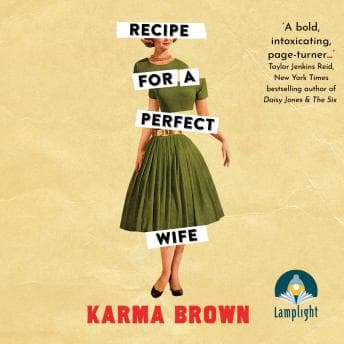

Everyone kept telling me this was a domestic thriller with recipes. And look, that's technically true in the way that Madame Bovary is technically about a bored housewife. But what Karma Brown is actually doing here is something sneakier — she's writing a parallel essay about the performance of wifehood across sixty years, and using a vintage cookbook as the connective tissue. I was not expecting to get this worked up during a faculty meeting. (Sorry, Principal Martinez. Again.)
I picked this one up because Denise had been reading it in print and kept leaving it face-down on the kitchen counter with this look on her face like she wanted to argue with someone. That's usually my cue. So I loaded the audiobook and took it on a Sunday lakefront walk, and by the time I hit North Avenue Beach I was so locked into Nellie Murdoch's 1955 storyline that I nearly walked into a cyclist.
The Cookbook as Confession
Here's what Brown does well: the dual narrative isn't just a gimmick. Alice, our modern protagonist, discovers Nellie's cookbook in the basement of her new suburban home and starts cooking from it — but Nellie has left annotations, clues, little marginalia breadcrumbs that reveal a marriage far darker than the Jell-O molds and Baked Alaska suggest. This reminds me of what Hemingway said about the iceberg theory — what's beneath the surface does all the heavy lifting. Nellie's recipes become coded language, a woman's only available vocabulary for rebellion when her actual voice has been systematically silenced.
The contrast between Alice's timeline and Nellie's is where the book earns its keep. Alice has left a career in advertising to "become a writer" and follow her husband Nate to the suburbs, and Brown is sharp enough to show that Alice's cage, while gilded differently than Nellie's, is still a cage. The question the book keeps circling — how much has really changed? — isn't subtle, but it doesn't need to be. Sometimes the obvious question is the one nobody wants to sit with.
Now, fair warning: the male characters in this book are drawn in pretty broad strokes. Nellie's husband Richard is controlling in ways that escalate from patronizing to genuinely dangerous, and Nate — Alice's husband — has a particular brand of progressive-sounding paternalism that might actually be more infuriating because he thinks he's one of the good ones. Some listeners bounce off this. I get it. But I teach The Yellow Wallpaper every year to juniors who think it's "too extreme," and then three of them come back senior year and say it was the most important thing they read. Brown isn't writing a balanced portrait of marriage. She's writing about power. That's a different project. She's Come Undone does something similar — it's not interested in fairness either, just in the full, uncomfortable weight of what women absorb across a lifetime, and I had the same unsettled feeling finishing both.
Two Narrators, Two Marriages, One Uncomfortable Mirror
The dual narration is what makes this worth the audio format. Mozhan Marnò handles Nellie's chapters, and she gets exactly the right register — there's a controlled loneliness in her delivery, a woman speaking carefully even in her own internal monologue, as if someone might overhear her thoughts. The prose deserves to be savored in those sections, and Marnò trusts the silences. The narrator understands that pause is punctuation.
Jorjeana Marie takes Alice's chapters, and here's where it gets interesting — some listeners find her delivery a bit cloying, and honestly? I think that's the point. Alice is performing a version of herself she doesn't fully believe in yet. She's playing at domesticity the way my students play at having done the reading. Marie's slightly saccharine tone captures a woman who hasn't figured out her own voice, and as Alice's arc darkens, Marie adjusts. It's a subtle shift. Whether Brown and the production team intended that symbiosis between character and performance, I don't know, but it works.
The production itself is clean — no music, no sound effects, just two women trading chapters across decades. At just under ten hours, it moves. The Alice sections occasionally drag in the middle when she's figuring out suburban social dynamics that feel a little familiar if you've read any contemporary domestic fiction, but Nellie's chapters keep pulling you forward like a thread being yanked from a hem.
Who This Is Really For
If you loved The Yellow Wallpaper and wished someone would expand it into a full novel with a modern counterpart, this is its spiritual successor — in spirit if not in style. Book clubs will eat this alive, and I mean that as a compliment. There's enough ambiguity in the ending to fuel a real argument. My students would hate this. I love it.
But if you need sympathetic male characters or prefer your feminist themes delivered with more subtlety, you might find yourself frustrated by the third hour. That's a legitimate critique. Brown isn't interested in balance here — she's interested in excavation.
Listen at 1.0x. The recipe interludes between chapters have a rhythm that rewards patience, and Marnò's Nellie sections especially lose something if you speed past them.
The Margin Notes We Leave Behind
I finished this one at 11 PM, grading papers I should've been paying more attention to, thinking about all the cookbooks on our kitchen shelf that Denise inherited from her grandmother. What did those women write between the lines that we never learned to read? Brown doesn't quite stick the landing — the final act wraps things up a little too neatly for a book that spent eight hours insisting nothing is neat — but the question it plants stays with you. That's enough. That's why we still read the classics, and why books like this one keep rewriting them.