
What does it actually cost to keep a marriage alive for 27 years?
I was asking myself that question at midnight, half-watching Jenny fold laundry while this played through my AirPods. She caught me nodding along and said, "You're listening to a relationship book voluntarily?" I told her it was research. She didn't buy it. She was right not to.
Two Teenagers From Queens vs. My Parents' Dry Cleaning Counter
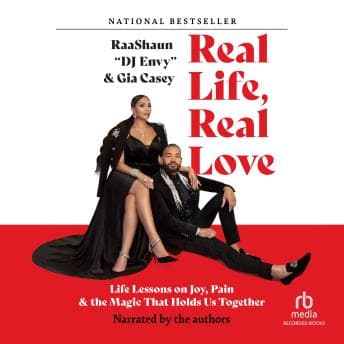
Here's what got me: Gia and Raashaun Casey met in high school, built something real, and then had to figure out how to keep it real when fame, money, and six kids entered the equation. And I kept hearing echoes of my parents' story - not the fame part, obviously, but the raw mechanics of two people grinding together through decades of change. My parents never had a podcast to hash out their problems. They had the back room of a dry cleaning shop in Koreatown and a lot of silence. The Caseys chose radical transparency instead, and honestly? Both approaches survived. That's the part business books about "partnerships" never capture - there's no single framework. There's just showing up.
The back-and-forth narration is what makes this audiobook specifically worth the audio format over print. Gia tells her side of a moment, then Raashaun jumps in with his version, and the gap between their memories is where all the real insight lives. When they get into the cheating scandal - which went very public, very ugly - you can hear the weight in Raashaun's voice shift. It's not performative guilt. It's the sound of a man who knows he almost lost everything and still can't fully explain why he risked it. Gia's sections during that stretch are quieter, more measured, almost clinical. The contrast tells you more about how couples process betrayal than any therapist's framework could.
The Self-Help Tax (And Whether It's Worth Paying)
Let me be direct. This is 8 hours and 26 minutes. The actual relationship insights - the stuff you'd screenshot if this were a slide deck - probably fill about 3 hours. The rest is chronological storytelling, childhood context, career milestones. Not bad content, just not the actionable stuff. This is what my parents did instinctively. Now it has a TED talk.
But here's where I'll push back on my own cynicism: the storytelling sections aren't filler in the traditional sense. They're context. When Gia talks about colorism and how it shaped her self-image before she even met Raashaun, that's not padding - that's the foundation for understanding why certain fights in their marriage hit differently. When Raashaun describes the pressure of becoming DJ Envy while still being the kid from Queens, you get why the celebrity lifestyle became a trap rather than a reward. That same tension between identity and success drives Gambler: Secrets from a Life at Risk — another audiobook where you hear the cost of high-stakes living in every word.
The mental health discussions surprised me. I expected surface-level "we went to therapy" stuff. What I got was more specific - the actual mechanics of two people who process emotions at completely different speeds trying to occupy the same emotional space. Gia is analytical. Raashaun is reactive. That dynamic plays out in the narration itself, and it's the most honest part of the book.
Who This Is (And Isn't) For
If you're looking for a step-by-step relationship repair manual, skip this. There are better clinical resources. If you want a real couple walking you through 27 years of figuring it out in real time - with real screw-ups, not hypothetical ones - this delivers.
I'll say this: I've sat across boardroom tables from CEOs who couldn't be this honest about a failed product launch, let alone a failed moment in their marriage. The vulnerability here is genuine, not curated for Instagram. You can hear it in the pauses. Jenny would say I'm being harsh when I say most celebrity memoirs are brand extensions disguised as books. Jenny is right. But this one actually earns its runtime - mostly.
At 2.0x, it moved well. No dead air, no over-produced transitions. Just two people talking like they're sitting across from you at a kitchen table.
The ROI on Honesty
Bottom line: This isn't a business book, but it taught me more about partnership dynamics than half the leadership titles in my Audible library. The Caseys didn't build a 27-year marriage by optimizing. They built it by being willing to look stupid, get hurt, and come back to the table anyway. My parents would recognize that. They just wouldn't have talked about it on a podcast.
Worth a credit if you're in a long-term relationship and tired of advice books written by people who've never actually been tested. Skip it if you want frameworks and bullet points. This is a story, not a system - and sometimes that's exactly what you need.