
"One of the hardest things to do is to put steam in a box."
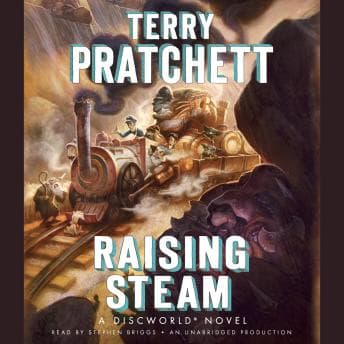
That line hit me at like 2 AM while I was pretending to debug a procedural terrain generator that's been broken since October. I had Raising Steam playing through my desk speakers, my apartment dark except for the monitor glow and the blinking LED on my router, and I just... stopped typing. Because Pratchett wasn't just talking about steam engines. He was talking about progress itself, about trying to contain something that fundamentally doesn't want to be contained. And that's basically the thesis of this entire book - which, unlike MY thesis, actually gets finished.
Moist von Lipwig Gets a Train and I Get Another Excuse Not to Write
So here's the setup: Dick Simnel, a young engineer from the Sto Plains, builds the Disc's first steam locomotive. Lord Vetinari, being Vetinari, immediately sees the political and economic potential and does what he always does - he hands the impossible job to Moist von Lipwig, the reformed con man who already rescued the post office and the banking system. Moist needs to build a railway across the Disc, and naturally every faction from dwarf fundamentalists to Ankh-Morpork's guilds has opinions about it.
This is book 40 of Discworld. Forty. And you can feel the weight of that history here, both in good ways and in ways that made me a little sad. The world-building is dense with callbacks - the clacks system, the golems, the politics between Ankh-Morpork and the Low King of the dwarfs. That kind of layered, faction-heavy world-building where every political relationship has centuries of weight behind it reminded me of what Brian Staveley does in Providence of Fire - different genre entirely, but the same sense that you're dropping into a world that was fully alive long before chapter one. If you're a Discworld veteran, it's like coming home. If you're not... honestly, don't start here. You'll be lost within twenty minutes. This isn't a standalone entry point. It's a love letter to people who've been riding along since The Colour of Magic.
What struck me, though - and this is where I started really paying attention instead of just vibing - is how the book handles technological revolution as a metaphor. Pratchett wrote this in 2013, and the way he depicts the railway as this unstoppable cultural force that terrifies traditionalists while exciting everyone else? It reads differently now. The dwarf grags, these ultra-conservative fundamentalists trying to destroy progress through terrorism, feel uncomfortably relevant. Pratchett was always doing social commentary under the comedy, but here it's closer to the surface than usual.
The pacing is... look, I love Pratchett, but I have to be honest. This one meanders. There are stretches in the middle - maybe hours five through eight - where it feels less like a plot moving forward and more like a series of vignettes about how cool trains are. Which, to be fair, trains ARE cool. But my D&D group would call this a session where the DM got too excited about their homebrew lore and forgot to advance the quest. The progression is satisfying when it happens, but you wait for it.
Stephen Briggs and the Voice That Knows Ankh-Morpork's Streets
Stephen Briggs has been narrating Discworld for years, and you can tell. His Vetinari is this cold, precise instrument - every word measured like the Patrician himself chose it. His Moist has this slightly breathless energy, the voice of a guy who's always half a step ahead of his own schemes. And the dwarfs! The way Briggs drops into a deeper register with a slight gravel for dwarf characters creates this immediate sense of underground halls and stone. It's not flashy voice acting - it's more like each character has a specific temperature, and Briggs adjusts accordingly.
Now. Some people find him flat, and I can see where they're coming from. If you're used to Steven Pacey (Steven Pacey walked so other narrators could run, I will never stop saying this), Briggs' approach is more... restrained. He trusts Pratchett's prose to do the heavy lifting on humor rather than performing the jokes. There are moments where I wished he'd lean harder into the absurdity - the scene where the train first moves and the crowd reacts feels like it should BOOM with energy, and Briggs plays it at maybe 70%. His sardonic delivery is perfect for Pratchett's dry wit, but the big emotional beats sometimes land softer than they should.
That said, for a 12-hour solo narration of a book with this many characters, Briggs keeps everyone distinct. That's craft. That's years of living inside this world.
Who Gets a Ticket and Who Stays at the Station
If you've read 30+ Discworld novels and want to see how Pratchett wraps his arms around industrial revolution themes with his signature wit - get on this train. If you love world-building that's Sanderson-level in its depth but delivered through jokes instead of appendices - yes. If you're looking for tight plotting or a first Discworld experience - wrong stop.
Knowing this was one of Pratchett's last novels (he was battling Alzheimer's while writing it) adds a layer I wasn't prepared for. There's a generosity to this book, a warmth toward its characters that feels like someone saying goodbye to friends. It's not his sharpest work. But it might be one of his kindest.
Roll for Nostalgia, DC 15
I read this instead of writing my thesis. Again. But here's the thing - Pratchett understood something about systems and progress and how societies adapt to change that's genuinely useful for thinking about procedural generation. (That's my story and I'm sticking to it, Dr. Patel.) It's a warm, sprawling, slightly unfocused farewell ride through a world I've loved since I was reading paperbacks by flashlight in rural Georgia. The train gets where it's going. Eventually. And the journey is worth the meandering.