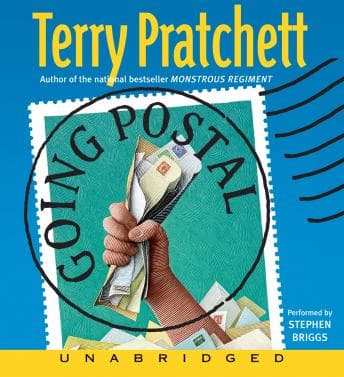

Terry Pratchett wrote a novel about a con man forced to run a post office, and somehow it's the most honest book about capitalism I've ever encountered.
I came to Going Postal late — book 33 of 41 in the Discworld series — and I'll admit I was skeptical. I've assigned Pratchett exactly zero times in twenty years of teaching English. Not because he isn't brilliant, but because my department chair would look at me like I'd suggested we replace The Great Gatsby with a cereal box. Their loss. This book does more with institutional critique than half the "serious" novels gathering dust on my AP reading list.
A Con Man, a Golem, and the Death of Honest Work
Moist von Lipwig is not your typical protagonist. He's a convicted fraudster who gets pulled from the gallows and handed the keys to Ankh-Morpork's decrepit Post Office by Lord Vetinari — a tyrant so pragmatic he makes Machiavelli look like an idealist. The setup sounds like a sitcom premise, and Pratchett leans into that. But here's what surprised me: by hour three or four, I'd stopped laughing at the absurdity and started feeling genuinely unsettled by how precisely the Grand Trunk clacks monopoly mirrors every tech company that's ever strip-mined a public good for shareholder value.
The dynamic between Moist and Mr. Pump, the golem assigned to keep him from running, is where the book finds its spine. Pump is relentless, literal, and incapable of being conned — which means Moist has to actually become something instead of just performing it. That's the trick Pratchett pulls. You think you're reading a caper novel, and then suddenly you're watching a man discover that pretending to care and actually caring produce the same result if you commit hard enough. This reminds me of what Hemingway said about writing one true sentence — except Pratchett writes forty absurd ones and sneaks the truth into the spaces between them.
My students would hate this. I love it.
Stephen Briggs Knows Where the Jokes Land
I listened to this walking the lakefront with Denise on a series of Saturday mornings, and more than once she pulled out an earbud to ask why I was laughing. Briggs's performance is the reason. The man has narrated something like thirty Discworld novels, and you can hear that familiarity in every beat. His Vetinari is ice — dry, clipped, the voice of a man who's already won every argument before it starts. His Moist shifts registers depending on who Moist is trying to fool, which is exactly right because Moist is always performing for someone. The narrator understands that pause is punctuation, and Briggs deploys silence before punchlines the way a drummer uses the rest before the downbeat.
What I didn't expect was his handling of the letters. There are moments — and I won't spoil the specifics — where the undelivered mail in the Post Office essentially speaks, carrying decades of unfinished human business. Briggs pitches these passages lower, quieter, almost reverential. It's a tonal shift that could've been corny. Instead it lands like a gut punch. That's not just reading. That's interpretation.
No complaints on audio quality. Clean production, single narrator, no music or effects — just Briggs and Pratchett's words. Exactly as it should be.
The Satire That Aged Too Well
Here's the thing that kept nagging at me: Pratchett published this in 2004. The Grand Trunk — a communication network built by visionaries, bought out by financiers who cut costs until people died, then rebranded as innovation — reads like a Wikipedia summary of half the companies in Silicon Valley circa 2024. The "bandit capitalism" Pratchett skewers here isn't historical satire anymore. It's just... Tuesday. I ran into that same disorienting feeling reading Blood Meridian — the sense that a book written decades ago has somehow gotten more accurate, not less, the longer the world keeps turning.
And the postal service itself — a government institution everyone wrote off as obsolete, brought back to life not through efficiency but through meaning — look, I teach in a public school. I didn't need Pratchett to tell me that institutions matter. But hearing it argued this well, this funny, while pretending not to pay attention during a curriculum planning meeting? (Sorry, Principal Martinez.) Worth pausing the faculty meeting for.
I'll grant the detractors one thing: if Pratchett's brand of wordplay doesn't click for you, eleven hours is a long time to spend with a style that never lets up. Some folks find his characters more archetype than person. I get that. Adora Belle Dearheart is written as a love interest who refuses to be a love interest, and whether that reads as subversive or as its own kind of cliché probably depends on your tolerance for Pratchett doing Pratchett things. But for me, the prose deserves to be savored, and eleven hours at 1.0x felt exactly right.
The Lesson Plan I'll Never Get Approved
If you loved Dickens's institutional satire but wished it came with golems and stamps made from cabbage, this is your book. If you've never touched Discworld, this is a genuinely strong entry point — self-contained plot, no required reading, and a protagonist whose arc is complete and earned. If you loved Catch-22 or A Confederacy of Dunces, this is their spiritual successor in fantasy clothing.
Skip it if: you need your satire served straight, you find British comic fantasy exhausting, or you genuinely believe audiobooks should be under six hours. (I disagree with all three positions, but I'm not your teacher. Well. I might be. Check your class roster.)
Briggs and Pratchett together make this one of those audiobooks where the performance and the text feel inseparable. Forty-seven podcast listeners and my mother can't be wrong.