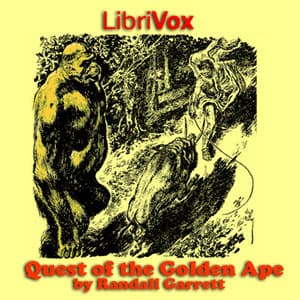

"The golden ape held the secret of a world's destiny" — and honestly, somewhere around hour two, I was sitting in my apartment at 1 AM with a half-eaten bag of Doritos, wondering if Randall Garrett had been running a 1950s D&D campaign and just transcribed his session notes into a novella. I mean that as a compliment. Mostly.
Pulp-Era World-Building With a Side of Space Opera Cheese
Let me set the scene for you. Quest of the Golden Ape is a product of the late 1950s magazine sci-fi era — Garrett was one of those guys cranking out stories for Astounding alongside luminaries, and this has that exact energy. We're talking planetary romance, we're talking quest structures that would feel right at home in a first-edition D&D module, we're talking prose that doesn't waste a single breath on subtlety. At four hours, it's practically a short story by Sanderson standards, and the pacing reflects that — things happen fast, characters announce their motivations like they're reading their alignment off a character sheet, and the world-building comes at you in concentrated bursts rather than the slow drip I usually prefer.
Is it Sanderson-level world-building? No. Obviously not. But there's something genuinely charming about the directness of it. Garrett doesn't spend three chapters explaining how his science-fantasy elements work — he just drops you into alien landscapes and expects you to keep up. The golden ape itself functions more as a MacGuffin than a fully realized creature, which bugged me a little, but for a story from this era? It works. The whole thing reads like a campaign where the DM had a really solid premise but the party kept trying to speed-run the main quest.
Mark Nelson Doing What Mark Nelson Does
So here's the thing — I don't have a ton of specifics on Nelson's character differentiation in this particular recording, but the guy has a reputation, and it's earned. Listeners who follow his work describe his readings as "near flawless and heartfelt," and one person flat out called him their favorite narrator. I can see why. His pacing is clean, easy to follow, and he brings a warmth to even the most dated dialogue that keeps you engaged rather than cringing at the 1950s genre conventions.
Does he do the Steven Pacey thing where every character sounds like a distinct human being with their own vocal identity? I honestly can't confirm that here — the source material doesn't demand a massive vocal range the way a Malazan or First Law book would. But Nelson's strength is that he reads with genuine investment. He sounds like he cares about the story, which — when you're dealing with pulp-era sci-fi that could easily come across as hokey — matters more than fancy accents. He keeps the energy up through the short runtime without it feeling rushed, and the audio itself is clean.
The Dungeon Master's Verdict on a 70-Year-Old Quest
Here's who should listen to this: if you're into the history of the genre, if you want to understand where modern sci-fi fantasy tropes came from, if you've ever read an Appendix N list and thought "I should actually check some of these out" — this is your jam. It's four hours. That's shorter than some D&D sessions I've played. You can knock this out during a single afternoon of pretending to work on your thesis. (I read this instead of writing my thesis. Dr. Patel, if you're reading this, I was doing "genre research.")
Who should skip it? If you need modern character depth, if info-dumps delivered at 1950s speed annoy you, if you want a magic system with rules and constraints rather than "it's science-fantasy, just go with it" — this probably isn't your thing. The plot is linear, the characters are archetypes rather than people, and the prose has that mid-century utilitarian quality that either charms you or doesn't.
But at four hours with Mark Nelson behind the mic? It's a fun little artifact. My D&D group would love this as background lore for a space-fantasy one-shot. It's not going to change your life, but it's a solid afternoon listen — the literary equivalent of finding a weird old module at a used bookstore and running it just to see what happens.
The progression is satisfying in the way that short, punchy quest narratives always are. You start, you quest, you get the thing. Sometimes that's exactly what you need between 1,200-page epic fantasy installments. The sprawling, myth-dense journey in Dark Tower II: The Drawing of the Three is basically the opposite end of that spectrum — King takes his sweet time and the character work is on another level entirely, but there's a reason I keep bouncing between doorstoppers and these lean little pulp runs.