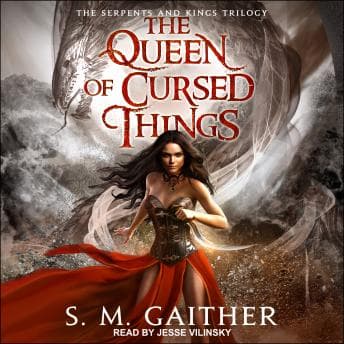

I went into Queen of Cursed Things expecting another generic fantasy romance with a hot prince and a special protagonist. The internet had me bracing for something forgettable. And for about the first two hours? I thought I was right.
Then Gaither did something I genuinely didn't expect. She made me care.
The Serpent Mark Hit Different
Alaya isn't just "special girl with hidden powers." She's a woman who's spent her entire life hiding a mark that would get her killed, adopted by a village that would exile her in a heartbeat if they knew the truth. (They do exile her. It happens fast.) The setup sounds tropey on paper, but the execution has this undercurrent of real desperation that caught me off guard.
The Serpent clan lore is where my D&D brain started firing on all cylinders. That same world-building depth hooked me in Dark Tower II: The Drawing of the Three, where King builds entire cultures through character interactions. These aren't your standard fantasy snake people—they're a conquered civilization whose magic literally cursed the land on their way out. Dormant curses waking up as Alaya travels? That's Sanderson-level magic system potential right there. The curses aren't just obstacles; they're remnants of a people's rage, and Gaither treats them with the weight they deserve.
I was supposed to be working on my thesis when I started this. Thirteen hours later, Dr. Patel's disappointment has a new chapter, and I regret nothing.
Jesse Vilinsky Knows What She's Doing
Here's where I expected mediocrity and got something genuinely solid instead. Vilinsky's emotional narration carries the weight of Alaya's isolation without tipping into melodrama. When Alaya's village turns on her—and they turn FAST—there's this crack in Vilinsky's delivery that made me pause my game and actually listen.
The crown prince could've been a disaster. Morally gray love interests in audiobooks live or die by whether the narrator can sell both the charm and the threat. Vilinsky threads that needle. His dialogue has this edge of "I'm helping you but I'm also definitely using you" that kept me guessing about his actual loyalties way longer than I expected.
No pronunciation issues that pulled me out. No weird audio glitches. Just clean, focused narration that let the story do its thing.
The Trust Problem (And Why It Works)
The central tension—can Alaya trust the son of the man who destroyed her people?—sounds like it should get old fast. It doesn't. Gaither keeps layering complications. The prince wants to overthrow his father, sure, but his reasons keep shifting. Alaya needs power that might be corrupted. The "stolen from the Serpent goddess herself" bit isn't just flavor text; it's a genuine question of whether this power should even be used.
My D&D group would absolutely steal this political setup for a campaign. We already borrowed heavily from Battlefield Earth for our last arc—conquered people rising up against oppressors makes for incredible campaign fuel. Exiled clan, tyrannical king, curses in the soil, goddess-stolen power, and two people who need each other but can't afford to trust each other. That's a session zero pitch right there.
The pacing does slow in the middle third—there's a jungle section that drags slightly while Alaya and the prince are doing the "we're definitely not falling for each other" dance. But even then, Gaither keeps dropping worldbuilding breadcrumbs that had me theorizing instead of checking how much time was left.
Who's Rolling Initiative on This One
Content warnings are real here: violence, language, and yes, spicy content. If you want clean fantasy, look elsewhere. If you want enemies-to-lovers with actual stakes and a magic system that rewards attention, this is your jam.
Skip it if you need constant action or hate info-dumps about clan history and curse mechanics. This book wants you to sit with Alaya's trauma, to understand why she can't just trust the hot prince even when it would be convenient. If slow-burn character work makes you antsy, you'll struggle. (But you're wrong.)
Campaign Complete: Final Loot Assessment
Yes, it's 13 hours. That's still a commitment. And yes, it's worth it.
This is the kind of fantasy that surprised me by being better than its premise suggested. Gaither's writing has teeth, Vilinsky's narration has heart, and the world-building has that satisfying crunch of a system that actually makes sense. I went in expecting to half-listen while coding and ended up abandoning my IDE entirely.
My thesis remains unwritten. The Serpent clan has my loyalty now.