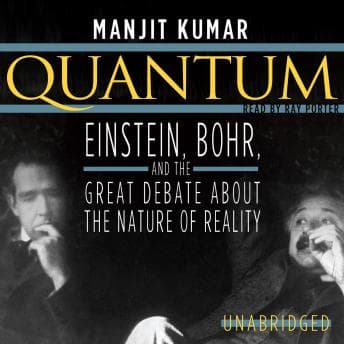

I was grading sophomore essays on The Great Gatsby at 11:47 PM—you know, the ones where every student discovers that the green light is a symbol, as if they've personally cracked the Da Vinci Code—when I realized I needed something to keep my brain from liquefying. So I put on a book about quantum physics. Because apparently I hate myself.
Except I don't. Not anymore. Not after fourteen hours with Manjit Kumar and Ray Porter.
When Scientists Fought Like My Students Fight About Symbolism
Here's what nobody tells you about the golden age of physics: these geniuses were petty. Brilliant, world-changing, and absolutely petty. Einstein and Bohr spent decades in what amounts to the most consequential "well, actually" exchange in human history. Kumar doesn't just explain their disagreement—he makes you feel the personal stakes. Einstein genuinely believed Bohr was wrong about the fundamental nature of reality. Not wrong about an equation. Wrong about what existence *is*.
This reminds me of what Hemingway said about writing—that the dignity of movement of an iceberg is due to only one-eighth of it being above water. Kumar's done the underwater work. He's read the letters, the conference transcripts, the marginalia. When he describes the 1927 Solvay Conference, you're not getting a Wikipedia summary. You're getting the tension in the room. The cigar smoke. The way Bohr would ramble and Einstein would sit there, quietly furious, waiting to demolish him.
Porter Understands That Pause Is Punctuation
Ray Porter has this trick—and I've listened to enough audiobooks to know it's rare—where he shifts his tone just slightly during the debate sections. Nothing theatrical. No silly accents for Einstein. Just a subtle edge when reading Einstein's objections versus Bohr's responses. It's the difference between reading a play and watching actors who understand subtext.
His enunciation on the technical material is frankly embarrassing for how good it is. I teach teenagers who mumble through Shakespeare, and here's Porter making wave-particle duality sound like something you could casually discuss over coffee. The pacing is impeccable. He knows when to let a concept breathe and when to push forward. Fourteen hours is a commitment, but I never felt like he was padding time or rushing through the good stuff.
My one observation—and this isn't really a complaint—is that the book requires your full attention. I tried listening during a faculty meeting once (sorry, Principal Martinez, you know how it is) and completely lost the thread during a section on matrix mechanics. This isn't background listening. This is "sit down and learn something" listening.
Why We Still Read the Classics—Even the Scientific Ones
Kumar has degrees in both physics and philosophy, and it shows. He's not just interested in what happened—he's interested in what it *means*. The debate between Einstein and Bohr wasn't just about equations. It was about whether God plays dice with the universe. Whether observation creates reality or merely reveals it. Whether science can ever give us access to truth or just useful predictions.
These are the questions I try to get my students to engage with when we read literature. What is real? What can we know? How do we live with uncertainty? Turns out the physicists were asking the same things, just with more math.
The prose deserves to be savored. Kumar writes with genuine affection for his subjects—not hagiography, but the kind of warmth that comes from spending years thinking about these people. That same biographical intimacy shows up in The Once and Future Witches, where Harrow makes historical figures feel like people you'd actually want to grab a drink with. Kumar does the same: Marie Curie and Ernest Rutherford feel like colleagues you might run into at a conference, not statues in a museum.
Worth Every Lost Hour of Sleep
Look, if you loved any of those "great minds" books—the ones about Darwin or Newton or the Manhattan Project—this is their spiritual successor for quantum physics. It's not dumbed down. It's not sensationalized. It's just really, really good science history, performed by a narrator who treats the material with exactly the right mix of authority and wonder.
My students would hate this. Too long, too dense, no explosions. I love it.
Who should skip it? Anyone who wants a quick explainer on quantum mechanics. This is 14 hours of context, biography, and intellectual history. If you just want to understand Schrödinger's cat, watch a YouTube video. But if you want to understand *why* Schrödinger put that damn cat in a box in the first place—and why Einstein thought it proved Bohr was wrong—this is your book.
I finished it at 2 AM, red pen still in hand, stack of ungraded essays mocking me from the kitchen table. Worth every minute of lost sleep.