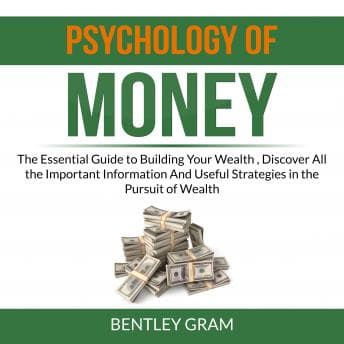

Look, I need to rant for a second about audiobook titles that ride the coattails of famous books. This is NOT Morgan Housel's "The Psychology of Money" - you know, the one that's actually worth your time. This is Bentley Gram's "Psychology of Money: The Essential Guide to Building Your Wealth," and honestly? The title confusion alone is enough to make me grumpy. I grabbed this during a particularly foggy Monday morning commute thinking I'd revisit Housel's insights, and about three minutes in I realized my mistake.
So here we are.
What You're Actually Getting
At 63 minutes, this is barely longer than my one-way commute. And that's... kind of the whole problem. The book promises "5 Principles to Unlocking Wealth" and delivers exactly what you'd expect from something that could be a Medium article stretched into audiobook form. There's talk about the power of thoughts, the law of success, pursuing wealth with intention. None of it is wrong, exactly. It's just surface-level stuff you've heard a hundred times if you've consumed any personal finance content in the last decade.
The ROI on this audiobook is pretty low. I kept waiting for the specific, actionable strategies the description promised, but they never really materialized. Cashvertising actually delivers on that promise with over 100 concrete psychological tactics you can use immediately. This one? A lot of "wealthy people believe in success" and "take calculated risks" without the HOW. Where are the case studies? The frameworks? The actual psychology? (I mean, it's in the title, right?)
The Voice in My Head
The narrator goes by "Courage" - which, okay, respect for the name choice - and delivers everything in this very clean, very steady, very... flat way. It's not bad. The audio quality is fine, no weird pops or background noise. But there's zero variation. No emphasis on key points, no energy shifts when the content should get exciting. It's like listening to someone read a corporate training manual. Competent but forgettable.
For a book about unlocking wealth and achieving your dreams, shouldn't there be some... fire? Some conviction? I found myself zoning out somewhere around the "Ladder to Success" section and had to rewind. On a packed Caltrain at 6:47 AM, that's basically a death sentence for an audiobook.
Perfect For / Skip For
If you're completely new to personal finance and self-improvement content - like, never read a business book, never listened to a podcast about success - this might work as a gentle introduction. It's short. It's accessible. It won't overwhelm you.
But if you've read "Rich Dad Poor Dad," "Atomic Habits," or literally any bestselling finance book from the last five years, you're not learning anything new here. This is basically a motivational pamphlet stretched into an hour.
Perfect for: absolute beginners who want something short and simple.
Skip for: anyone with even basic personal finance knowledge.
The Comparison That Hurts
I keep coming back to the Housel book because the title similarity feels almost intentional. Housel's "The Psychology of Money" is a deep dive into behavioral finance - specific stories, counterintuitive insights, stuff that actually sticks with you. This? This is the generic store-brand version. Same packaging, different product entirely.
If you want actual psychology of money content, go read Housel. If you want wealth-building strategies with teeth, try "I Will Teach You to Be Rich" by Ramit Sethi (the audiobook is way better and actually entertaining). This one just... exists.
Save Your Credit
No, I wouldn't listen again. I finished it in one commute and immediately started something else to cleanse my palate. At 1.5x speed, it flew by, but that's not a compliment when the content is this thin. Could've been a blog post. Should've been a blog post.
The frustrating thing is that the bones of something useful are here - the idea that wealth is psychological before it's practical is TRUE. The Chimp Paradox explores that psychological foundation with actual neuroscience and a framework you can apply. But the execution here is so generic that it doesn't land. I wanted frameworks, I got fortune cookies.
Save your credit for something with more substance.