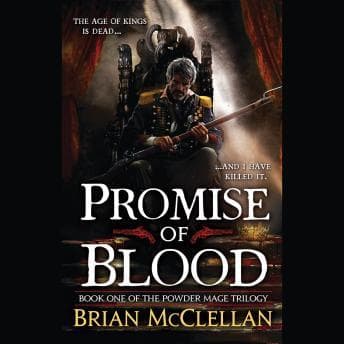

I was walking the lakefront last Saturday morning - one of those rare Chicago days where the wind off the lake is actually pleasant instead of trying to murder you - and I realized I'd been standing still for a solid three minutes, just staring at the water, completely lost in a scene where powder mages are snorting black powder like it's a line of cocaine to fuel their magic. Denise had to double back for me. She asked if I was okay. I told her a fictional field marshal was executing aristocrats and I needed a moment.
That's Promise of Blood for you. It grabs you by the collar in ways you don't expect from a fantasy novel.
The French Revolution Got Weird (And I'm Here For It)
Let me set the stage for what Brian McClellan is actually doing here, because I think it gets undersold. This isn't just "fantasy with guns." This is the Terror. This is Robespierre's France, if Robespierre could snort gunpowder and use it to guide bullets around corners. The guillotines are falling, the bread lines are real, the political alliances are fracturing before the blood on the palace floor is dry. McClellan takes the moral complexity of revolution - the kind of stuff I spend entire class periods trying to get seventeen-year-olds to care about when we read A Tale of Two Cities - and drops it into a world where gods might literally be waking up to punish everyone involved. That same moral weight shows up in There There: A novel, though Tommy Orange is working with a different kind of historical violence—the kind that doesn't get resolved with guillotines.
Field Marshal Tamas has just overthrown his king, and the book opens in the aftermath, which is the smart move. We skip the glory and land squarely in the consequences. Tamas is stretched thin, fighting wars on four fronts while trying to feed a nation. His son Taniel is a brilliant marksman and a complete mess of a human being - estranged from his father, carrying the kind of resentment that only makes sense between people who are too similar to each other. And then there's Adamat, the retired police inspector being blackmailed into service, who functions as the reader's detective brain in a world that keeps getting stranger.
Three POV characters, three very different stories, and McClellan rotates between them with the confidence of someone who studied under Brandon Sanderson. (He literally did, by the way. Sanderson blurbed it with "just plain awesome," which is the most Sanderson endorsement possible.)
Christian Rodska and the Art of the Gruff Commander
Here's where I need to be honest, because the narrator situation is... complicated. Christian Rodska does something specific very well: he nails Tamas. That gruff, exhausted, iron-willed military commander voice? Perfect. You hear a man who hasn't slept in three days and is still making decisions that will kill thousands. When characters have Teutonic-sounding names, Rodska shifts into a German accent that actually helps you track the political geography of this world - you can hear where someone is from before McClellan tells you.
But I understand why some listeners bounce off him. His pacing is deliberate. Patient. He reads like a man who believes - as I do - that the prose deserves to be savored. At 1.0x speed, this is a nineteen-hour commitment, and Rodska isn't going to rush you through it. If you're coming from Michael Kramer's Sanderson audiobooks, which have that propulsive, almost cinematic energy, Rodska's approach might feel like downshifting from fifth gear to third. It took me maybe two hours to fully settle into his rhythm, particularly with some of the accent work for secondary characters.
Once I did, though? The action sequences hit differently. When magic and bullets are flying, Rodska's cadence matches the chaos without losing clarity. That's harder than it sounds.
Who Should Enlist (And Who Should Desert)
If you loved the political machinations of Joe Abercrombie's First Law but wished there was a harder magic system underneath it all - this is your book. If you're a Sanderson reader looking for something with more grit and moral gray area, you'll feel right at home with the worldbuilding but pleasantly unsettled by the ethics.
If you need your fantasy narrators to sound like action movie trailers, Rodska might not be your guy. And if slow-burn setup frustrates you - if you want the plot to sprint from page one - know that McClellan is building something. The payoff is real, but he's going to make you earn it.
My students would hate this. Too long, too many political factions, not enough dopamine hits per chapter. I love it. This reminds me of what Hemingway said about prose being architecture - McClellan is building a cathedral here, and you can see the scaffolding, but the structure is sound.
Worth Pausing the Faculty Meeting For
Nineteen hours is a serious investment. I won't pretend every one of those hours is essential - there are stretches in the middle where the Adamat investigation thread spins its wheels a bit while the other storylines are cooking. But when this book is firing on all cylinders - Tamas making impossible choices, Taniel lining up shots that shouldn't be possible, the growing dread that actual gods are involved - it's the kind of fantasy that reminds you why the genre exists. It's doing something new with something old, which is basically my entire teaching philosophy.
Principal Martinez, if you're reading this: I finished it during your curriculum alignment meeting. The one about standardized testing. I regret nothing.