
Look, I need to rant about something before we get into this. I'm a horror person. That's my lane. But every few months a fantasy series grabs me by the collar and refuses to let go, and then I'm sitting in the back office of my library branch at 10 PM - long after closing - with my headphones in, completely ignoring the fact that I should be processing returns, because Field Marshal Tamas is trapped behind enemy lines and I physically cannot press pause. The Powder Mage trilogy has done this to me twice now, and I'm not even mad about it. I'm mad about the female voices. We'll get there.
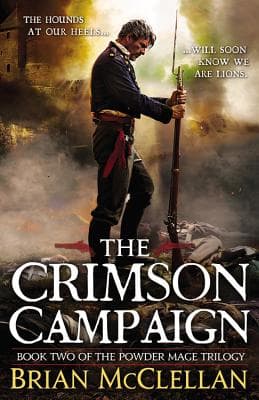
Brian McClellan's The Crimson Campaign picks up after the disaster at the end of Promise of Blood, and the structure here is what keeps you locked in across twenty hours. You've got three storylines braided together - Tamas's desperate march through enemy territory with a shattered army, Inspector Adamat's hunt for the genuinely unsettling Lord Vetas (who has Adamat's wife), and Taniel Two-shot holding the line against a literal angry god who's nursing a bullet wound in his eye. That last detail? Chef's kiss. A god who got shot in the eye and is furious about it. McClellan understands that the best antagonists have petty motivations layered under cosmic ones.
Flintlocks, Powder Snorting, and Why This World Earns Its Twenty Hours
The thing that keeps me coming back to this series - and the thing that puts it squarely in my wheelhouse even though there are no ghosts - is the dread. Not horror dread, exactly, but that slow military dread where every chapter ratchets the odds against your people. Tamas's march is essentially a survival horror story wearing a Napoleon hat. No supplies, no reinforcements, outnumbered, and McClellan doesn't let anyone off easy. The win-loss ratio between protagonists and antagonists stays uncomfortably realistic. Your favorites take hits. Real ones.
And the powder magic system continues to be one of the most satisfying magic systems in modern fantasy. Mages who snort gunpowder to enhance their senses, guide bullets mid-flight, ignite powder at a distance - it's tactile in a way that crystal-and-incantation systems rarely achieve. You can feel how it works, which means when Rodska narrates a battle sequence where Taniel is burning through his powder reserves, the stakes are physical. The LitRPG crowd figured this out early — tactile, mechanical magic that has rules and costs is just more satisfying to experience, and Ritualist scratches a similar itch if you want that same sense of a power system you can actually visualize working in real time.
Christian Rodska Commits. Mostly.
The narrator commits. That's rare. Rodska's voice is this series for me now, and I genuinely can't imagine anyone else doing it. His Tamas has this weathered authority - you believe this man led a coup and would do it again before breakfast. His Adamat has a different register entirely, more cerebral, more desperate, which tracks because Adamat's storyline is essentially a noir detective plot dropped into a fantasy war. And when Rodska hits the battle sequences? He brings a physicality to the chaos that makes twenty hours feel like a sprint.
But. The female voices.
I'm not going to sugarcoat this because I respect you as a listener. Rodska's female characters sound... off. Not unintelligible, not distracting enough to ruin anything, but there's a thinness to them that pulls you out of the scene. Ka-poel, who's a fascinating mute blood mage and one of the most interesting characters in the series, communicates through gestures and expressions that Rodska narrates rather than voices, which actually works in his favor. But when other women speak, you feel the narrator reaching for something he can't quite grab. It's the one consistent crack in an otherwise strong performance.
Here's the thing though - the clarity is superb. Even in the most chaotic battle scenes with multiple factions clashing, I never lost track of who was where. That's a craft thing. That's someone who's studied the source material and understands spatial storytelling.
Who Gets the Powder and Who Gets Left Behind
If you bounced off Promise of Blood, this won't save you. It's a direct continuation that assumes you remember who everyone is and what happened. If you haven't started the series? Go back. Don't be that person.
If you love military fantasy that treats logistics and morale as actual plot elements - not just window dressing between sword fights - this is your book. If you need strong female voice work from your narrators, temper your expectations. If you want magic systems that feel physical and violent and earned, and you've got twenty hours of focused listening ahead of you, this is worth every minute.
I will say: don't listen to this as background audio. The political intrigue between Tamas's bickering generals requires your actual brain. I tried folding laundry during a strategy scene and had to rewind three times.
Shelving This One in the Good Section
I finished this at midnight, sitting on my apartment floor with Shirley (my cat) asleep on the charging cable of my phone. She was unimpressed. I was already downloading The Autumn Republic. McClellan writes fantasy the way I wish more people wrote horror - with respect for the genre's intelligence, with consequences that stick, and with the understanding that dread doesn't require monsters. Sometimes it just requires a field marshal who's out of food, out of powder, and out of options. My podcast listeners are going to hear about this one whether they like it or not.