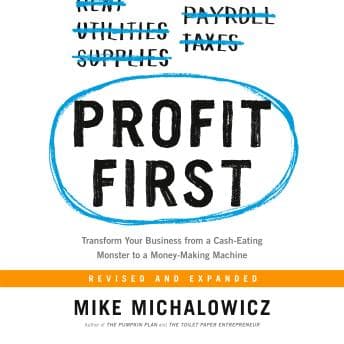

How many business books have you listened to that could've been a blog post, a tweet thread, and maybe a decent infographic - and you'd have gotten the same value in 4 minutes instead of 8 hours?
Because Profit First is genuinely not one of them. And I say that as someone who has rage-quit more business audiobooks than I've finished.
The Whole Book Is One Formula Flip (And It Actually Works)
TL;DR: Worth your commute. The core idea is dead simple - instead of Sales - Expenses = Profit, you flip it to Sales - Profit = Expenses. You pay yourself first, then figure out how to run the business on what's left. That's it. That's the tweet.
But here's the thing - Michalowicz actually earns the 7 hours and 52 minutes. The smaller plates analogy in Chapter 5 is the one that clicked for me: just like you eat less when you use a smaller plate (Parkinson's Law applied to food), you spend less when you limit what's available to spend. He takes this behavioral economics angle and builds an entire cash management system around it - multiple bank accounts, specific allocation percentages, a rhythm for when you move money around. It's basically "envelope budgeting" but for your LLC.
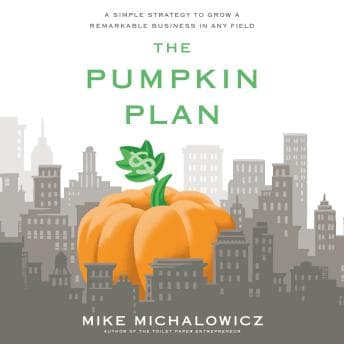
Michalowicz pulls the same kind of simple-but-effective trick in Pumpkin Plan, which he also narrates himself.I was half-listening during a Monday morning commute, probably around Millbrae, when the allocation framework kicked in and I actually paused to take a screenshot of my notes app. That never happens with business books. The ROI on this audiobook is surprisingly high because it's one of the rare ones where you walk away with an actual system to implement, not just vibes about "thinking differently."
Mike Narrating Mike Is the Right Call
Author-narrated business books are hit or miss. Sometimes you get a founder who sounds like they're reading a hostage statement. Michalowicz is... not that. He's warm, a little goofy, and narrates like he's explaining this stuff to you over beers. Not Ray Porter levels of narrator magic (obviously), but his comedic timing on his own jokes lands way better than an actor reading them would. There's this energy of someone who genuinely gets fired up about bank account allocations, which sounds absurd, but it works.
The updated commentary sprinkled through this edition is a nice touch - he basically does a director's commentary on his own advice, noting what he'd tweak or what he's learned since the original publication. It's the kind of meta-layer that makes the audio version feel like a genuine upgrade over the print book rather than just "someone reading the pages."
The production is clean but bare - no music, no sound effects, just Mike talking. Which is fine. This isn't a book that needs atmosphere. It needs clarity, and it delivers.
Where It Drags (Because It Does)
Look, it's still a business book. There are stretches - particularly in the middle third - where the case studies start to blur together. Small business owner was struggling, implemented Profit First, now they're thriving. Got it after the third one, Mike. By the sixth I was bumping up to 1.75x.
The one-two punch of case studies and genuinely useful frameworks reminded me of SalesDogs - solid ideas wrapped in a lot of repetitive reinforcement.And some of the advice is clearly calibrated for brick-and-mortar small businesses, service companies, that kind of thing. If you're a solo dev or freelancer, you'll need to do some mental translation. The principles still apply, but the specific percentage targets and account structures assume a more traditional business model. He acknowledges this somewhat, but not enough.
Also - and this is a minor thing that bugged my engineer brain - the book presents the system as almost universally applicable without really addressing edge cases or failure modes. What happens when you have a lumpy revenue business? What about seasonal businesses that need to stockpile cash? He touches on it, but a distributed systems person in me wanted more discussion of the failure scenarios.
Who Gets Value, Who Doesn't
Perfect for: Anyone running a small business who looks at their bank account and thinks "where did it all go?" - especially if you've never had a formal system for managing cash flow. Also solid for freelancers and side-hustlers who are winging it financially.
Skip for: If you already have solid financial discipline and a real accounting setup, this will feel elementary. And if you're looking for investment strategy or scaling advice, wrong book.
Perfect for: train, gym. Skip for: deep work (you don't need deep focus for this, the concepts are straightforward enough to absorb at 1.5x while dodging elbows on a packed Caltrain).
The Commit Message
I finished this in 3 commutes at 1.75x and immediately texted my friend who runs a small design studio. That's my real litmus test for business books - did I actually recommend it to a specific person within 24 hours? Profit First passed. It's not going to change your life if you already understand behavioral economics and envelope budgeting, but it packages those ideas into something actionable for business owners who've been running on gut feel. The formula flip is simple, maybe even obvious in retrospect, but obvious ideas packaged with a clear implementation plan are worth more than brilliant ideas with no instructions.
Could parts of it have been a blog post? Honestly, yeah, the middle third. But the system itself - the specific accounts, the percentages, the cadence - that needs the full treatment. And hearing Michalowicz walk through it with his own enthusiasm makes it stick better than reading it ever would.