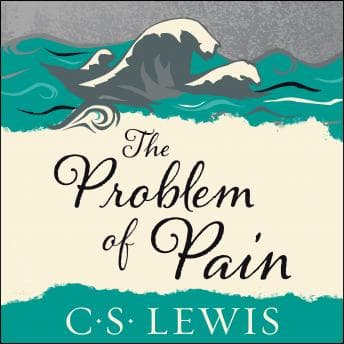

Here's the thing that irritates me about C.S. Lewis: he's smarter than me, he knows it, and he's gracious enough to make me feel like I'm keeping up. The Problem of Pain is barely four hours long and I've now listened to it twice, which means I've spent eight hours on a book that most of my students could hold in one hand. And I still don't think I've caught everything.
Let me set the scene. It's 11 PM, I'm three-quarters through a stack of sophomore essays about The Great Gatsby (no, Jaylen, the green light does not represent weed), and I put this on thinking a short theological work would be easy background company. It was not. Fifteen minutes in, I'd stopped grading entirely because Lewis was dismantling my lazy assumptions about divine goodness with the precision of a surgeon who also happens to write better prose than anyone in the operating room.
Lewis Argues Like He's Grading Your Paper
What struck me - what I genuinely didn't expect even after years of teaching The Screwtape Letters - is how relentlessly structured this book is. Lewis doesn't wander. He sets up the problem (an omnipotent, loving God allows suffering), acknowledges every reasonable objection you'd raise, and then walks you through his counter-argument with the patience of someone who's had this conversation a hundred times at Oxford and isn't tired of it yet. His chapter on divine goodness versus human conceptions of "kindness" hit me particularly hard. Lewis distinguishes between a God who wants us comfortable and a God who wants us complete, and he does it with an analogy about a painter's relationship to a canvas that I actually paused to sit with for a while. That painter metaphor stuck with me in a way that unexpectedly echoed something I felt reading Painter's Daughter, though the two books couldn't be more different in scope.
The chapter on animal suffering is where Lewis gets genuinely speculative, and he's honest about it. He essentially says, "I don't know, but here's my best guess," which is refreshing from a writer who could easily bluster through it. This is why we still read the classics - not because they have all the answers, but because they're brave enough to sit in the questions.
James Simmons: Clear, Competent, a Little Too Buttoned-Up
So here's where I have a minor complaint. James Simmons reads this with clarity and precision. His diction is excellent. He handles Lewis's long, subordinate-clause-heavy sentences without losing the thread, which is genuinely difficult - I've tried reading Lewis aloud to classes and have tripped over his syntax more than once. Simmons doesn't.
But - and this is a real "but" - Lewis on the page has a conversational warmth that Simmons doesn't quite capture. Lewis writes like he's sitting across from you in a cluttered study, pouring tea, occasionally cracking a wry joke. Simmons reads like he's delivering a lecture from behind a podium. It's not bad. It's just a degree more formal than the material calls for. The narrator understands that pause is punctuation, but I wanted a few more of those pauses - moments to let a devastating line land before moving to the next thought. At under four hours, the pacing already runs brisk for material this dense. Simmons's steady, efficient delivery compounds that.
I listened at 1.0x and I'd honestly recommend going slower if your app allows it. Maybe 0.9x. My students would think I've lost my mind. (They already do.)
Who Should Press Play - And Who Should Read Instead
If you loved Mere Christianity and want Lewis tackling a harder, narrower question with the same intellectual honesty, this is its spiritual successor. It's not devotional reading. It's not comforting in the way people sometimes want faith-based books to be. Lewis is working through genuine philosophical difficulty here, and he expects you to work with him.
This is absolutely a "dedicated listening" audiobook. I cannot stress this enough. Do not put this on while doing dishes. Do not listen while driving through construction on the Dan Ryan. You will miss a critical logical turn, lose the thread, and then blame Lewis for being unclear when really you were thinking about whether you remembered to defrost the chicken. (Denise, if you're reading this, I did remember. Once.)
If you're someone who processes dense argument better through reading than listening, you might actually prefer the print version. Simmons is good, but the material is so tightly constructed that being able to flip back a page has real value. The audiobook works - it just demands your full attention in a way that Simmons's pacing doesn't always accommodate.
Worth Pausing the Faculty Meeting For
Lewis wrote this in 1940, during the Blitz, when the question of suffering wasn't academic. You can feel that urgency underneath the careful logic. At three hours and fifty-one minutes, it's the kind of book that takes longer to think about than to listen to, and I mean that as the highest compliment I can give. My students would hate this. I love it. Simmons gets you through it cleanly, if not quite brilliantly. For a book this important, "cleanly" is enough.