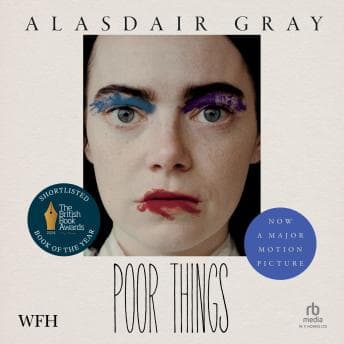

Alasdair Gray wrote a novel that is simultaneously a Victorian gothic, a feminist manifesto, a satirical travelogue, and a literary hoax — and somehow the audiobook makes all of those things work at once.
I started Poor Things on a Saturday morning walk along the lakefront with Denise. By the time we'd looped back to our building, she was asking why I kept stopping dead on the path to laugh. I couldn't explain it. How do you summarize a book where a mad scientist named Godwin Baxter — God, to his friends, and yes, Gray knows exactly what he's doing with that — resurrects a drowned woman by transplanting her unborn child's brain into her skull? And that's just the setup. The real story is what happens when Bella, this magnificent, uninhibited creation, refuses to be anyone's creation at all.
The Author Is Lying to You (And He Wants You to Know)
This is the thing my students would struggle with, and honestly, it's the thing that makes the book sing. Gray structures the novel as a found manuscript — McCandless's memoir, discovered and annotated by a fictional editor who is also Alasdair Gray. Then Bella herself gets the last word in a letter that contradicts half of what McCandless told you. The unreliable narrator isn't a gimmick here. It's the entire point. Every man in this book is telling Bella's story for her, reshaping her into what they need her to be — the innocent, the lover, the experiment, the wife. And Gray lets you sit in that discomfort before Bella dismantles the whole apparatus.
This reminds me of what Hemingway said about the iceberg theory, except Gray's iceberg is upside down and covered in graffiti. Everything is on the surface — the grotesque medical experiments, the sexual frankness, the political arguments about socialism and imperialism that Bella stumbles into during her Grand Tour. But underneath all that maximalism is a question so simple it cuts: who gets to tell a woman's story?
Two Narrators, Two Centuries of Male Confidence
Russ Bain handles McCandless's memoir sections, and here's what I appreciate — he doesn't play McCandless as a villain. He plays him as a man who genuinely believes he's the hero. There's this earnest Scottish cadence to his delivery that makes McCandless's possessiveness sound almost reasonable, almost romantic, until you step back and realize what you're actually hearing. Bain's God Baxter is something else entirely — deeper, more measured, with a clinical detachment that occasionally cracks into something like paternal warmth. You can hear the difference between a man who wants to own Bella and a man who simply wants to observe what she becomes.
Kathryn Drysdale takes over for Bella's sections — her letters home, her eventual rebuttal — and the shift is jarring in exactly the right way. Where Bain's narration is controlled and literary, Drysdale's Bella is blunt, curious, sexually direct in a way that must have scandalized readers in 1992 and still raises eyebrows now. She doesn't soften Bella's edges. When Bella describes her experiences in Alexandria and Paris with the same matter-of-fact tone she'd use to describe breakfast, Drysdale commits to that flatness, and it's devastating. The narrator understands that pause is punctuation — and Drysdale uses silence after Bella's most radical statements like a teacher waiting for the class to catch up.
Where the Scaffolding Creaks
I'll be honest: the historical notes at the end nearly lost me. I was grading sophomore essays on The Great Gatsby at 11 PM — don't judge me, I was behind — and the shift from narrative to pseudo-academic apparatus felt like going from a novel to a faculty meeting handout. It's intentional, I know. Gray is playing with the conventions of scholarly editing. But knowing something is intentional doesn't make it riveting at eleven-thirty on a Tuesday. I found myself drifting, and I never drift at 1.0x.
The middle sections drag slightly too — Bella's travels through the Mediterranean hit some repetitive notes, the political conversations occasionally reading more like essay than fiction. But Gray earns those slower stretches. If you loved Middlemarch for the way Eliot embeds social criticism inside domestic drama, this is its spiritual successor — just weirder, dirtier, and Scottish.
Who Gets the Syllabus Spot
If you watched the Yorgos Lanthimos film and thought, "I want more of this, but angrier and more layered" — here's your answer. If unreliable narrators frustrate you rather than fascinate you, or if you need a story that moves in a straight line, you'll want to skip this one. My students would hate this. I love it. Nine hours and fifteen minutes at proper speed, and I'd listen again just to catch what I missed while laughing on the lakefront. Honestly, the last time I felt this compelled to do an immediate relisten was with Return of the King — completely different world, obviously, but that same sensation of realizing you were so caught up in the ride that you missed half of what Tolkien was actually doing.
The prose deserves to be savored. Gray was a writer who understood that the funniest books are often the most furious ones, and this dual narration captures both registers — the comedy and the rage — without letting either one win.