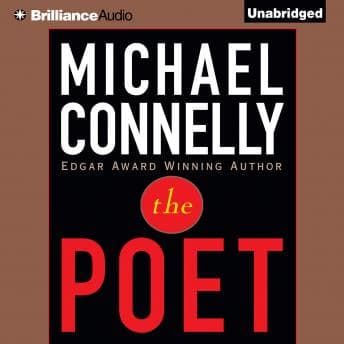

Look, I need to talk about The Poet because it's been living in my head rent-free since I finished it. And not in the fun, cozy way. In the "checking the locks twice before bed" way.
Michael Connelly wrote this in 1996, and honestly? It holds up disturbingly well. A serial killer targeting homicide detectives, leaving Edgar Allan Poe quotes at the scenes? That's the kind of premise that makes me want to high-five the horror gods. This isn't supernatural terror—it's the real-world kind. The kind where humans are the monsters. And Connelly understands that the scariest thing isn't the murder itself. It's the wait. The dread. The slow realization that something is very, very wrong.
When Grief Becomes Obsession
Jack McEvoy's brother Sean is a homicide cop who apparently died by suicide. Jack's a crime reporter. He doesn't buy it. And here's where Connelly does something brilliant—he makes Jack's investigation feel personal without making it melodramatic. The grief is there, simmering underneath every interview, every dead end, every breakthrough. It's not a revenge story. It's a grief story wearing a thriller's clothes.
The pacing is Connelly at his best—taut, relentless, the kind where you look up and realize you've been listening for three hours and missed your exit twice. (Yes, this happened. No, I'm not proud of it.) The plot twists aren't cheap gotchas. They're earned. And that ending? I won't spoil it, but my podcast listeners are going to love dissecting this one.
The Voice in My Head
Okay, here's where I need to be honest about Buck Schirner's narration. It's... complicated.
On the technical side, he's solid. Clear delivery, good character differentiation, keeps the momentum going even in the slower investigative sections. When the tension ramps up, he ramps with it. There's a reason people describe this audiobook as easy to listen to during long commutes—Schirner has that "I could listen to this for hours" quality.
But here's the thing: Jack McEvoy is supposed to be 35. Schirner sounds... older. Like, noticeably older. Some listeners found this distracting enough that they almost didn't finish. I get it. There's a mismatch between the voice you're hearing and the character you're imagining. For me, it wasn't a dealbreaker—I adjusted after the first hour or so—but I can see how it would pull some people out of the story.
The character voices are where Schirner shines, though. He gives each player in this twisted game their own distinct sound without going full cartoon. The FBI agent, the various cops, the suspects—they all feel like separate people. That matters in a mystery this layered.
The Dated Tech Problem (And Why It Doesn't Matter)
Yes, this book was written in the mid-90s. Yes, there are references to technology that will make you feel ancient if you remember using it. Fax machines. Dial-up. The works.
Here's my take: it doesn't hurt the story. If anything, it adds a layer of atmosphere. This is pre-smartphone investigation. Pre-Google. Jack can't just look things up instantly. He has to work for every piece of information. There's something almost nostalgic about watching a thriller unfold without the crutch of modern technology solving half the problems.
Some listeners complained about plausibility issues—characters making choices that feel more soap opera than procedural. I'll give them this: there are moments where you want to shake Jack and ask what he's thinking. But honestly? People make stupid decisions when they're grieving. When they're obsessed. That felt real to me.
The Poe of It All
I'm a sucker for literary serial killers. (Shirley—my cat, not Jackson—just judged me for typing that. Whatever, Shirley.) The Poe angle isn't just window dressing. Connelly weaves it into the killer's psychology in a way that feels intentional rather than gimmicky. Each quote chosen for each victim means something. It's not random edginess. It's craft.
This understands that horror isn't about gore—it's about dread. The Poet earns its Dilys Award. It earns the fifteen-plus hours you'll spend with it.
I found that same slow-burn mastery in I Am Pilgrim: A Thriller, where the tension builds through meticulous investigation rather than cheap scares. That same philosophy—dread over spectacle—is what makes Camp of the Dog work so well too, another thriller that trusts the slow burn.Would I Listen Again?
Probably not immediately—it's the kind of book that benefits from forgetting the twists before a re-listen. But would I recommend it? Absolutely. If you're a Connelly fan who somehow missed this standalone, fix that. If you're new to his work, this is a solid entry point that doesn't require knowing Harry Bosch or Mickey Haller.
And if you want to explore that same literary killer psychology in a different setting, Ceremony in Death scratches that itch with its own twisted intellectual villain. Though if you want to stay in Connelly's world and need something with even higher stakes, Dark Hours hits harder—4.5 stars for a reason.Just maybe don't listen in the dark. Mistake? Maybe. Worth it? Absolutely. But I did have to turn the lights on around hour twelve. The Poet earned that.