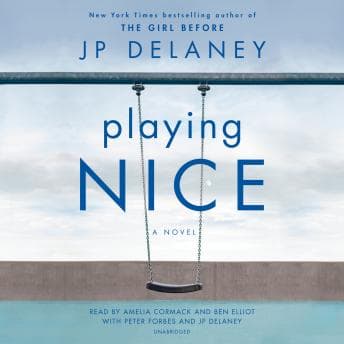

Everyone told me this was JP Delaney's best work. I went in expecting another slick psychological thriller that would be clever but forgettable. I was wrong - but not in the way I expected.
I started this one during a late-night drive back from a client site in San Antonio. Two hours of empty I-35 with nothing but headlights and three narrators slowly tightening a knot in my gut. By the time I pulled into my driveway, I sat in the truck for another twenty minutes because I couldn't stop listening. Ranger was staring at me through the front window like I'd lost my mind.
The Ambush You Don't See Coming
Let me cut to the chase - the premise sounds like a Lifetime movie. Babies switched at birth, two families forced together, custody drama. I almost passed on it. But Delaney does something smart here: he turns what could be melodrama into a slow-burn tactical engagement. Miles Lambert shows up at Pete Riley's door with this devastating news, and from that moment, every interaction between these two families is a chess move. The brilliance is that you're never quite sure who's playing whom.
Pete is a stay-at-home dad, a bit soft, the kind of guy who'd apologize for someone else bumping into him. Miles is wealthy, polished, and immediately suspicious - the kind of corporate operator I've seen a hundred times in boardrooms. The power dynamic between them is where this book lives. I've seen this scenario play out in real life - not babies switched, obviously, but that specific tension when someone with money and resources decides they want something from someone who doesn't have the leverage to fight back. Delaney nails that asymmetry.
What got me was the lawsuit angle. When they decide to sue the hospital, that's when the investigation starts pulling threads, and suddenly the night of the switch doesn't add up. The book shifts from domestic suspense into something closer to a procedural investigation, and I was genuinely caught off guard by where some of those threads led.
Three Voices, Two Sides, One Mess
Three narrators - Amelia Cormack, Ben Elliot, and Peter Forbes - split the duties. The structure works because you're hearing Pete's perspective and then getting the Lamberts' side, and the tonal contrast between narrators reinforces how differently these families process the same events. Ben Elliot gives Pete this slightly bewildered, earnest quality that fits a guy who's been blindsided and is trying to do the right thing even when the right thing keeps shifting. Peter Forbes handles Miles with a controlled precision that made my skin crawl in exactly the right way - you can hear the calculation underneath the politeness.
Cormack handles Maddie's sections, and she brings something raw to a character who starts cooperative and gradually becomes a cornered animal. The transition is gradual enough that when Maddie makes some genuinely questionable decisions, they feel earned rather than manufactured.
I wouldn't call any of the performances exceptional on their own, but the three-narrator structure does real work here. It keeps the pacing tight and prevents you from getting too comfortable in any one character's version of events. At 1.25x speed, this moved like a well-planned operation - no dead air, no wasted sections.
Where the Armor Has Gaps
Here's the thing - some of this is far-fetched. I can suspend disbelief with the best of them, but there are moments in the back half where character decisions felt driven by plot necessity rather than human logic. A couple of twists that were clearly engineered for shock value rather than growing organically from the situation. Without spoiling anything, there's a reveal involving events from the night of the switch that I saw coming about two hours early, and another one I didn't see at all that stretched credibility.
The book also flirts with some dark territory - abuse, manipulation, gaslighting - and handles it with varying degrees of success. Some of it lands hard. Some of it feels like it's checking thriller boxes.
But here's what kept me in: the central question isn't really "what happened that night." It's "how far would you go to keep your kid?" And that question - man, that one doesn't have a clean answer. The moral compromises these characters make are uncomfortable precisely because you understand every single one of them. Night Moves runs a similar current underneath its procedural surface - that same queasy recognition that good people will do ugly things when their families are on the line.
Worth Your Time? Here's the Debrief
This is a domestic thriller that punches above its weight class. Not perfect - the plot mechanics creak in places, and if you demand airtight plausibility, you'll find holes. But the character dynamics are sharp, the pacing is relentless, and the three-narrator setup genuinely adds to the experience rather than feeling like a gimmick.
Who should grab this: anyone who likes psychological suspense with real stakes, parents especially (this one will get under your skin in ways you won't enjoy but can't look away from). Skip it if you need your thrillers grounded in strict realism - there are a few leaps here that require goodwill.
I burned through this in about three sessions. Linda asked what I was listening to and I described the premise. She said it sounded like "a nightmare dressed as a novel." She's not wrong. Ranger approved this one - mostly because I was too tense to stop petting him.









