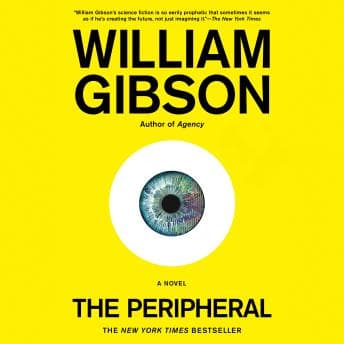

Look, I need to rant about something before we get into this: William Gibson invented the word "cyberspace" and basically predicted the internet, and yet his audiobooks still feel like they're fighting you for the first three hours. The Peripheral is no exception. I started this on a Monday morning commute, 6:12 AM, crammed against the window of a southbound Caltrain, and by the time I hit Millbrae I genuinely thought I'd accidentally loaded two different books onto my phone.
Gibson's Two-Timeline Architecture Is Basically Microservices With No Documentation
Here's the thing nobody warns you about: The Peripheral runs two parallel narratives separated by seventy-ish years, and Gibson drops you into both without a single line of exposition. Flynne Fisher's rural near-future America - where she's assembling product at a 3D print shop and moonlighting as a combat gamer for rich clients - runs on one thread. Wilf Netherton's post-apocalyptic London, where reaching into the past is literally a hobby for bored oligarchs, runs on another. And for the first four hours, the connection between them is about as clear as a stack trace with no line numbers.
I'm not exaggerating when I say this book requires active listening in a way that makes it genuinely hostile to the half-asleep commute crowd. Gibson's prose is dense even on paper, but in audio form, his invented terminology ("peripherals" as remote-controlled biological bodies, "stubs" as forked timelines, klept oligarchies) just washes over you if your attention drifts for thirty seconds. I had to rewind at least six times in the first week. That never happens to me.
But - and this is the critical but - once you get past roughly hour five and the two timelines start talking to each other, the payoff is genuinely wild. The concept that Wilf's future can communicate with Flynne's present, and that this communication creates a branching timeline (a "stub") that the future people treat like a sandbox? That's one of the most creative time-travel-adjacent ideas I've encountered in sci-fi. The science doesn't exactly hold up under pressure, but the internal logic is consistent enough that your brain accepts it. In the Afterlight pulls off something similar — a dystopian world with its own dense internal rules that you just have to trust the author on, and it mostly earns that trust.
Lorelei King: Businesslike Flynne, Inconsistent Everything Else
Lorelei King narrates, and my feelings are... complicated. Her Flynne has this clipped, businesslike tone that actually works for the character - Flynne's a no-nonsense rural woman who's seen some stuff and isn't impressed by much. That lands. And King handles Wilf Netherton's sections with a different register that makes the timeline switches trackable, which is essential when Gibson gives you zero other signposts.
But here's where it gets rough: King's voice for Flynne reads older than early-twenties. There's a breathiness to it that some listeners have called "harsh," and yeah, I can see that. It's not how I hear Flynne in my head. She should sound younger, sharper. And I noticed the energy dropping in the back half - around hour 10 or so, the narration starts to flatten out right when the plot is finally accelerating, which is exactly the wrong time for that to happen.
The character differentiation is adequate. She handles different nationalities decently and the male POV characters don't sound like caricatures. But "adequate" and "good" are different things, and for a 14-hour commitment, I wanted more. The audio quality itself felt a little flat to me, though I was listening through AirPods on a train so take that with appropriate salt.
Who Should Queue This Up (And Who Shouldn't)
Perfect for: dedicated listening sessions where you can actually focus. This is not a gym book. This is not a background-while-coding book. This is a sit-down-with-coffee-on-a-Saturday book.
Skip for: commuters who need something they can zone in and out of. I literally had to switch this to my weekend listening after three failed attempts to track the plot at 6 AM.
If you loved Neuromancer but wished it had a more human emotional core, Flynne delivers that. If you're coming from the Prime Video show - I can't speak to the adaptation, but the book's structure is way more demanding than anything a TV show would attempt.
Speed recommendation: stick to 1.25x max. I tried my usual 1.5x and missed critical worldbuilding details. Gibson's prose density at 1.5x is basically a DDoS attack on your comprehension.
The ROI Calculation
The ROI on this audiobook is backloaded. You're investing 5-6 hours of confusion for 8-9 hours of increasingly rewarding payoff. The narration is serviceable but not the reason to choose audio over print. I finished it in about two weeks of mixed commute and weekend listening, and I'm glad I stuck with it - but I'd be lying if I said I didn't consider bailing around hour 3.
Gibson is still Gibson. Nobody else writes futures that feel this inevitable and this alien simultaneously. But this particular audio edition? It's the book carrying the production, not the other way around.