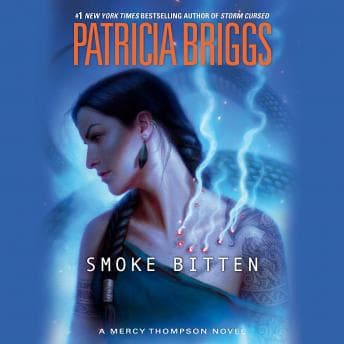

Okay, I need to rant about something real quick: why did it take me until book twelve to start this series? I've been listening to Brandon Sanderson build magic systems for years while Patricia Briggs was over here crafting one of the most satisfying urban fantasy worlds in the genre. My D&D group has been telling me to read Mercy Thompson forever, and I kept putting it off. I am a fool.
So yeah, I jumped in late. Sue me. But honestly? Smoke Bitten works surprisingly well as a mid-series entry point - there's enough context woven in that I wasn't completely lost, though I definitely missed some emotional beats that longtime fans probably felt in their bones.
The World-Building Is Chef's Kiss
Here's what grabbed me: the Underhill lore. Briggs doesn't just throw "fae realm" at you and call it a day. She builds this whole ecosystem of abandoned magical creatures, prisoners left behind when the fae locked their doors centuries ago. And now one of those prisoners - this shapeshifting, mind-controlling nightmare called a smoke weaver - has escaped into Mercy's territory.
The magic system isn't Sanderson-level hard magic (nothing is), but it's got internal logic that actually holds up. Warded Man has that same kind of structured magic - clear rules that make the stakes feel real. The smoke weaver can look like anyone, can make you do anything if it bites you. That's terrifying in a way that feels earned because Briggs takes time to establish the rules. When characters break those rules or find loopholes, it hits different.
I will say - and this might be a "jumping in at book twelve" problem - the cast is massive. Like, genuinely massive. There's the werewolf pack, the vampires, the fae, Mercy's complicated family situation. I spent the first hour trying to keep everyone straight. (This is where having the previous eleven books would've helped. Lesson learned.)
Lorelei King Walked So Other Narrators Could Run
Let me be real: Lorelei King is doing something special here. Her Mercy voice captures this perfect blend of confidence and "oh crap, I'm in over my head" that makes the character feel genuinely human despite, you know, turning into a coyote. The vulnerability comes through without making Mercy seem weak. That's hard to pull off.
But the real star of her performance? Tilly. The smoke weaver's voice is this unsettling mix of childlike and predatory - playful in a way that makes your skin crawl. King switches between "creepy little girl" and "ancient monster wearing a mask" so smoothly that I actually got chills during a few scenes. On my morning commute. Looking like a weirdo.
Her male voices are solid too - there's this deep growl she uses for the werewolves that works way better than it should. Some narrators go too cartoonish with male voices, but King keeps it grounded.
Minor gripe: she mispronounces a few names (Aurielle, Stefan, Marsilia). It's not a dealbreaker, but if you've been listening to this series for twelve books, I can see how that'd bug you. For me, jumping in fresh, I just assumed her pronunciations were correct until I looked it up later.
Where the Emotional Hits Land
The relationship stuff in this book is surprisingly good for what I expected to be "werewolf action romp." Mercy and Adam's marriage feels lived-in - they argue, they support each other, they have actual conversations about pack politics and territorial disputes. It's not just romance window dressing.
There's also this thread about control running through the whole book. The smoke weaver literally controls people, makes them hurt the ones they love. But Briggs uses that to explore how trauma and manipulation work in real relationships too. It's heavier than I expected, honestly.
The pacing is solid - ten hours felt right. There's a slow build in the first third while Briggs establishes the threat, then it ramps up pretty quickly once the smoke weaver starts making moves. I listened at 1.25x and it flowed perfectly.
Who Should Listen (And Who Should Skip)
If you're already invested in this series, this is apparently a strong entry - the stakes feel personal, the threat is genuinely scary, and the resolution is satisfying without being too neat. Skip it if you need hard magic systems or hate jumping into established casts. If you're new like me? Maybe start from the beginning. I'm going back to book one now because I clearly missed a lot of context that would've made this even better.
Would My D&D Group Love This?
Absolutely. The pack dynamics are basically a ready-made adventuring party with all the interpersonal drama that entails. That group dynamic reminds me of the ensemble cast in Memory of Light - different power sets, constant tension, but they make it work when it counts. The creature design for the smoke weaver would make an excellent high-level encounter. And Mercy herself is basically a rogue/druid multiclass who solves problems through cleverness rather than raw power.
Briggs knows what she's doing. Twelve books in and she's still finding new corners of this world to explore. That's impressive. That's the kind of series commitment I respect.
(Now if you'll excuse me, I have eleven audiobooks to catch up on and a thesis to continue ignoring.)