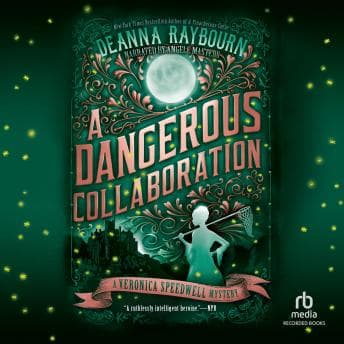

I'd heard people describe the Veronica Speedwell series as "cozy mystery with Victorian flair" and went in expecting something pleasant but lightweight - the literary equivalent of chamomile tea. And for the first hour or so, stirring a too-ambitious chicken tikka masala at 9 PM on a Tuesday, I thought I had it pegged. Then Raybourn did something I genuinely didn't expect: she wrote a protagonist whose psychology actually holds up under scrutiny.
Let me explain.
Veronica Speedwell Is the Best Case Study I Didn't Assign
Veronica is a Victorian butterfly hunter who refuses to marry, refuses to be modest, and refuses to stay out of murder investigations. On paper, this reads like every "feisty historical heroine" trope that makes me want to throw my phone into the Charles River. But here's what Raybourn gets right - Veronica's defiance isn't performative rebellion for the reader's benefit. It's rooted in something psychologically coherent. She's someone who has structured her entire identity around autonomy because she learned early that depending on others gets you hurt. The protagonist exhibits classic counter-dependent attachment patterns, and Raybourn never once names it, never psychologizes it, just lets Veronica be that person. When she pushes Stoker away in their more intimate moments - and there are a few that had me standing over a pot of burning onions, completely forgetting dinner - it's not manufactured tension. It's a woman whose defense mechanisms are so well-built she can't dismantle them even when she wants to.
I found myself asking: why does Veronica really take on this case? Lady Sundridge's true identity reveal (which I won't spoil, but - royalty, people) gives her every reason to walk away. The research actually shows that people who compulsively help others often do it to maintain a sense of control, not out of pure altruism. Veronica fits this pattern exactly. She needs to be the smartest person investigating because if she's not solving the puzzle, she's just another woman in 1887 London with no power.
The Stoker Problem (And Why It Works)
Stoker - brooding natural historian, scarred, prone to working shirtless while taxidermying large animals (my therapist would have thoughts about this character) - should be insufferable. He's basically a romance novel cover come to life, except Raybourn gives him genuine emotional intelligence. What makes this character compelling is that he doesn't try to fix Veronica. He matches her. Their banter has real teeth to it, and the slow-burn tension between them in this second installment is the kind that's psychologically earned rather than artificially prolonged. You feel two people who genuinely see each other circling the thing they're both too stubborn to name.
The mystery itself - an artist murdered, her patron accused, a ticking clock before he hangs - is solid Agatha Christie territory. (My inner twelve-year-old from New Jersey, the one who read And Then There Were None under the covers with a flashlight, was delighted.) The Bohemian artists' colony scenes gave me strong Pre-Raphaelite chaos energy, and the subterranean grotto with its "decadent history" is exactly the kind of detail that makes Victorian settings feel lived-in rather than costume-drama stiff. The whodunit itself won't shock anyone who's been paying attention to which characters get suspiciously little page time, but honestly, the mystery is the vehicle, not the destination. The destination is watching Veronica and Stoker orbit each other while pretending they aren't. The slow-burn dynamic here is actually more psychologically satisfying than the one I found in Savannah Breeze, which had the coastal charm but none of the earned tension.
Angele Masters Understands Class Like a Sociologist
This is where I was genuinely surprised. Masters doesn't just do "English accents" - she does class-stratified English accents. Her Veronica is crisp, educated, slightly imperious. Her Stoker has a different register entirely - warmer, rougher around the edges, with this husky quality that signals his outsider status among the upper classes. When she shifts to working-class characters or the American male voice that shows up, you hear the social hierarchy in the vowels. For a book set in a period where your accent literally determined your life trajectory, this matters. It's not just performance; it's world-building through voice.
At 12 and a half hours, this is a comfortable listen. Not rushed, not padded. I finished it across three evenings and a particularly long Saturday morning jog through Cambridge where I probably looked unhinged, smiling at the Stoker banter while dodging puddles on Memorial Drive.
Who Gets an Invitation to the Curiosity Club
If you want a mystery that respects both your intelligence and your desire for slow-burn romantic tension with actual psychological foundations - yes. If you need your Victorian heroines to behave like actual Victorians and can't handle anachronistic feminism - Veronica will annoy you, but I'd argue she shouldn't, because women like her existed; history just didn't write them down. If you're purely a puzzle-box mystery person who needs the whodunit to be airtight and shocking, this might feel a bit soft in the middle.
But if you, like me, read mysteries primarily to watch people reveal themselves under pressure? This is a fascinating case study in how two damaged people build trust one argument at a time. And Raybourn knows it.
The Diagnosis
Solid second installment that deepens the character psychology without sacrificing the fun. I've already downloaded the next one. Don't tell my dissertation committee - they think I'm working on my fourth paper. (I am. Sort of. Veronica Speedwell is basically research.)