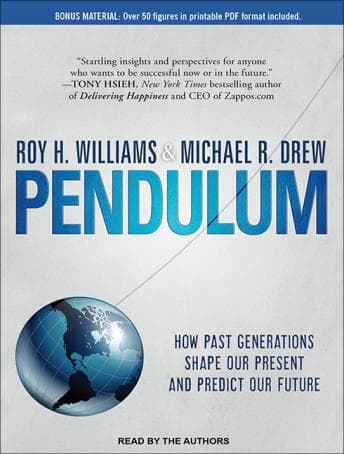

Can a forty-year cycle really explain everything from the rise of punk rock to why your uncle's political opinions are what they are?
I found myself chewing on this question while chopping onions for a biryani I'd been meaning to make for weeks. The kitchen was getting warm, my eyes were watering, and Michael R. Drew and Roy H. Williams were confidently asserting that Western society swings like a pendulum between "Me" generations and "We" generations. Every forty years. Without fail.
The research actually shows that humans love finding patterns. We're pattern-seeking creatures—it's how we survived on the savanna, how we make sense of chaos. But here's the thing: sometimes we find patterns that aren't really there. And Pendulum had me oscillating (pun intended) between genuine fascination and serious skepticism.
The Seduction of a Simple Framework
I'll give Drew and Williams credit: the core concept is genuinely interesting. The idea that 2003 was a "fulcrum year"—a turning point from individualism toward collectivism—and that 1963 represented its opposite? That's the kind of framework that makes you want to test it against everything you know. I caught myself mentally cataloging cultural shifts while stirring my pot. The Mad Men era giving way to the hippie movement. The Reagan years dissolving into... whatever we're calling the 2010s.
But here's where my academic training kicks in (my therapist would have thoughts about how I can't just enjoy anything without analyzing it to death). The book is heavy on dates and facts. Dense. The kind of dense where you realize you've been stirring the same pot for ten minutes without actually processing what you just heard.
The authors narrate their own work, which creates an interesting dynamic. There's genuine enthusiasm in their delivery—you can tell they believe in this theory completely. But enthusiasm doesn't replace evidence, and this is a fascinating case study in confirmation bias. Every historical example seems cherry-picked to support the forty-year thesis. What about the events that don't fit? They're conspicuously absent. For a more grounded approach to how our brains actually construct patterns and beliefs, Evolve Your Brain: The Science of Changing Your Mind offers the neuroscience behind why we're so susceptible to these grand narratives.
When Marketing Meets History
Here's what you need to know: Michael R. Drew runs a marketing agency. He's presented this theory alongside the Dalai Lama and Richard Branson. And suddenly, the book's purpose snaps into focus. This isn't really a history book or a psychology book—it's a framework for marketers and entrepreneurs who want to "predict" cultural trends.
Which is fine! Having any framework for thinking about cultural change is probably more useful than having none. But the presentation is haphazard. Charts appear. Quotes get thrown around. Lists materialize. It feels less like a coherent argument and more like a pitch deck that got expanded into book form.
I found myself asking: why does this theory need to be so absolute? Forty years exactly? No room for variation? The human mind has patterns, yes, but human societies are messier than clockwork. This is why I appreciated It's Not Always Depression so much—it embraces complexity instead of forcing messy human experience into tidy frameworks. The certainty here feels unearned.
Five Hours of Lecture Hall Energy
At five hours and fifteen minutes, this is a manageable commitment. The authors reading their own work means you get authentic passion, but not necessarily polished narration. There's nothing wrong with the audio quality—no weird background noise, no pronunciation disasters. It just... exists. Serviceable.
If you're the kind of listener who needs dynamic vocal performance to stay engaged, you might struggle. This is very much "lecture you're attending because it might be on the exam" energy rather than "TED talk you chose to watch at 2 AM" energy.
Who's This Actually For?
Marketers and entrepreneurs looking for a lens to think about generational shifts? Actually, yes. This could be useful for you—not as gospel truth, but as one framework among many.
History buffs expecting rigorous scholarship? Hard pass. You'll spend the whole time mentally arguing with the authors.
Psychology enthusiasts like myself? The book itself is more interesting than its content. It's a case study in how humans construct grand narratives from selective evidence. Meta-fascinating, if you're into that sort of thing.
The Dissertation Committee Would Have Notes
I finished the biryani. It turned out well—better than this book, honestly. Pendulum has an interesting central idea that gets stretched too thin, presented too confidently, and supported too selectively. It's not worthless—the core concept genuinely made me think. But it's also not the revelatory framework it claims to be.
The authors exhibit classic overconfidence bias. They've found a pattern that sometimes works and concluded it always works. My dissertation committee would have sent this back with a lot of red ink.
Worth a credit? Only if you're specifically in marketing or trend forecasting. For everyone else, this is a library borrow at best. Interesting enough to sample, not substantial enough to own.